

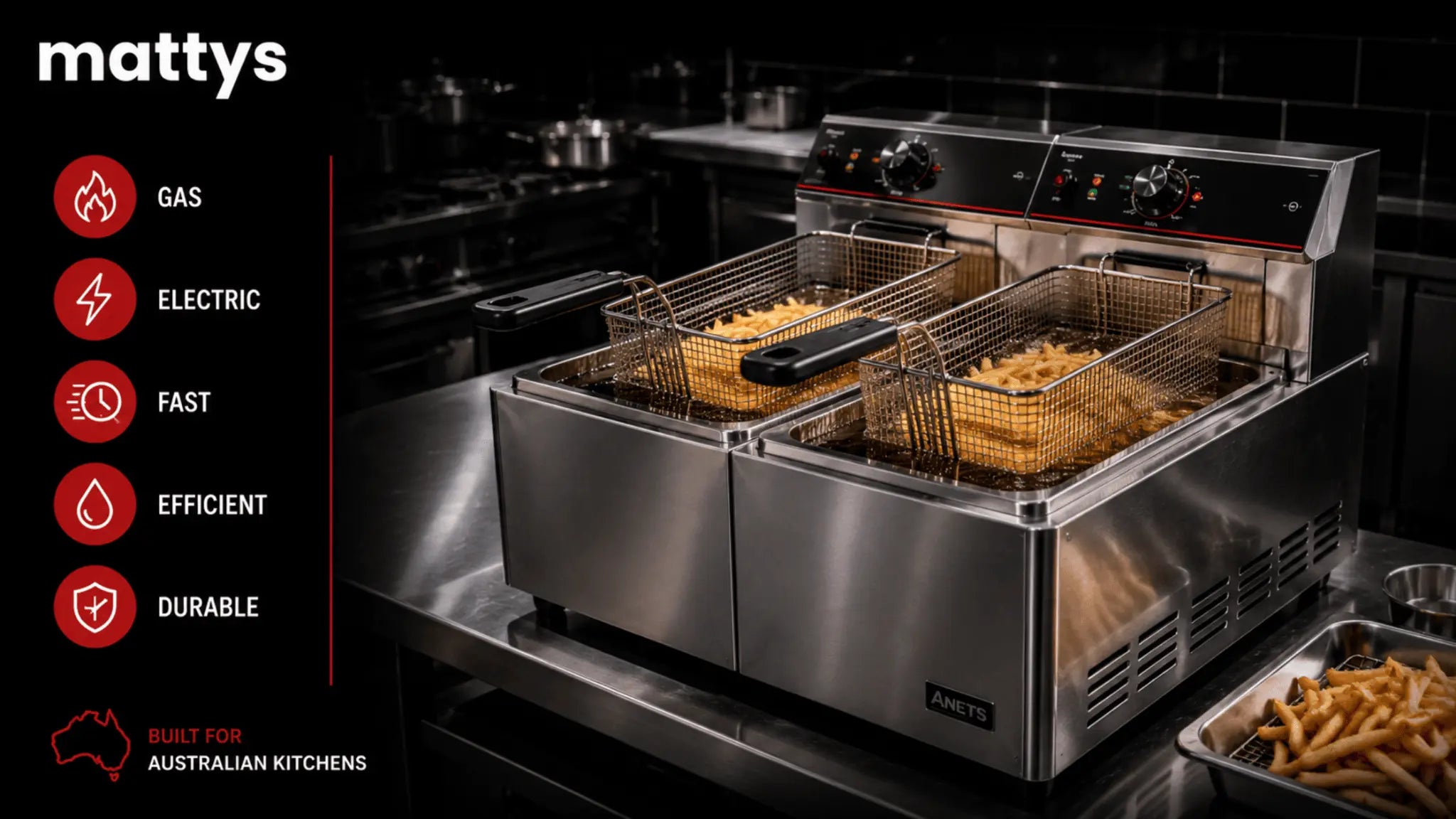
Why Your Fryer Decision Matters More Than You Realise
Most operators think about fryers as simple equipment — a box that heats oil. That simplicity is deceptive. Your fryer affects ticket times, oil costs, food quality, energy bills, and kitchen safety for the next 7–10 years.
Ticket times. A fryer that recovers temperature in 90 seconds keeps pace with a 50-order rush. One that takes 4 minutes creates a cascading delay across your entire kitchen. During a 200-cover Friday service, that recovery gap costs 15–20 minutes of cumulative delay.
Oil costs. Cooking oil is the most expensive consumable in a fried-food kitchen. A poorly managed fryer burns through oil 40–50% faster than a well-specified one with proper filtration. On a kitchen spending $400–$800/month on oil, that's $160–$400/month wasted — nearly $5,000/year.
Food quality. Old, degraded oil produces greasy, dark, inconsistent product. Customers notice. Reviews suffer. Repeat business drops. The difference between fresh-oil chips and tired-oil chips is visible, tasteable, and measurable in customer satisfaction.
Energy bills. A commercial fryer runs 6–12 hours a day, consuming 15–20% of total kitchen energy. The wrong power source or an oversized unit wastes $1,000–$3,000/year in unnecessary energy costs.
Safety. Hot oil is the most dangerous element in a commercial kitchen. An improperly maintained fryer with degraded thermostats, blocked gas lines, or cracked wiring is a fire and burn risk. Australian compliance requires regular inspection and maintenance — cutting corners here risks staff, customers, and your licence.
What most operators miss: They focus on the fryer's purchase price. The real cost is oil consumption, energy, and maintenance over 7–10 years. A $3,000 fryer that burns through oil 40% faster than a $5,500 fryer costs more by month 8. The maths is worth doing before you buy.
What this guide covers: Fryer types | Gas vs electric | Sizing by volume | Oil management | Real AUD pricing | Brand comparison | Mistakes to avoid | FAQ
→ Browse our commercial deep fryer range — Pitco, Frymaster, Blue Seal, Goldstein, and more
Understanding Fryer Types: Which Design Suits Your Kitchen
Not all fryers cook the same way. The internal design determines what you can fry, how efficiently it heats, and how easy it is to clean.
Open Pot Fryers
Design: A wide, open vat without internal obstructions. The heating element (gas burners beneath or electric elements submerged) heats a large, unobstructed oil volume.
Best for: Battered products (fish, onion rings, tempura) and items that shed heavy debris during frying. The open design means loose batter and food particles sink to the bottom of the pot, away from the cooking zone, rather than burning against heating tubes.
Why Australian fish-and-chip shops love them: If your menu is 60%+ battered seafood, an open pot fryer is purpose-built for your operation. The sediment zone below the heating area collects debris without carbonising it, which extends oil life and maintains product quality.
Typical capacity: 15–30 litres (floor-standing). Benchtop models: 5–12 litres. AUD pricing (2026): $2,500–$6,000 (benchtop); $5,000–$10,000 (floor-standing).
Tube Fryers
Design: Gas burners heat metal tubes that run through the oil. The tubes create a large heating surface area, which means faster heat-up and recovery.
Best for: High-volume operations frying predominantly non-battered products — chips, chicken pieces, nuggets, spring rolls. Tube fryers are the workhorse of fast-food and QSR kitchens globally.
Limitation: Battered products that shed heavy debris can clog around the tubes, which accelerates oil degradation and creates cleaning challenges. If battered fish is your primary product, open pot is better.
Typical capacity: 20–50 litres (floor-standing). AUD pricing (2026): $6,000–$14,000 (floor single); $10,000–$22,000 (twin vat).
Flat Bottom Fryers
Design: A flat, smooth heating surface at the bottom of the vat. No tubes, no obstructions.
Best for: Delicate items that sink or need to rest on the bottom — doughnuts, funnel cakes, tortilla chips, Asian-style flat frying. Also excellent for operations that fry items of varying sizes.
Typical capacity: 10–25 litres. AUD pricing (2026): $3,500–$8,000.
Pressure Fryers
Design: A sealed lid creates pressure during frying, which locks in moisture, reduces oil absorption, and produces a crispier result at lower temperatures. Pressure frying cooks 30–40% faster than open frying at equivalent temperatures.
Best for: Bone-in chicken, large protein pieces where moisture retention and speed are critical. These require specific training and safety procedures — they're not interchangeable with standard fryers.
Typical capacity: 15–30 litres. AUD pricing (2026): $8,000–$18,000.
Running a fish-and-chip shop? See the complete fitout guide including fryer bank configuration and display specification:
Fish & Chip Shop Equipment Guide — The Complete Australian Fitout
Gas vs Electric: The Power Source Decision
This is the second-biggest decision after fryer type, and it affects your installation cost, running cost, and cooking performance for the life of the equipment.
Gas Deep Fryers
Strengths: Faster initial heat-up (12–18 minutes from cold). Lower energy cost per hour — a gas fryer running 8 hours/day saves $1,000–$2,500/year over electric. High-volume performance — gas delivers raw power for kitchens pushing 300+ covers.
Limitations: Only 30–40% of gas energy transfers to the oil — the rest heats the kitchen. Requires gas infrastructure, AGA-certified installation, and adequate ventilation. Installation premium: $2,000–$5,000 over electric. Slower recovery after product drop (2–4 minutes vs 1–2 minutes for electric).
AUD running cost (2026, 20L floor fryer, 8hrs/day): $2,500–$4,000/year in gas.
Electric Deep Fryers
Strengths: Superior heat transfer (80–90% efficiency vs 30–40% for gas). Faster recovery time — electric fryers recover cooking temperature 40–60% faster than gas after a frozen product drop. More precise temperature control (±1°C). Simpler installation — no gas lines, no AGA certification. Cooler kitchen environment.
Limitations: Higher energy cost per hour. Annual premium: $1,000–$2,500 over gas. Requires dedicated electrical circuit. Floor-standing models need 15A–32A circuits.
AUD running cost (2026, 20L floor fryer, 8hrs/day): $3,500–$5,500/year in electricity.
The Verdict
| Factor | Gas | Electric | Winner |
|---|---|---|---|
| Initial heat-up speed | 12–18 minutes | 15–25 minutes | Gas |
| Recovery after product drop | 2–4 minutes | 1–2 minutes | Electric |
| Temperature precision | ±3–5°C | ±1°C | Electric |
| Energy cost per year | $2,500–$4,000 | $3,500–$5,500 | Gas |
| Heat transfer efficiency | 30–40% | 80–90% | Electric |
| Installation cost | $4,000–$8,000 | $2,000–$4,000 | Electric |
| Kitchen heat output | High | Low | Electric |
| High-volume suitability | Excellent | Good | Gas |
Mathew's's recommendation: For high-volume operations (fish-and-chip shops, fast food, 200+ covers) already on gas — go gas. The annual energy savings compound over the fryer's 7–10 year life. For cafes, small restaurants, and any kitchen without gas infrastructure — go electric. The faster recovery, precise temperature, and simpler installation make electric the smarter choice.
Want the full gas vs electric breakdown with state-by-state energy cost modelling? Read our complete guide:
Gas vs Electric Commercial Deep Fryer — The $15,000 Decision
Sizing Your Fryer: Oil Capacity by Operation
Getting the size right is critical. An undersized fryer can't keep up with demand. An oversized fryer wastes oil and energy heating capacity you don't use.
The Sizing Rule
1 litre of oil capacity per 1 kilogram of product per hour at peak, plus 25% buffer.
Example: A fish-and-chip shop that fries 15kg of product per hour during peak → needs 15L + 25% buffer = ~19L minimum. A 20L fryer is the right fit.
Sizing Guide by Operation Type
| Operation | Peak Frying Volume | Recommended Oil Capacity | Configuration |
|---|---|---|---|
| Small cafe (frying is secondary) | 3–5 kg/hr | 8–12L benchtop | Single tank, electric |
| Medium cafe / pub | 8–15 kg/hr | 15–20L floor-standing | Single or twin tank |
| Fish & chips / takeaway | 15–30 kg/hr | 20–30L floor-standing | Twin tank (separate fish/chips) |
| High-volume restaurant | 20–40 kg/hr | 30–50L floor-standing | Twin or triple tank |
| Fast food / QSR | 30–60+ kg/hr | 40–50L+ floor-standing | Multiple fryers, tube type |
| Food truck | 5–10 kg/hr | 10–15L benchtop | Single tank, gas (LPG) |
Twin Tank vs Single Tank
Twin tank lets you fry different products simultaneously without flavour transfer. Fish in one tank, chips in the other. Chicken in one, vegetables in the other. This is essential for any operation with diverse fried items.
Single tank is fine if you're frying one product type (chips only, doughnuts only) or your volume doesn't justify the extra oil cost of a second tank.
Our recommendation: For any Australian restaurant or pub with more than two fried items on the menu, specify twin tank. Cross-flavour transfer — fish-flavoured chips — is a quality killer and a customer complaint generator.
Want the complete sizing framework with portion weights and real-world calculations? Read our full guide:
Commercial Fryer Sizing Guide — How to Get It Right
Oil Management: The Hidden Budget That Most Operators Ignore
Here's the number that changes how you think about fryers: cooking oil is typically the third-highest cost in a fried-food kitchen, behind labour and ingredients. A busy fish-and-chip shop spends $400–$800/month on oil. A restaurant with moderate frying: $200–$400/month.
How Oil Degrades
Every frying cycle breaks down oil molecules. Heat, moisture from food, starch particles, protein debris, and oxygen exposure all accelerate degradation. Degraded oil produces darker, greasier food, smokes at lower temperatures, and imparts off-flavours.
The Filtration Advantage
Built-in oil filtration systems are the single most valuable feature on a modern commercial fryer. They remove food particles, starch, and carbonised debris, extending oil life by 30–50%.
The maths on a 20L fryer: Without filtration, replace 20L every 4 days = $4.50 × 20L × 91 changes/year = $8,190/year. With filtration, replace 20L every 7 days = $4.50 × 20L × 52 changes/year = $4,680/year. Annual saving: $3,510.
A fryer with built-in filtration costs $1,500–$3,000 more than one without. It pays for itself in oil savings within 6–10 months.
Mathew's's rule: Every fryer we recommend for operations doing more than 10kg/hour includes built-in filtration. The oil savings alone justify the investment — and the food quality improvement is the bonus.
Want the complete oil management system — daily routine, TPM testing, oil selection, and disposal? Read our full guide:
Commercial Fryer Oil Management — Cut Your Oil Bill by 40%
Budget Reality: What Commercial Deep Fryers Cost in Australia (2026)
Purchase Prices (AUD)
| Fryer Type | Benchtop | Floor Single | Floor Twin |
|---|---|---|---|
| Budget (Cookrite, Benchstar) | $1,200–$2,500 | $3,000–$5,000 | $5,500–$8,000 |
| Mid-range (Blue Seal, Waldorf, Goldstein) | $2,500–$4,500 | $5,000–$8,000 | $8,000–$14,000 |
| Premium (Pitco, Frymaster) | $4,000–$6,000 | $8,000–$14,000 | $14,000–$22,000 |
| Pressure fryer (Henny Penny, BKI) | — | $8,000–$14,000 | $14,000–$18,000 |
Installation Costs
| Component | Electric | Gas |
|---|---|---|
| Delivery (metro) | $300–$800 | $300–$800 |
| Electrical connection | $800–$2,000 | $500–$1,000 (controls only) |
| Gas fitting + AGA compliance | — | $1,500–$4,000 |
| Ventilation (if upgrade needed) | $2,000–$5,000 | $2,500–$6,000 |
| Total installation | $3,100–$7,800 | $4,800–$11,800 |
Annual Running Costs (20L Floor-Standing Fryer)
| Cost Category | Gas | Electric |
|---|---|---|
| Energy | $2,500–$4,000 | $3,500–$5,500 |
| Cooking oil (with filtration) | $4,500–$6,000 | $4,500–$6,000 |
| Cooking oil (without filtration) | $7,000–$9,000 | $7,000–$9,000 |
| Maintenance | $400–$700 | $300–$500 |
| Total (with filtration) | $7,400–$10,700 | $8,300–$12,000 |
| Total (without filtration) | $9,900–$13,700 | $10,800–$15,000 |
7-Year Total Cost of Ownership
| Scenario | Budget Gas (no filtration) | Mid-Range Gas (filtration) | Premium Gas (filtration) |
|---|---|---|---|
| Purchase + install | $8,000 | $14,500 | $20,000 |
| Energy (7 years) | $21,000 | $22,750 | $19,250 |
| Oil (7 years) | $56,000 | $36,750 | $33,250 |
| Maintenance (7 years) | $4,200 | $4,550 | $3,850 |
| 7-year total | $89,200 | $78,550 | $76,350 |
The insight: The cheapest fryer produces the most expensive 7-year cost because it lacks filtration and burns through oil faster. The premium fryer with advanced filtration is the cheapest over 7 years despite costing $12,000 more upfront.
Australian Brands Worth Knowing
Premium Brands
Pitco — American manufacturer known for innovative energy-efficient designs. The Solstice series uses 40% less oil than conventional fryers and features a self-cleaning burner system. We stock Pitco for operators who want the best frying performance available.
Frymaster — 90+ year heritage (founded 1935). Known for precision temperature control (±1°C) and advanced oil filtration. The HD Series features automatic reheating that reacts instantly to temperature drops. Premium choice for operators prioritising consistent product quality.
Mid-Range Brands
Blue Seal — Australian hospitality staple. Reliable, well-supported, parts readily available nationally. Good mid-range option for cafes and restaurants that need dependable performance without premium pricing.
Goldstein (Austheat) — Australian-made. Designed specifically for Australian gas and electrical standards. Strong local parts supply and service network. Popular in pubs and clubs.
Waldorf — Well-known in Australian commercial kitchens for robust build quality. Floor-standing models are popular in medium-to-high volume operations.
Budget-Friendly Options
Cookrite — Competitive pricing with reliable basic performance. Good for small cafes where frying is a secondary cooking method (under 5kg/hour).
Benchstar — Entry-level benchtop fryers suited for low-volume operations.
Our approach: We stock all tiers because different kitchens need different solutions. A 40-cover cafe doesn't need a Pitco. A 300-cover fish-and-chip shop shouldn't be on a Benchstar. We'll recommend based on your operation, not our margins.
Deciding between Pitco, Frymaster, and Blue Seal? Read our full three-way comparison:
Pitco vs Frymaster vs Blue Seal — The Honest Australian Comparison
Customer Story: How a Sydney Fish & Chip Shop Cut Oil Costs by 42%
The situation: A high-traffic fish-and-chip shop in Maroubra, Sydney, was running two aging open-pot gas fryers without filtration. Oil was being replaced every 3–4 days at a cost of $680/month across both units. Annual oil spend: $8,160.
The problem: No filtration meant oil degraded rapidly. Product quality declined between changes — Friday's chips were golden and crispy, but by Sunday the oil was dark, producing greasy, flat-tasting chips. Customer complaints were increasing.
What we recommended: Two Pitco open-pot gas fryers with built-in automatic filtration. Total purchase: $18,500. Installation: $6,200.
The result after 12 months:
- Oil now lasts 6–7 days instead of 3–4. Monthly oil cost dropped to $395. Annual saving: $3,420 (42% reduction)
- Product quality is consistent from Monday to Saturday — no more "Sunday chips" complaints
- Energy costs dropped 18% ($1,200/year) due to better heat recovery
- Combined annual saving: $4,620
- Payback on the $24,700 investment: 5.3 years
"I didn't believe oil filtration would save that much. I was wrong. The fryers paid for themselves faster than anything else in the kitchen."
— Owner, Maroubra fish & chips
Mistakes to Avoid
Mistake 1: Buying based on purchase price, ignoring oil cost
You buy a $3,500 fryer without filtration. Oil replacement costs $8,000+/year. Your mate buys a $6,500 fryer with filtration. His oil costs $4,800/year. By month 10, he's ahead financially — and his food tastes better. Always calculate 7-year total cost of ownership.
Mistake 2: Undersizing the fryer for your peak demand
Size to peak demand + 25% buffer. Never size to average throughput — your fryer needs to handle Friday night, not Tuesday lunch.
Mistake 3: Ignoring the twin-tank advantage
If your menu includes more than one fried protein category (seafood, chicken, vegetables), specify twin tanks. Cross-flavour transfer from frying fish and chips in the same oil loses customers quietly — they don't complain, they just don't come back.
Mistake 4: Skipping daily oil filtration
Food particles carbonise in the oil, accelerating degradation. Oil that should last 7 days lasts 3. You spend $3,000+/year more on oil than you need to. Filter every day, without exception. It takes 10–15 minutes and the payback is $250–$300/month in extended oil life.
Mistake 5: Not training staff on fryer safety
An untrained cook drops wet product into hot oil, causing a violent spit reaction. Burns. Insurance claim. Work cover investigation. Mandatory fryer safety training for every cook covers: water-in-oil dangers, fire suppression, thermostat monitoring, and proper filling and draining procedures. It takes 30 minutes and prevents catastrophic incidents.
FAQ: Questions We Hear Every Week
Q: How often should I change my fryer oil?
With daily filtration: every 5–8 days depending on volume and product type. Without filtration: every 3–5 days. Use TPM (Total Polar Materials) test strips weekly — replace oil when TPM exceeds 24%. Some Australian states mandate this threshold for food safety compliance.
Q: What type of oil is best for commercial frying?
In Australia, high-oleic canola oil or rice bran oil are the most popular choices. They have high smoke points (220–230°C), neutral flavour, and good stability under repeated heating. Avoid olive oil (low smoke point) and palm oil (flavour transfer). Budget: approximately $4.00–$5.50/litre for quality commercial frying oil (2026 pricing).
Q: Is a benchtop fryer enough for a small cafe?
If frying is secondary to your menu (under 5kg/hour at peak), a benchtop fryer with 8–12L capacity is sufficient. If frying is a significant menu component (more than 3–4 fried items), invest in a floor-standing unit — the capacity, recovery, and durability difference is worth the price jump.
Q: How long does a commercial fryer last?
Quality mid-range and premium fryers (Blue Seal, Pitco, Frymaster, Goldstein): 7–10 years with proper maintenance. Budget fryers: 4–6 years. The biggest lifespan factors are oil management (clean oil extends component life), regular thermostat calibration, and professional servicing every 6–12 months.
Q: Do I need a grease trap?
In most Australian states, yes. Commercial kitchens that produce grease-laden waste water typically require a grease trap to prevent fats, oils, and grease from entering the sewer system. Requirements vary by council — check with your local authority before installation.
Q: What safety certifications do I need?
Gas fryers require AGA (Australian Gas Association) certification. Electric fryers need SAA/RCM electrical safety compliance. All fryers should have a high-limit thermostat that automatically shuts off heating if oil temperature exceeds safe levels. Your kitchen must also have an appropriate fire suppression system — typically a wet chemical system for fryers.
Q: Can I use air fryers commercially?
Commercial air fryers exist but serve a different purpose. They produce lower-volume, "healthier" fried-style product without submerging in oil. They cannot match the throughput, texture, or speed of a traditional commercial deep fryer. For high-volume frying operations, traditional fryers remain essential. Air fryers are a complementary tool, not a replacement.
Next Steps: How to Specify Your Commercial Deep Fryer
Step 1: Identify your primary fried product. Battered seafood → open pot. Chips, chicken → tube. Doughnuts, delicate items → flat bottom. Bone-in chicken → pressure.
Step 2: Calculate your peak hourly volume. Weigh your fried output during your busiest service. Apply the sizing rule: 1L oil per 1kg product/hour + 25%.
Step 3: Decide gas or electric. Gas infrastructure available + high volume = gas. No gas + moderate volume = electric.
Step 4: Decide on filtration. If you fry more than 10kg/hour, built-in filtration isn't optional — it's essential. The oil savings justify it within months.
Step 5: Talk to someone who's fitted 10,000+ kitchens. We'll tell you exactly what you need — and equally importantly, what you don't. That conversation prevents the $5,000 mistake of buying the wrong type.
The Mattys Difference
We stock Pitco, Frymaster, Blue Seal, Goldstein, Waldorf, Cookrite, and Benchstar because no single brand serves every kitchen. Our recommendation is based on your menu, your volume, your space, and your budget — not on which fryer gives us the biggest margin.
Every fryer we sell includes proper installation, thermostat calibration, staff safety briefing, and ongoing maintenance support. We want your fryer to run for 10 years because that's how we earn the next recommendation.
Ready to Specify Your Fryer?
📞 Call us: 1300 628 897 — tell us what you fry, how much, and how often. We'll recommend the right fryer, the right size, and the right oil management setup.
🛒 Browse: Commercial deep fryers | Benchtop fryers | Oil filtration systems
Share:
Fish & Chip Shop Equipment Guide: The Complete Australian Fitout
Commercial Ice Machines: The Complete Australian Buyer's Guide (2026)