



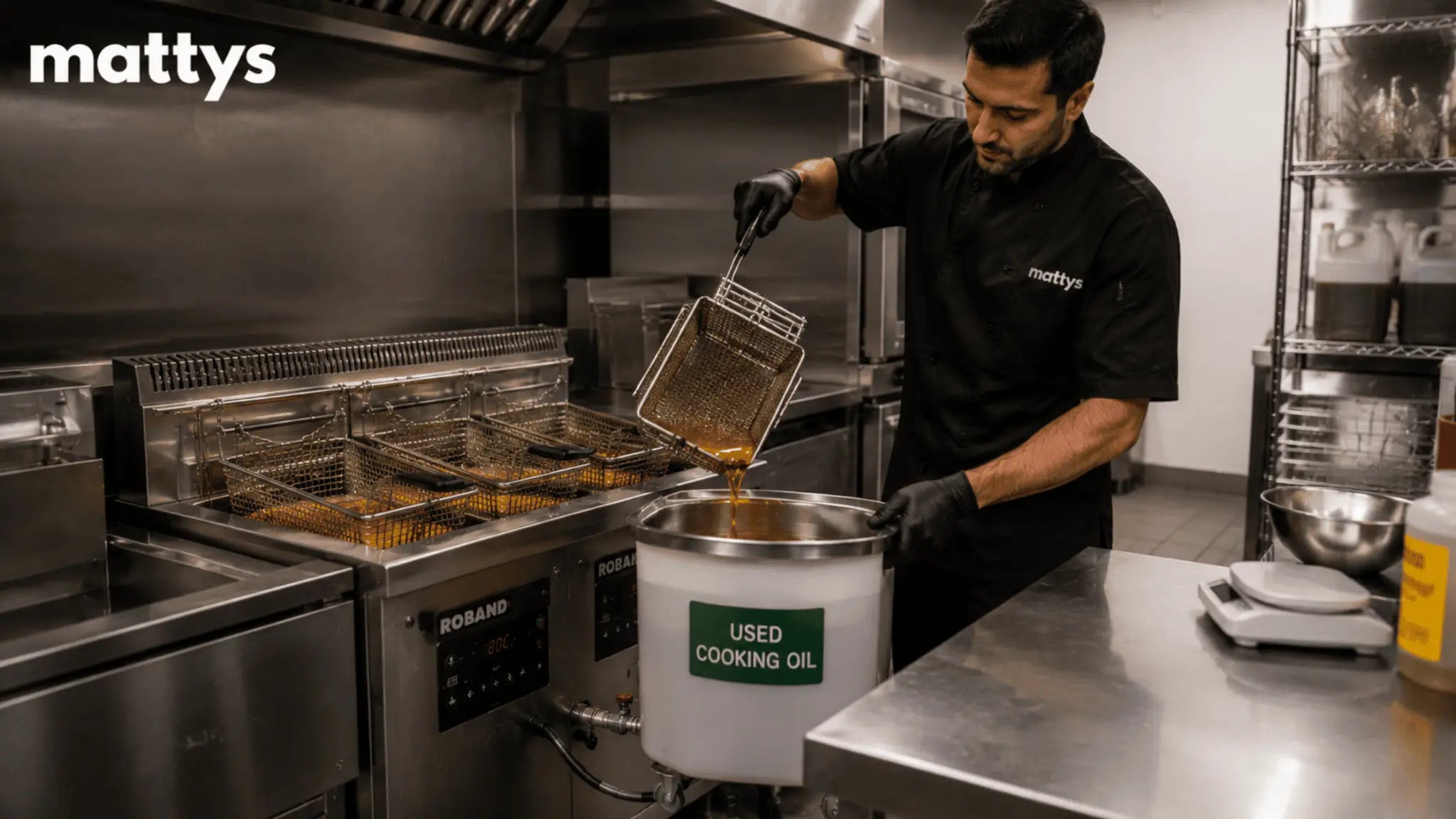
Oil Is Your Third-Biggest Kitchen Cost. Most Operators Manage It Last.

After labour and food ingredients, cooking oil is the single largest consumable expense in any kitchen that fries. A busy fish-and-chip shop spends $6,000–$10,000 per year on oil. A medium restaurant with moderate frying: $3,000–$5,000. A high-volume takeaway: $8,000–$12,000+.
And here's the number that changes everything: 40% of that spend is preventable waste. Operators who filter daily, test weekly, and use the right oil extend their oil life from 3–4 days to 6–8 days per fill — cutting their annual oil bill nearly in half.
After fitting out 10,000+ commercial kitchens across Australia, the single most impactful operational advice I give isn't about equipment specification. It's about oil management. A $15 filter pad and 10 minutes of daily routine saves more money per year than almost any equipment upgrade.
How Cooking Oil Degrades (And Why It Costs You Money)

Every time you fry, the oil breaks down. Understanding how and why helps you manage it intelligently.
The Four Enemies of Fryer Oil
Heat. Oil molecules break apart at frying temperatures (170–190°C). Each heating cycle accelerates degradation. Oil left at temperature during slow periods degrades faster than oil heated only when needed.
Moisture. Water released from food (especially frozen products) causes hydrolysis — a chemical breakdown that produces free fatty acids. These acids lower the smoke point, create off-flavours, and accelerate further degradation.
Food particles. Batter fragments, breadcrumbs, starch, and protein debris that settle in the oil carbonise over time. Carbonised particles darken the oil, create bitter flavours, and act as catalysts for further breakdown.
Oxygen. Oil exposed to air oxidises, producing rancid flavours and harmful compounds. Leaving your fryer uncovered overnight accelerates oxidation significantly.
What Degraded Oil Does to Your Food and Business
- Darker product. Chips go from golden to brown. Batter darkens unevenly. Visual quality drops.
- Greasier product. Degraded oil is absorbed more readily. Food comes out oily instead of crispy.
- Off-flavours. Customers describe it as "stale," "bitter," or "fishy" — even on non-fish items from cross-contaminated oil.
- Lower smoke point. Fresh oil smokes at 220–230°C. Degraded oil smokes at 180–190°C — at your frying temperature. Smoke means kitchen discomfort, fire risk, and unhappy staff.
- Increased oil consumption. You replace oil more frequently, spending $200–$400/month unnecessarily.
The Filtration System That Pays for Itself in 6 Months

Built-In vs Manual Filtration
Built-in filtration: The fryer pumps oil through a filter system (paper, mesh, or diatomaceous earth) and returns it to the tank. Operated by pressing a button or running an automated cycle. Takes 10–15 minutes. Available on mid-range and premium fryers.
Manual filtration: You drain the oil through a portable filter cart or cone filter, then return it to the tank. Takes 15–25 minutes. Requires more labour but works with any fryer.
The Cost Maths (20L Floor-Standing Fryer)
Without filtration:
- Oil replacement every 3–4 days
- 91–122 oil changes per year
- 20L × $4.50/L × 91 changes = $8,190/year (minimum)
With daily filtration:
- Oil replacement every 6–8 days
- 46–61 oil changes per year
- 20L × $4.50/L × 52 changes = $4,680/year
Annual saving: $3,510 — on a single 20L fryer. For twin-tank operations (2 × 20L): Annual saving doubles to $7,020.
Filtration system cost: Built-in adds $1,500–$3,000 to fryer purchase price. Portable filter cart: $800–$2,000. Both pay for themselves within 4–8 months.
→ See our oil filtration systems
The Daily Oil Management Routine (10 Minutes)

This is the routine we teach every operator who buys a fryer from Mattys. It takes 10 minutes and saves $3,000–$7,000 per year.
During Service
Skim every 30 minutes. Use a spider or fine-mesh skimmer to remove floating debris — batter fragments, breadcrumbs, loose particles. This takes 15 seconds and prevents debris from sinking, carbonising, and darkening the oil.
Monitor temperature. Don't run the oil hotter than your product requires. Every 10°C above optimal frying temperature accelerates oil degradation by approximately 20%. If you're frying chips at 175°C, don't leave the fryer set at 190°C during downtime.
Reduce idle temperature. Between service rushes, drop the thermostat to 120–130°C. This "standby" temperature keeps the oil warm enough for quick recovery but significantly slows degradation. Modern fryers with digital controls make this a one-button operation.
End of Service (The Critical 10 Minutes)
Step 1: Turn off the fryer and allow oil to cool to approximately 120–130°C (warm enough to flow, cool enough to filter safely).
Step 2: Run the filtration cycle. If built-in, press the filter button. If manual, drain through the filter cart. This removes particles down to 1–5 microns — invisible debris that accelerates degradation.
Step 3: Clean the tank interior. While the oil is drained (or after filtration returns it), wipe the tank walls and bottom with a cloth to remove residue. Pay attention to corners and the area around heating elements or tubes.
Step 4: Top up the oil level. Frying absorbs oil into food — typically 8–12% of the food weight. After a busy service, your oil level will have dropped. Top up with fresh oil to the fill line. This "refreshes" the oil chemistry slightly, extending usable life.
Step 5: Cover the fryer. Place the lid or a cover sheet over the oil surface. This reduces oxygen exposure overnight, slowing oxidation.
TPM Testing: The Objective Measure of Oil Quality

What Is TPM?
Total Polar Materials (TPM) measures the percentage of degradation compounds in your cooking oil. Fresh oil starts at 3–5% TPM. As it degrades, TPM rises. Australian food safety guidelines recommend replacing oil when TPM exceeds 24%.
How to Test
TPM test strips cost approximately $0.50–$1.00 each. Dip the strip in warm oil, wait 2 minutes, and compare the colour change to the reference chart. Takes 3 minutes total.
Digital TPM meters cost $150–$400 and give an instant numerical readout. More accurate than strips and worth the investment for high-volume operations.
When to Test
Weekly minimum for moderate-volume operations. Every second day for high-volume operations (fish and chips, fast food).
Why Testing Beats Guessing
Most operators change oil based on appearance — "it looks dark, time to change." This is unreliable. Oil colour darkens from food particles (which filtration removes) long before the oil is actually degraded. Conversely, oil can appear acceptable while TPM has exceeded safe levels.
Testing removes guesswork. You change oil when the chemistry says to, not when it looks bad. This prevents premature changes (wasting good oil) and delayed changes (serving degraded product).
Choosing the Right Cooking Oil for Australian Commercial Frying
| Oil Type | Smoke Point | Stability | Flavour | AUD Cost/L (2026) | Best For |
|---|---|---|---|---|---|
| High-oleic canola | 230°C | Excellent | Neutral | $4.00–$5.00 | General commercial frying |
| Rice bran oil | 225°C | Very good | Neutral | $4.50–$6.00 | Premium results, lighter texture |
| Sunflower (high-oleic) | 225°C | Good | Neutral | $4.00–$5.50 | General frying, good availability |
| Cottonseed oil | 215°C | Good | Mild | $3.50–$4.50 | Budget frying, chips |
| Peanut oil | 230°C | Good | Nutty | $6.00–$8.00 | Asian, specialty (allergen risk) |
| Vegetable blend | 220°C | Moderate | Neutral | $3.00–$4.00 | Budget, low-volume |
Our recommendation: High-oleic canola is the best all-round choice for Australian commercial kitchens. It has a high smoke point, excellent stability under repeated heating, neutral flavour, and competitive pricing. Rice bran oil is premium but delivers a noticeably lighter result.
Avoid for deep frying: Olive oil (smoke point too low for sustained deep frying), coconut oil (strong flavour transfer), standard canola (lower stability than high-oleic varieties).
Customer Story: Brisbane Takeaway Saves $6,800/Year With One Change
The situation: A busy chicken and chips takeaway in Brisbane running twin 25L fryers. Oil was changed every 3 days based on appearance. No filtration. Annual oil spend: $14,600.
The problem: The owner thought dark oil meant bad oil. He was changing oil that was only at 16% TPM — well below the 24% threshold. He was throwing away thousands of dollars of usable oil every year.
What we did: Installed a portable filtration cart ($1,200). Provided TPM test strips. Trained the team on daily filtration and weekly testing.
The result: Oil now lasts 7 days instead of 3. Changes are based on TPM testing, not appearance. Annual oil spend dropped to $7,800. Annual saving: $6,800 — from a $1,200 investment and 10 minutes of daily routine.
"I was literally pouring money down the drain. Daily filtration and TPM testing changed everything. I wish someone had told me this five years ago."
— Owner, Brisbane takeaway
Mistakes to Avoid
Mistake 1: Changing oil based on colour instead of chemistry
Dark oil isn't necessarily degraded oil — food particles darken oil long before TPM reaches unsafe levels. Test, don't guess.
Mistake 2: Leaving the fryer at frying temperature during downtime
Running oil at 180°C during a 2-hour afternoon lull degrades it unnecessarily. Drop to standby (120–130°C) between services.
Mistake 3: Mixing oil types
Adding rice bran oil to a tank of canola changes the oil's chemistry, smoke point, and stability. Top up with the same oil type you started with.
Mistake 4: Skipping filtration "because it was a quiet day"
Degradation is cumulative. One skipped filtration day doesn't seem significant, but particles that should have been removed carbonise overnight and accelerate degradation the next day. Filter every day, regardless of volume.
FAQ
Q: Can I reuse filtered oil indefinitely?
No. Filtration extends oil life but doesn't reverse chemical degradation. Even filtered oil eventually reaches 24% TPM and must be replaced. Filtration typically doubles oil life — from 3–4 days to 6–8 days — but not infinitely.
Q: How do I dispose of used fryer oil in Australia?
Used cooking oil must be collected by a licensed waste oil recycler. Most Australian states prohibit pouring cooking oil down drains. Many recyclers collect for free (they resell the oil for biodiesel production). Ask your local council for approved collectors.
Q: Does oil filtration affect food taste?
Positively. Filtered oil produces lighter, crispier, more consistently golden product. Customers notice the improvement even if they can't articulate why. Food fried in fresh, well-managed oil simply tastes better.
Q: What are Total Polar Materials (TPM) and why does 24% matter?
TPM measures degradation compounds (free fatty acids, polymers, oxidation products) in cooking oil. At 24%, the oil produces noticeably inferior food quality and approaches safety thresholds. Several Australian states reference 24% as the disposal guideline. Some European countries legally mandate it.
Ready to Optimise Your Oil Management?
📞 Call us: 1300 628 897 — we'll recommend the right filtration system for your fryer
🛒 Browse: Oil filtration systems | Commercial deep fryers
Share:
Gas vs Electric Deep Fryers: The Full Australian Cost Comparison
Fryer Sizing Guide: Matching Oil Capacity to Your Menu and Volume