

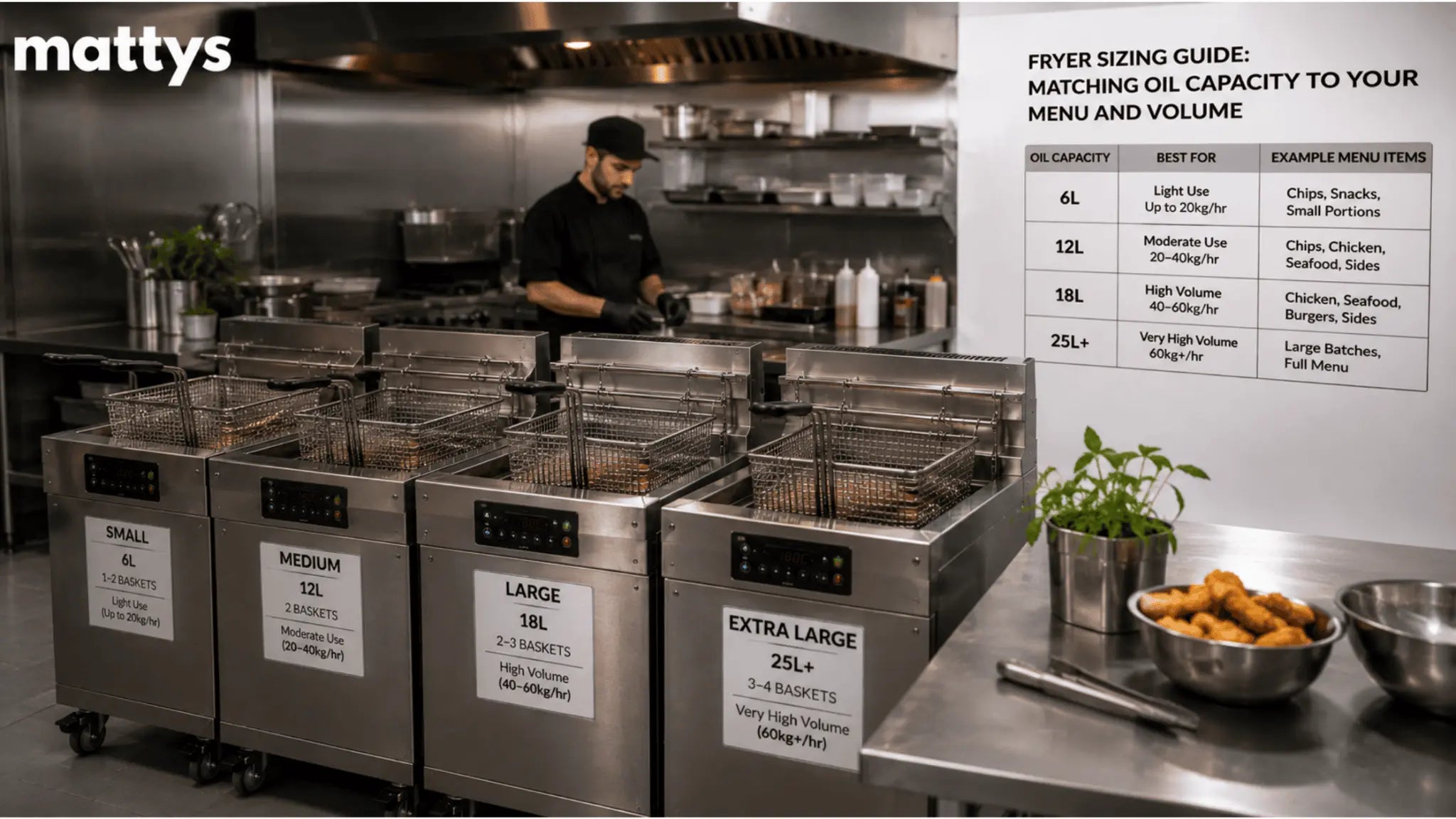
The Wrong Size Fryer Costs You $200 Every Week
An undersized fryer can't recover temperature fast enough. Product comes out greasy. Service backs up. Staff stress. You lose 15–20 minutes of peak productivity every busy night.
An oversized fryer wastes oil (heating 30L when you only need 15L), wastes energy (maintaining temperature on unused capacity), and takes up floor space your kitchen can't afford to lose.
After fitting out 10,000+ commercial kitchens across Australia, the sizing mistake is the one I see most often — and the one with the most immediate financial impact. Getting it right takes 15 minutes of calculation. Getting it wrong costs $200+/week in wasted oil, energy, and lost productivity.
This guide gives you the framework: how to calculate your actual requirement, how to match capacity to your menu, and when to go benchtop, floor-standing, single, or twin.
The Sizing Rule: 1 Litre Per Kilogram Per Hour (Plus 25%)

This is the formula we use for every fryer specification:
Minimum oil capacity = Peak hourly frying volume (kg) × 1L + 25% buffer
How to Calculate Your Peak Hourly Volume
Step 1: Identify your busiest frying hour. For most restaurants, this is Friday or Saturday dinner service (6pm–7pm). For takeaways, it might be Friday lunch (12pm–1pm).
Step 2: Estimate the total weight of fried product served during that hour. Count every fried item on every ticket.
Step 3: Add portion weights. Chips: 200g per serve. Schnitzel: 250g. Calamari: 150g. Spring rolls: 100g per serve.
Step 4: Multiply by expected orders. If you expect 40 chip serves + 15 schnitzels + 10 calamari during your peak hour:
- Chips: 40 × 200g = 8kg
- Schnitzels: 15 × 250g = 3.75kg
- Calamari: 10 × 150g = 1.5kg
- Total: 13.25kg/hour
Step 5: Apply the formula: 13.25 × 1L = 13.25L + 25% = 16.6L minimum
Result: A 20L floor-standing fryer is the right specification.
Sizing by Operation Type
| Operation | Typical Peak Volume | Recommended Capacity | Configuration |
|---|---|---|---|
| Small cafe (frying is secondary — occasional chips, spring rolls) | 3–5 kg/hr | 8–12L benchtop | Single tank, electric |
| Medium cafe / bistro (fried items on menu but not dominant) | 6–12 kg/hr | 12–18L | Single floor or large benchtop |
| Pub / bar (chips, schnitzels, parmigianas, wedges) | 12–20 kg/hr | 18–25L floor | Twin tank recommended |
| Fish & chip shop (frying is the primary output) | 20–35 kg/hr | 25–35L floor | Twin tank essential |
| High-volume takeaway (fried chicken, chips, multiple fried items) | 30–50+ kg/hr | 35–50L+ floor | Twin or triple tank |
| Food truck | 5–12 kg/hr | 10–15L benchtop | Single tank, gas (LPG) |
| Catering / event | Variable, 10–30 kg/hr | 15–25L portable | Single or twin, gas |
Why the 25% Buffer Matters
Your peak hour isn't perfectly distributed. Orders cluster. A table of 8 all ordering schnitzels hits your fryer with 2kg of cold product simultaneously. The buffer absorbs these demand spikes without crashing the oil temperature below effective frying range.
Without the buffer, every cluster event creates a 3–4 minute recovery delay. With the buffer, your oil volume is large enough to absorb the temperature drop and recover within 1–2 minutes.
→ Not sure about your peak volume? Call us on 1300 628 897 and we'll calculate it for you.
Benchtop vs Floor-Standing: The Space and Volume Decision

Benchtop Fryers (5–15L)
Best for: Operations where frying is secondary — cafes adding chips to a breakfast menu, food trucks, small bars with a limited fried snack menu.
Advantages: Small footprint (sits on bench or dedicated stand). Lighter weight (portable for food trucks). Lower purchase cost ($1,200–$4,500). Lower oil cost (heating 8–12L instead of 20–30L).
Limitations: Lower throughput (5–8kg/hour maximum before recovery becomes a bottleneck). No built-in filtration on most models. Less durable than floor-standing units — components are lighter, designed for moderate use.
Lifespan: 4–6 years with moderate use.
Floor-Standing Fryers (15–50L+)
Best for: Any operation where frying is a primary or significant cooking method — fish and chips, pubs, restaurants with 3+ fried items, takeaways, fast food.
Advantages: Higher throughput (15–50+ kg/hour). Faster recovery. Built-in filtration available. More durable components designed for continuous, heavy-duty use. Better temperature stability under load.
Limitations: Requires dedicated floor space (typically 400–600mm wide × 800mm deep). Heavier (requires levelling). Higher purchase cost ($3,000–$22,000). Higher oil volume means higher cost per fill.
Lifespan: 7–10 years with proper maintenance.
The Decision Threshold
Under 8kg/hour peak → benchtop is adequate. Over 8kg/hour peak → floor-standing is necessary. Over 20kg/hour peak → floor-standing with built-in filtration is essential.
Twin Tank vs Single Tank: When You Need Both

The Cross-Flavour Problem
Frying fish and chips in the same oil tank creates cross-flavour transfer. Your chips taste fishy. Your calamari tastes like last night's spring rolls. Customers notice — even if they can't articulate what's wrong, they describe the food as "off" or "not as good as last time."
When Twin Tank Is Essential
- You fry seafood AND non-seafood items
- You fry battered products AND non-battered products (batter debris degrades oil faster)
- You fry items at different temperatures (chips at 175°C, tempura at 185°C)
- You serve diverse fried items and quality consistency matters
When Single Tank Is Fine
- You fry one product type exclusively (chips only, doughnuts only)
- Your frying volume is low (under 8kg/hour) and cross-contamination risk is minimal
- You're on a tight budget and willing to manage oil changes more frequently
Twin Tank Pricing Premium
A twin-tank fryer costs 40–60% more than a single tank of equivalent total capacity. But the oil management advantage — keeping fish oil separate from general frying oil — extends the life of both tanks independently, often offsetting the price premium within 12 months through reduced oil changes.
Budget Reality: Sizing-Specific Costs (AUD, 2026)
| Fryer Size | Purchase | Oil Per Fill | Fills/Year (filtered) | Annual Oil Cost | Annual Energy |
|---|---|---|---|---|---|
| 8L benchtop | $1,200–$2,500 | $36 | 52–78 | $1,872–$2,808 | $1,500–$2,200 |
| 12L benchtop | $2,000–$4,000 | $54 | 52–78 | $2,808–$4,212 | $2,000–$3,000 |
| 20L floor single | $3,500–$8,000 | $90 | 52–61 | $4,680–$5,490 | $3,000–$5,000 |
| 20L+20L floor twin | $6,000–$14,000 | $180 | 52–61 | $9,360–$10,980 | $5,000–$8,000 |
| 30L floor single | $5,000–$10,000 | $135 | 52–61 | $7,020–$8,235 | $3,800–$6,000 |
| 40L+ floor (heavy duty) | $8,000–$18,000 | $180+ | 52–61 | $9,360+ | $5,000–$9,000 |
The pattern: Oil cost scales directly with capacity. An oversized fryer doesn't just waste energy — it wastes oil on every fill. A 30L fryer that only needs 20L of capacity costs an extra $2,340/year in oil alone.
Customer Story: Cronulla Cafe Went From Bottleneck to Breakthrough
The situation: A 50-cover beachside cafe in Cronulla, Sydney, was running a single 8L benchtop electric fryer. Menu included chips, calamari, spring rolls, and battered fish. Peak frying volume: approximately 12kg/hour.
The problem: The 8L benchtop couldn't keep up. Oil temperature crashed with every basket drop. Recovery took 4+ minutes. Staff were queuing fried orders and delaying mains. Friday service consistently ran 15 minutes behind by 7pm.
What we recommended: A 20L floor-standing gas fryer with twin tanks (10L + 10L split). Fish in one tank, everything else in the other. Built-in filtration on both sides. Total investment: $8,500 + $3,200 installation.
The result: Peak throughput increased from 8kg/hour to 22kg/hour. Recovery dropped from 4+ minutes to 90 seconds. Friday service runs on time. Fish no longer flavours the chips. Oil lasts 7 days instead of 3 (filtration + separate tanks).
"The benchtop fryer was strangling our kitchen. Going to a properly-sized floor model was the best $11,700 we spent. Service is faster, food is better, and we're not throwing away oil every three days."
— Owner, Cronulla cafe
Mistakes to Avoid
Mistake 1: Sizing based on average demand instead of peak
Your fryer needs to handle Friday 7pm, not Tuesday 2pm. Size to your busiest hour + 25% buffer.
Mistake 2: Buying the biggest fryer "just in case"
A 40L fryer for a 12kg/hour operation wastes $3,000+/year in unnecessary oil and energy costs. Size accurately.
Mistake 3: Choosing single-tank to save money when your menu needs twin
Cross-flavour transfer loses customers. The $2,000–$4,000 premium for twin tanks is cheaper than the repeat business you'll lose from fishy chips.
FAQ
Q: Can I use a smaller fryer if I fry in batches?
Technically yes, but batching adds time. If you're frying 15kg/hour in 5 batches on a 10L fryer, each batch takes 3–4 minutes plus 2 minutes recovery = 25–30 minutes per hour occupied. A 20L fryer handles the same volume in 3 batches = 15–18 minutes. The larger fryer frees 12 minutes per hour for other tasks.
Q: What if my volume varies seasonally?
Size to your peak season + 25%. Running a larger fryer at lower capacity during quiet periods costs slightly more in energy, but not enough to justify owning two different fryers.
Q: How do I measure my peak volume if I haven't opened yet?
Estimate from your menu plan. Count the fried items, estimate portions per cover, and multiply by your target peak covers. We can help with this calculation — call us on 1300 628 897 with your menu and target cover count.
Ready to Size Your Fryer?
📞 Call us: 1300 628 897 — tell us your menu and covers, we'll calculate the exact size
🛒 Browse: Benchtop fryers | Floor-standing fryers
Share:
Fryer Oil Management: How to Cut Your Oil Costs by 40%
Pitco vs Frymaster vs Blue Seal: Which Fryer Brand Suits Your Australian Kitchen?