

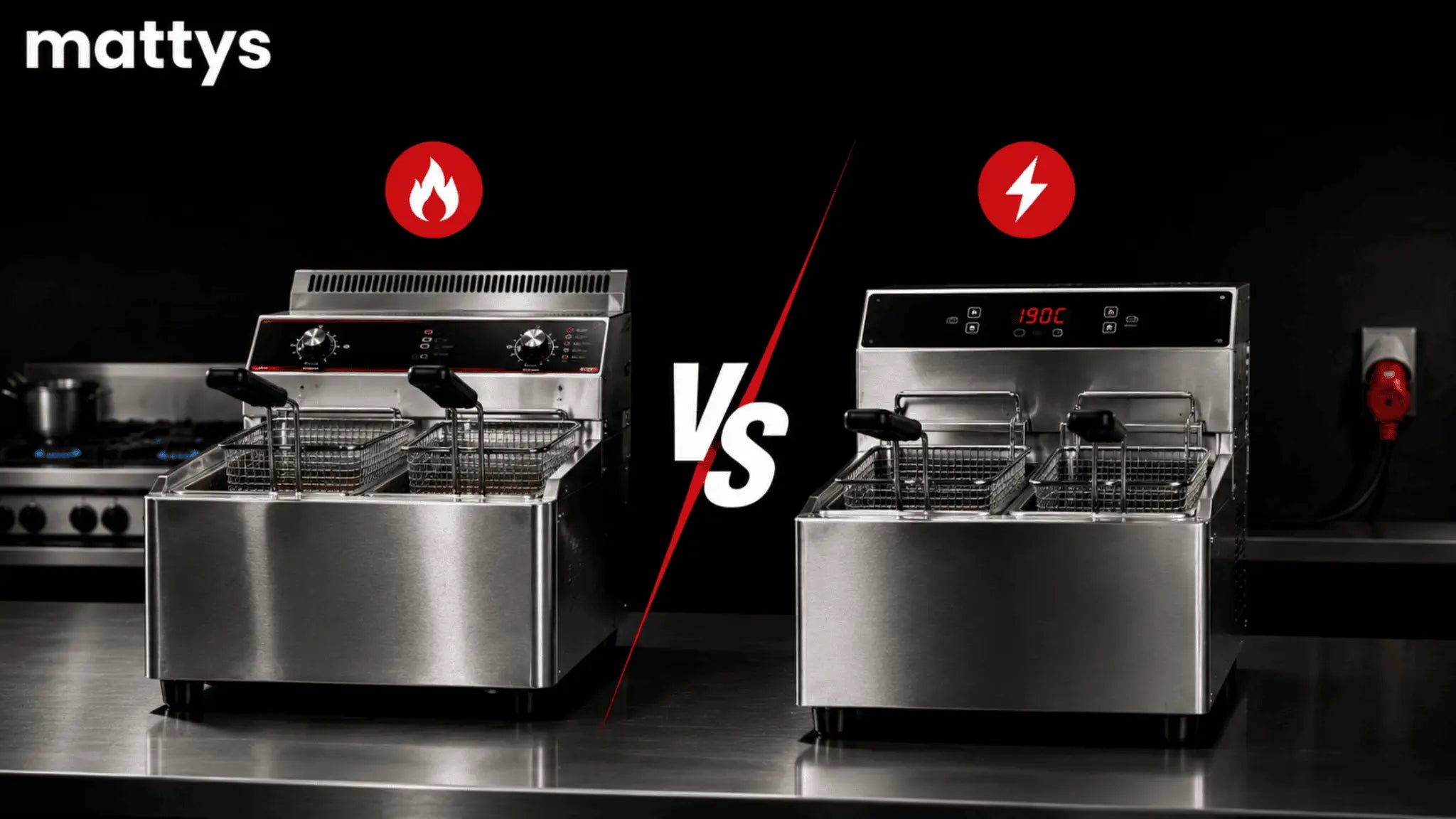
One Choice. $15,000 Difference Over 7 Years.

Gas or electric. Two words. Fifteen thousand dollars in total cost difference over the life of a commercial deep fryer — depending on which side you land and whether you land correctly for your operation.
This isn't a coin flip. It's a calculation that depends on your existing infrastructure, your frying volume, your state's energy tariffs, and your kitchen's physical constraints. After fitting out 10,000+ commercial kitchens across Australia, I've seen operators save thousands by matching the right power source to their situation — and I've watched others waste thousands by choosing based on habit instead of maths.
This guide gives you the actual numbers: installation costs, annual energy costs, recovery performance, heat efficiency, and the 7-year total cost comparison that tells you which fryer genuinely costs less for your kitchen.
→ Compare our gas and electric fryers
Why This Decision Has Long-Term Financial Consequences

Your fryer runs 6–12 hours per day, 300+ days per year. It's one of the most energy-hungry appliances in your kitchen. The power source you choose locks in your energy spend for the next 7–10 years.
Here's the reality most suppliers won't tell you: the purchase price difference between a gas and electric fryer of equivalent capacity is typically only $500–$1,500. But the energy cost difference over 7 years can exceed $10,000. Installation adds another $2,000–$5,000 gap. The total lifetime difference between choosing correctly and choosing wrong? $12,000–$17,000.
That's not a rounding error. That's the cost of a second fryer, or six months of cooking oil, or a solid used combi oven.
How Gas and Electric Fryers Actually Heat Oil Differently

This matters more than most operators realise, because the heating method affects efficiency, recovery speed, and kitchen environment.
Gas Fryers: Heat From Below
Gas burners sit beneath or around the oil tank. Flames heat the tank walls or tubes, which transfer heat to the oil indirectly. The oil nearest the heat source gets hot first; convection currents distribute heat through the volume.
Heat transfer efficiency: 30–40%. The remaining 60–70% of gas energy becomes waste heat that enters your kitchen, heats the surrounding air, and exits through the ventilation system. This is the fundamental inefficiency of gas — you're paying for BTUs that never reach the oil.
What this means practically: Your kitchen is hotter. Your ventilation works harder. Your air conditioning (if you have it) fights against the heat your fryer produces. In an Australian summer, this compounds into real discomfort and higher total energy costs beyond just the fryer itself.
Electric Fryers: Heat From Within
Electric heating elements are submerged directly in the oil. The element surface contacts the oil, transferring heat through direct conduction. Every watt goes into the oil with minimal loss.
Heat transfer efficiency: 80–90%. Nearly all the electrical energy becomes heat in the oil. Minimal waste heat enters the kitchen. The frying environment is measurably cooler.
What this means practically: Your kitchen stays cooler. Your ventilation handles less heat load. Your staff are more comfortable during summer service. And crucially — more of the energy you pay for actually cooks your food.
Recovery Speed: Where Electric Wins the Technical Battle

Recovery time — how quickly the oil returns to frying temperature after you drop cold or frozen product — is the performance metric that most directly affects ticket times and food quality.
What Happens During Recovery
You drop 2kg of frozen chips into 180°C oil. The oil temperature instantly plunges to 145–155°C. Below 160°C, food absorbs oil rather than frying in it. The faster the fryer recovers to 175–180°C, the crispier and less greasy your product.
Gas Recovery: 2–4 Minutes
Gas burners respond instantly (flames ignite immediately) but heat transfer through the tank wall is slow. The oil nearest the burner heats first; the oil further away takes longer. Result: gradual, uneven recovery.
Electric Recovery: 1–2 Minutes
Electric elements are in the oil. When the thermostat detects a temperature drop, elements engage at full power, heating the oil directly from within. Recovery is faster and more uniform.
The impact on a busy service: During a 200-cover Friday night, your fryer handles 30–50 basket drops. If each recovery takes 2 minutes longer on gas vs electric, you lose 60–100 minutes of cumulative frying time. That's 15–25 fewer orders served at peak — directly affecting revenue.
Mathew's's take: Recovery speed is where electric fryers genuinely earn their keep. For kitchens where frying is your primary production method (fish and chips, fried chicken, takeaway), the faster recovery translates directly to higher throughput and better food quality. Gas has advantages elsewhere, but not here.
The Full Cost Comparison (AUD, 2026)
Installation Costs
| Component | Gas Fryer | Electric Fryer | Difference |
|---|---|---|---|
| Equipment purchase (20L floor) | $6,500–$10,000 | $5,500–$8,500 | Gas +$1,000–$1,500 |
| Gas fitting + AGA compliance | $1,500–$4,000 | $0 | Gas +$1,500–$4,000 |
| Electrical connection | $500–$1,000 | $800–$2,000 | Electric +$300–$1,000 |
| Ventilation (if upgrade needed) | $2,500–$6,000 | $2,000–$5,000 | Gas +$500–$1,000 |
| Total installation | $11,000–$21,000 | $8,300–$15,500 | Gas +$2,700–$5,500 |
Annual Energy Costs (20L Floor-Standing, 8 Hours/Day)
| State | Gas Annual | Electric Annual | Gas Saving |
|---|---|---|---|
| NSW (gas ~$0.04/MJ, elec ~38¢/kWh) | $3,200 | $4,800 | $1,600/yr |
| VIC (gas ~$0.035/MJ, elec ~35¢/kWh) | $2,800 | $4,400 | $1,600/yr |
| QLD (gas ~$0.045/MJ, elec ~32¢/kWh) | $3,600 | $4,100 | $500/yr |
| SA (gas ~$0.05/MJ, elec ~42¢/kWh) | $4,000 | $5,300 | $1,300/yr |
| WA (gas ~$0.04/MJ, elec ~40¢/kWh) | $3,200 | $5,000 | $1,800/yr |
Key insight: Gas saves $500–$1,800/year depending on state. The saving is largest in WA and NSW, smallest in QLD where electricity rates are lower.
7-Year Total Cost of Ownership
| Component | Gas (20L floor) | Electric (20L floor) |
|---|---|---|
| Purchase + installation | $11,000–$21,000 | $8,300–$15,500 |
| Energy (7 years, NSW) | $22,400 | $33,600 |
| Oil (7 years, with filtration) | $32,760 | $32,760 |
| Maintenance (7 years) | $3,500 | $2,800 |
| 7-year total | $69,660–$79,660 | $77,460–$84,660 |
| Difference | — | Electric +$5,000–$7,800 |
The verdict for NSW: Gas saves approximately $5,000–$7,800 over 7 years. But only if gas infrastructure already exists. If you need a new gas connection ($3,000–$5,000), the saving shrinks to $0–$4,800.
The verdict for QLD: Gas saves only $3,500 over 7 years. After factoring in higher gas installation costs, the saving disappears entirely. Electric is the pragmatic choice in Queensland.
Customer Story: Melbourne Pub Saves $11,200 by Switching to Gas
The situation: A high-volume pub in Richmond, Melbourne, running two electric benchtop fryers (15L each). Annual energy cost for frying: $8,200. The pub already had gas connected for the cooktop and grill.
The problem: Electric fryers were costing $4,100 each per year in energy. Recovery during Friday/Saturday rush was too slow — staff were waiting 3+ minutes between batches, backing up the kitchen.
The solution: Replaced both electric benchtops with two gas floor-standing fryers (20L each, twin-tank configuration) connected to the existing gas line. Gas fitting: $2,200. New fryers: $14,000. Total investment: $16,200.
The result after 2 years:
- Annual energy cost for frying dropped to $5,600 (from $8,200) — $2,600/year saving
- Recovery improved from 3+ minutes to 90 seconds — peak throughput increased 20%
- Projected 7-year energy saving: $18,200 minus installation premium of $7,000 = net saving $11,200
"The electric fryers were killing us on energy and speed. Gas was already in the building — we just needed to connect it. Should have done it three years earlier."
— Pub manager, Richmond
Decision Framework: 5 Questions
Do you have gas already connected? Yes → gas is almost always cheaper long-term. No → calculate connection cost; if over $5,000, electric likely wins.
What's your frying volume? Over 15kg/hour → gas handles high-volume heat load better. Under 10kg/hour → electric's efficiency advantage matters more.
How important is recovery speed? Critical (fish & chips, fast food) → electric recovers faster. Less critical (cafe, occasional frying) → either works.
How hot is your kitchen? Already hot with poor ventilation → electric produces less waste heat. Well-ventilated → gas heat output is manageable.
Which state are you in? WA, NSW, SA → gas saving is significant. QLD → saving is minimal; electric is simpler.
Mistakes to Avoid
Mistake 1: Connecting gas just for the fryer when nothing else uses it
A $4,000 gas connection for one fryer that saves $1,600/year takes 2.5 years to pay back. If the fryer is the only gas appliance, the economics are marginal.
Mistake 2: Choosing electric because "it's simpler" without running the numbers
Simplicity has a price. Over 7 years in NSW, electric costs $5,000–$7,800 more. If gas is already available, the simpler option is the expensive option.
Mistake 3: Ignoring the kitchen heat impact
Gas fryers dump 60–70% of their energy into your kitchen as waste heat. In a 30°C Sydney summer with minimal AC, that heat costs you in staff comfort, productivity, and potentially in additional cooling costs. Factor this into your decision.
FAQ
Q: Can I run a gas fryer on LPG instead of natural gas?
Yes. Most commercial gas fryers are available in natural gas and LPG variants. LPG is common in regional Australia and food trucks. Running costs are similar to natural gas. Confirm the gas type before ordering — conversion costs $300–$800.
Q: Is electric safer than gas?
Both are safe when properly installed and maintained. Gas requires AGA-certified installation and ventilation. Electric requires correct circuit sizing. The primary safety risk with any fryer is the hot oil, not the power source.
Q: Which has lower maintenance costs?
Electric, slightly. No gas burner servicing, no flue cleaning, simpler components. Annual maintenance: electric $300–$500, gas $400–$700.
Q: Can I switch from gas to electric (or vice versa) later?
Yes, but it requires infrastructure changes. Switching to gas means gas fitting ($1,500–$4,000). Switching to electric means potential switchboard upgrade ($1,000–$3,000). It's cheaper to choose correctly the first time.
Ready to Decide?
📞 Call us: 1300 628 897 — tell us your gas/electric situation, we'll run the 7-year numbers
🛒 Browse: Commercial deep fryers | Benchtop fryers
Share:
Commercial Combi Ovens: The Complete Australian Buyer's Guide (2026)
Fryer Oil Management: How to Cut Your Oil Costs by 40%