



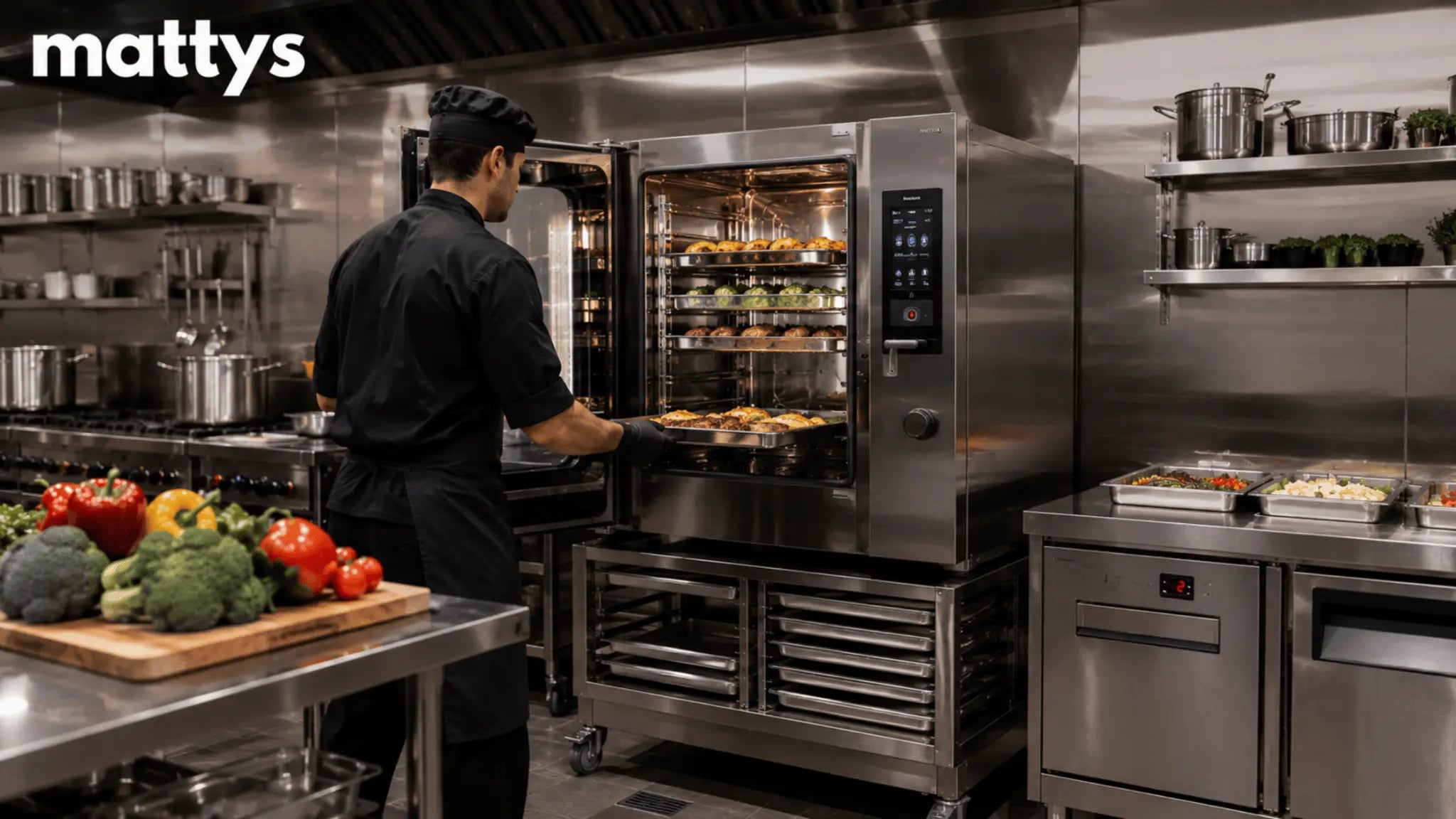
Your Next Oven Will Either Run Your Kitchen or Ruin Your Year
You're looking at a combi oven because someone told you it replaces six pieces of equipment. That's true. What nobody mentioned is that the wrong combi oven — wrong size, wrong steam system, wrong brand for your volume — creates six new problems instead.
A combi oven is the single biggest cooking investment most Australian operators make. Entry-level starts at $8,000. A Rational iCombi Pro walks out the door at $25,000–$40,000+. At that price, you're not buying an appliance. You're committing to a cooking partner that will shape your menu, your workflow, your energy bills, and your staff's daily experience for the next 7–10 years.
After fitting out 10,000+ commercial kitchens across Australia, I've installed every major combi oven brand into every type of venue — from a 40-cover Surry Hills brunch cafe to a 500-cover hotel banquet kitchen in Melbourne's CBD. I've watched operators thrive with the right specification and struggle with the wrong one. The difference is never the oven itself. It's always the decision that came before it.
This guide covers what actually matters: how combi ovens work, which type fits your operation, how to choose between Rational, Unox, Convotherm, and the rest, what you'll really pay in Australia, and the mistakes I've watched operators make that cost them thousands.
What this guide covers: How combi ovens work | Types and sizes | Brand comparison | Gas vs electric | Boiler vs boilerless | Real AUD pricing | Sizing by cover count | Mistakes to avoid | FAQ
→ Browse our commercial combi ovens — Rational, Unox, Convotherm, and more
Why a Combi Oven Changes Everything in a Commercial Kitchen

Most operators underestimate what a combi oven actually does. They think "steam and convection in one box." That's like calling a smartphone "a phone with a camera." Technically accurate. Completely missing the point.
A modern commercial combi oven is an intelligent cooking system. It roasts, bakes, steams, braises, grills, poaches, sous vides, regenerates, dehydrates, smokes, and proofs — all in a single footprint that measures less than one square metre. During a 200-cover dinner service, it can run three different cooking programs simultaneously on different rack levels without flavour transfer between dishes.
Here's what that means for your operation in practical terms:
Space reclaimed. A 10-tray combi oven replaces a convection oven, a steamer, a salamander for some applications, and a bain-marie for regeneration. In a 25sqm Sydney kitchen where every 500mm of bench space is currency, that consolidation is transformational.
Labour reduced. Programmable cooking means your junior cook loads the tray, selects the program, and walks away. The oven monitors core temperature, adjusts humidity, manages browning, and alerts when the dish is done. We've seen operators reduce their cooking team by one full-time position after installing a programmable combi — not because the oven replaces people, but because it handles the monitoring and adjustment that used to require a dedicated set of hands.
Consistency guaranteed. A human cook has good days and bad days. A combi oven delivers the same result at 6am as it does at 11pm. For multi-site operators — and we work with several across Sydney and Melbourne — that consistency is worth more than any individual feature.
Waste cut. Steam injection during roasting reduces protein shrinkage by 15–25% compared to dry convection. On a $200/kg wagyu loin, that's $30–$50 saved per piece. Across a week of 150-cover services, the waste reduction alone can cover the oven's monthly finance payment.
What most operators miss: They focus on what a combi oven cooks. They should focus on what it eliminates — equipment purchases, labour hours, food waste, and inconsistency. The cooking is the obvious part. The operational savings are where the real ROI lives.
Fitting out a new kitchen? See how the combi-first approach changes your entire budget: How to Set Up a Commercial Kitchen Under $50K
Understanding Combi Oven Cooking Modes
Every combi oven operates in three core modes. Understanding when to use each one is the difference between an operator who gets 30% of the oven's value and one who gets 100%.
Convection Mode (Dry Heat)
The oven circulates hot air using fans, cooking food through even, dry heat distribution. This is your roasting, baking, gratinating, and browning mode.
Best for: Pastries, bread, pizza bases, gratins, roasted vegetables where you want caramelisation and crispness. Pies, sausage rolls, croissants — anything where moisture is the enemy of the crust.
Temperature range: Typically 30°C–300°C depending on model. Most Australian kitchens operate convection mode between 160°C and 220°C for standard roasting and baking.
What to know: Pure convection in a combi oven performs identically to a standalone convection oven. If you're only using convection mode, you've paid $15,000+ for a $5,000 capability. The value is in the other two modes.
Deciding between a combi and a convection oven? Read our full comparison:
Combi Oven vs Convection Oven: When Is the Premium Actually Worth It?
Steam Mode (Moist Heat)
The oven generates steam — either via an internal boiler or by injecting water directly onto a heating element (boilerless) — to cook food in a saturated moisture environment at temperatures from 30°C to 130°C.
Best for: Vegetables (retains colour, nutrients, and texture), fish (gentle, even cooking without drying), rice, eggs, custards, dim sum, and any protein where moisture retention is critical. Also brilliant for regenerating pre-cooked food without drying it out — a massive advantage for hotels and aged care facilities.
Why it matters in Australia: Steam cooking uses less energy than convection for equivalent results on many dishes. In a commercial kitchen paying 38¢/kWh (NSW, 2026), every kWh saved compounds across 300+ operating days per year. We've measured 15–20% energy savings for operators who shift appropriate dishes from convection to steam mode.
Combination Mode (The Game-Changer)
This is why you bought a combi oven. Combination mode blends convection heat with precisely controlled steam injection, giving you simultaneous browning and moisture retention that neither mode achieves alone.
Best for: Roasting proteins (chicken with crispy skin and juicy interior), baking bread (steam creates the crust, convection sets the crumb), braising, slow-cooking, and any dish where you need exterior texture with interior moisture.
The technical magic: In combination mode, the oven manages humidity as a percentage. At 60% humidity, you get moisture retention with moderate browning. At 20% humidity, you get aggressive crisping with minimal moisture. The ability to program humidity curves — starting high and finishing low — is what separates a $25,000 Rational from a $8,000 entry-level unit.
Mathew's take: I tell every operator the same thing: combination mode is the reason you spent $15,000+ instead of $5,000 on a convection oven. If your team isn't using it daily, you're leaving money on the table. We offer hands-on training sessions to make sure your investment gets used properly.
Choosing Your Combi Oven Size: Tray Capacity by Cover Count
Size matters more than brand in the first decision. An undersized combi oven creates bottlenecks during service. An oversized one wastes energy heating empty space. Here's the framework we use for Australian kitchens.
Tray Sizes Explained
Commercial combi ovens use Gastronorm (GN) tray standards:
- GN 1/1 (530mm × 325mm): The industry standard. Fits most combi ovens, blast chillers, and food transport trolleys.
- GN 2/1 (530mm × 650mm): Double-width. Used in larger floor-standing models for high-volume operations.
Sizing Guide by Operation Type
| Operation | Covers/Session | Recommended Size | Typical Models |
|---|---|---|---|
| Small cafe / food truck prep | 30–60 | 6-tray (GN 1/1) countertop | Unox ChefTop MIND.Maps ONE, Rational iCombi Classic 6-1/1 |
| Cafe / small restaurant | 60–100 | 6–10 tray (GN 1/1) | Rational iCombi Classic 10-1/1, Unox ChefTop MIND.Maps PLUS 10 |
| Medium restaurant | 100–180 | 10-tray (GN 1/1) or 10-tray (GN 2/1) | Rational iCombi Pro 10-1/1, Convotherm maxx pro 10.10 |
| Large restaurant / hotel | 180–300 | 20-tray (GN 1/1) or 10-tray (GN 2/1) | Rational iCombi Pro 20-1/1, Unox ChefTop MIND.Maps 20 GN 1/1 |
| Banquet / production kitchen | 300+ | 20-tray (GN 2/1) or stacked units | Rational iCombi Pro 20-2/1, dual-stack configurations |
The 20% rule: Always size 20% above your current peak requirement. Your menu will expand. Your covers will grow. Seasonal demand spikes will test your capacity. A 10-tray oven for a kitchen currently running 90 covers gives you headroom to reach 120 without upgrading equipment.
Countertop vs. floor-standing: Countertop combis (typically 6-tray) are compact and sit on a bench or dedicated stand. Floor-standing models (10–20 tray) are self-supporting units that need floor space, ventilation clearance, and often a dedicated power circuit. For most Australian restaurants doing 80+ covers, floor-standing is the practical choice.
Brand Comparison: Who Makes What and Why It Matters

Rational: The Market Leader
Founded: 1973, Germany | Global market share: ~50% | Key range: iCombi Pro, iCombi Classic
Rational is the default recommendation from most commercial kitchen consultants, and for good reason. Their iCookingSuite technology automatically adjusts temperature, humidity, air speed, and cooking time based on what's in the oven. Load a tray of chicken thighs — the oven detects the volume, calculates the optimal cooking path, and delivers a consistent result whether your head chef is running the line or your weekend casual.
Strengths: Unmatched cooking intelligence. iCareSystem automated cleaning (9 programs including a 12-minute express clean). Exceptional build quality — components tested for 10+ year durability. Comprehensive Australian service network through authorised distributors.
Limitations: Premium pricing — a 10-tray iCombi Pro sits at $22,000–$30,000 AUD. The interface, while powerful, has a steeper learning curve than competitors. The iCombi Classic offers a more accessible entry point at lower cost.
Best for: High-volume restaurants, hotels, multi-site operators, and any kitchen where cooking consistency across different staff members is critical.
Not sure whether to choose the iCombi Pro or iCombi Classic? Read our full breakdown: Rational iCombi Pro vs iCombi Classic: The Honest Australian Comparison
Unox: The Innovation Challenger
Founded: 1990, Italy | Key range: ChefTop MIND.Maps (PLUS and ONE models)
Unox has earned a fierce following among chefs who value intuitive operation and versatility. Their touchscreen interface is arguably the most user-friendly in the industry — new staff learn it in one shift rather than the 2–3 shifts typical for Rational. The SENSE.Klean system estimates oven dirtiness and recommends the most efficient cleaning cycle, reducing chemical waste.
Strengths: Intuitive touchscreen operation. Side-positioned fans reduce overall oven depth (critical in tight Australian kitchens). Triple-glazed doors for heat retention and clear visibility. Individual tray-level lighting that signals when each tray is cooked. Strong bakery-specific models. Competitive pricing — typically 15–25% less than equivalent Rational models.
Limitations: Service network in regional Australia can be thinner than Rational's. Some operators report that the cooking intelligence doesn't match Rational's iCookingSuite for fully automated multi-dish programs.
Best for: Cafes, bakeries, small-to-medium restaurants, and any kitchen where ease of use and staff turnover are primary concerns.
Rational vs Unox — which is right for your kitchen? Read our head-to-head:
Rational vs Unox Combi Ovens: The Honest Australian Comparison
Convotherm: The Reliable Workhorse
Founded: Germany | Key range: maxx pro, mini
Convotherm (owned by Welbilt/Ali Group) is the brand chefs recommend when they want "something that just works." The maxx pro range uses up to 16% less electricity and 80% less water than previous-generation ovens. The 10-inch touchscreen is clear and straightforward.
Strengths: Energy efficiency leader (measurable savings on water and electricity). Durable build quality from German engineering. User-friendly operation — the learning curve sits between Rational (complex) and Unox (simple).
Best for: Energy-conscious operators, medium-volume restaurants, and kitchens that want German engineering without Rational's price premium.
Other Brands Worth Knowing
Hobart: Excellent build quality with in-built steam generators and self-cleaning cycles. Strong in institutional kitchens (hospitals, aged care, universities). Premium pricing.
Blue Seal / Turbofan: Australian-familiar brand. Good entry-level and mid-range options. Solid choice for budget-conscious operators who want local parts availability.
Giorik: Italian brand known for compact combis with innovative touchscreen control. Good option for very small kitchens where footprint is the primary constraint.
Gas vs. Electric: Which Power Source for Your Kitchen?

Electric Combi Ovens
Advantages: More precise temperature control. Easier installation (no gas fitting required). Dominates the countertop/compact segment. Lower installation cost — electrical connection runs $1,500–$3,500 versus $2,000–$5,000 more for gas fitting and AGA compliance.
Disadvantages: Higher energy cost per operating hour at current Australian commercial electricity tariffs. Requires dedicated high-amperage circuit (often 32A or 50A three-phase for floor-standing models).
Running cost (2026): A 10-tray electric combi running 8 hours/day at 38¢/kWh costs approximately $4,500–$7,000 per year in energy.
Gas Combi Ovens
Advantages: 20–30% lower operating cost per hour compared to electric at current Australian commercial gas tariffs. Faster heat recovery when the door opens during service. Preferred by many chefs for the quality of radiant heat in roasting applications.
Disadvantages: Requires gas line access and AGA (Australian Gas Association) certification. Installation is more complex and expensive. Ventilation requirements are stricter. Fewer models available in compact/countertop sizes.
Running cost (2026): A 10-tray gas combi running 8 hours/day costs approximately $3,000–$5,000 per year in energy — a $1,500–$2,000 annual saving versus electric.
Mathew's recommendation: If you already have gas in the kitchen and you're running 100+ covers, gas is usually the better long-term investment. The annual saving of $1,500–$2,000 compounds meaningfully over a 10-year oven lifespan. If you're a smaller cafe without gas infrastructure, electric is simpler and the installation savings offset 2–3 years of higher running costs.
Want the full gas vs electric breakdown with 10-year cost modelling? Read our complete guide:
Gas vs Electric Combi Ovens: Cost, Performance and Installation
Boiler vs. Boilerless: The Steam Generation Decision

Boiler-Based Systems
How they work: A separate internal boiler heats water to generate steam, which is then injected into the cooking chamber. The boiler maintains a constant reservoir of ready steam.
Advantages: Instant, consistent steam delivery. Superior for high-volume steam cooking (vegetables, seafood, rice). Better humidity control at lower temperatures. Ideal for kitchens that use steam mode heavily (aged care, hotels, Asian cuisine).
Disadvantages: Higher maintenance — boilers require descaling, especially in hard-water areas (Sydney's water hardness varies by suburb; western Sydney is notably harder). More complex servicing. Higher purchase cost.
Boilerless (Direct Injection) Systems
How they work: Water is sprayed directly onto a hot heating element or into the oven cavity, creating steam on demand. No separate boiler component.
Advantages: Lower maintenance (no boiler to descale). More energy-efficient (only generates steam when needed). Simpler construction means fewer potential failure points. Typically 10–15% cheaper to purchase.
Disadvantages: Steam response is slightly slower than boiler systems. Less effective at sustained low-temperature steam cooking in very large-volume operations.
Our recommendation: For 80% of Australian commercial kitchens — restaurants, cafes, bakeries — boilerless is the smarter choice. Lower maintenance, lower cost, and perfectly adequate steam performance for standard cooking applications. Choose boiler-based if you're a high-volume operation (200+ covers) that relies heavily on sustained steam cooking.
Budget Reality: What Combi Ovens Cost in Australia (2026)
Purchase Prices (AUD, 2026)
| Category | 6-Tray (GN 1/1) | 10-Tray (GN 1/1) | 20-Tray (GN 1/1) | 10-Tray (GN 2/1) |
|---|---|---|---|---|
| Entry-level (Blue Seal, Turbofan) | $8,000–$12,000 | $12,000–$16,000 | $18,000–$24,000 | — |
| Mid-range (Unox, Convotherm, Giorik) | $10,000–$16,000 | $16,000–$22,000 | $24,000–$32,000 | $20,000–$28,000 |
| Premium (Rational iCombi Pro, Hobart) | $14,000–$20,000 | $22,000–$30,000 | $32,000–$42,000+ | $28,000–$38,000 |
Installation & Setup Costs
| Component | Electric | Gas |
|---|---|---|
| Delivery (metro Sydney/Melbourne/Brisbane) | $600–$1,500 | $600–$1,500 |
| Electrical connection | $1,500–$3,500 (may need switchboard upgrade) | $800–$1,500 |
| Gas fitting + AGA compliance | — | $2,000–$5,000 |
| Ventilation (if new exhaust required) | $3,000–$8,000 | $3,000–$8,000 |
| Water connection (for steam/cleaning) | $500–$1,200 | $500–$1,200 |
| Commissioning + staff training | $500–$1,500 | $500–$1,500 |
| Total installation | $6,100–$15,700 | $7,400–$17,700 |
Annual Running Costs
| Cost Category | 6-Tray | 10-Tray | 20-Tray |
|---|---|---|---|
| Energy (electric, 8hrs/day) | $2,500–$4,000 | $4,500–$7,000 | $7,000–$11,000 |
| Energy (gas, 8hrs/day) | $1,800–$2,800 | $3,000–$5,000 | $5,000–$8,000 |
| Cleaning chemicals/tabs | $400–$700 | $600–$1,000 | $800–$1,400 |
| Annual professional service | $300–$500 | $500–$800 | $700–$1,200 |
| Total annual (electric) | $3,200–$5,200 | $5,600–$8,800 | $8,500–$13,600 |
| Total annual (gas) | $2,500–$4,000 | $4,100–$6,800 | $6,500–$10,600 |
Total Cost of Ownership: 7-Year Comparison (10-Tray Electric)
| Component | Entry-Level ($14,000) | Mid-Range ($19,000) | Premium ($26,000) |
|---|---|---|---|
| Purchase + install | $20,100–$29,700 | $25,100–$34,700 | $32,100–$41,700 |
| Energy (7 years) | $38,500–$49,000 | $31,500–$42,000 | $28,000–$38,500 |
| Maintenance (7 years) | $4,200–$7,000 | $3,500–$5,600 | $2,800–$4,900 |
| Replacement parts | $2,000–$4,000 | $1,000–$2,500 | $500–$1,500 |
| 7-year total | $64,800–$89,700 | $61,100–$84,800 | $63,400–$86,600 |
The insight: Over 7 years, the premium oven costs roughly the same as the entry-level oven because it uses less energy, needs fewer repairs, and lasts longer. The mid-range option often delivers the best TCO. Buy the cheapest and you pay the same — just in worse instalments spread across energy bills and repair callouts.
Customer Story: How a Melbourne Hotel Saved $14,000 by Choosing Right
The situation: A 180-room hotel in Melbourne's CBD was replacing two aging convection ovens and a standalone steamer. The executive chef wanted separate replacements for each. The hotel's GM wanted to explore consolidation.
The problem: Three separate units consumed $12,800/year in combined energy costs, occupied 4.2sqm of kitchen floor space, and required three separate maintenance contracts totalling $2,400/year.
What we recommended: One Rational iCombi Pro 20-tray (GN 1/1) to replace all three units. Purchase: $34,000. Installation (electrical upgrade + ventilation modification + commissioning): $9,500.
The result after 18 months:
- Energy costs dropped from $12,800/year to $7,200/year (44% reduction)
- Floor space reclaimed: 2.8sqm (now used for additional prep bench)
- Maintenance: $800/year (one unit, one contract)
- Staff training: Two days of hands-on training with Rational's commissioning team
- Menu expanded: The chef added sous vide proteins and steamed Asian dishes that weren't possible before
- 18-month savings: $14,200 in combined energy, maintenance, and food waste reduction
"I was sceptical about replacing three dedicated units with one combi. Eighteen months later, I can't imagine going back. It does more, costs less, and my team produces better food."
— Executive Chef, Melbourne CBD hotel
Mistakes to Avoid When Buying a Combi Oven
Mistake 1: Undersizing to save money
What happens: You buy a 6-tray to save $8,000 over a 10-tray. During Friday service at 120 covers, staff are queuing dishes for the oven. Service slows. Kitchen stress spikes. You're effectively running a 150-cover restaurant through a 60-cover bottleneck.
How to avoid it: Size for your peak plus 20% growth buffer. The $8,000 you "saved" costs you $200/week in slower service and overtime.
Mistake 2: Ignoring ventilation requirements
What happens: You install a combi oven without upgrading your exhaust system. Steam and heat build up in the kitchen. The oven's performance degrades because ambient temperature is too high. Food safety inspectors notice condensation on surfaces.
How to avoid it: Budget $3,000–$8,000 for ventilation as part of your installation cost. Every combi oven has specific exhaust requirements — ask us before you buy, not after.
Mistake 3: Not training staff properly
What happens: You spend $25,000 on a Rational iCombi Pro. Your team uses it exclusively in convection mode because nobody showed them the programmable features. You've paid premium price for entry-level functionality.
How to avoid it: Insist on manufacturer commissioning and staff training as part of the purchase. Rational, Unox, and Convotherm all offer this through authorised Australian distributors.
Mistake 4: Choosing brand before choosing size
What happens: The chef wants Rational because a mate recommended it. The budget only stretches to a 6-tray Rational, when a 10-tray Unox at the same price would actually serve the kitchen's volume properly.
How to avoid it: Decide the size first (based on covers and workflow), then choose the best brand within that size at your budget. A correctly-sized mid-range oven outperforms an undersized premium oven every time.
Mistake 5: Forgetting water quality
What happens: You install a boiler-based combi oven in a hard-water area (western Sydney, parts of Melbourne, Adelaide). Within 12 months, limescale clogs the boiler. Descaling costs $400–$800 per treatment. Steam output degrades. Cooking consistency drops.
How to avoid it: Install a water filter or softener ($500–$1,500) at the point of connection. This costs a fraction of repeated descaling and extends boiler life by years.
Want the complete maintenance schedule to protect your investment? Read our full guide: Combi Oven Maintenance: How to Get 10+ Years From Your Equipment
FAQ: The Questions We Hear Every Week
Q: How long does a commercial combi oven last?
With proper maintenance — annual professional service, regular cleaning cycle use, water filter where needed — a quality combi oven lasts 7–10 years. Premium brands like Rational and Convotherm are tested for 10+ year component durability. Entry-level models typically deliver 5–7 years. The biggest lifespan killer is neglected cleaning — baked-on grease degrades heating elements and door seals faster than anything else.
Q: Is Rational worth the premium over Unox?
It depends on your operation. For a 150+ cover restaurant where consistency across multiple staff members is critical, Rational's iCookingSuite intelligence justifies the premium. For a 60–80 cover cafe where ease of use and budget matter more, Unox delivers 90% of the capability at 75–85% of the price. We stock both and recommend based on your specific situation — not brand loyalty.
Q: What certifications does a combi oven need in Australia?
Electric models need electrical safety certification (typically SAA/RCM mark). Gas models require AGA (Australian Gas Association) certification. Water connections need WaterMark certification. All units should comply with AS/NZS 60335 safety standards. We only stock ovens that meet all Australian certification requirements.
Q: How often should I clean a combi oven?
Run the automatic cleaning cycle daily (or after every heavy service). Most modern combis have express clean (12–15 minutes) and deep clean (45–60 minutes) options. Use the manufacturer's recommended cleaning tabs — generic alternatives can damage the oven cavity coating. Monthly: inspect door gaskets, drain traps, and fan assemblies. Annually: professional service including calibration, descaling (if boiler-based), and component inspection.
Q: Can I finance a combi oven in Australia?
Yes. Equipment leasing is common — typical terms are 3–5 years at $350–$800/month depending on the unit cost. Mattys offers our Rent-Try-Buy program where you can lease for 6 months, then purchase (with rental payments credited toward the purchase price), or return the unit if it's not right for your kitchen.
Q: Combi oven vs. convection oven — when is a convection oven enough?
If your menu is exclusively baking, roasting, and dry-heat cooking (pizza, pastries, roasted vegetables), a convection oven at $3,000–$8,000 may suffice. The moment you need steam — proteins with moisture retention, vegetable steaming, bread with proper crust development, regeneration of pre-cooked food — you need a combi. For most Australian restaurants and cafes, the menu versatility alone justifies the combi premium.
Q: What's the difference between a 6-tray and a 10-tray in real-world output?
A 6-tray (GN 1/1) produces approximately 40–60 meals per cooking cycle. A 10-tray produces 70–100. During a 3-hour dinner service with multiple cycles, the 10-tray delivers roughly 60–70% more output. For a kitchen doing 100+ covers, the 6-tray becomes a bottleneck. If you're on the fence between sizes, always go larger.
Next Steps: How to Specify Your Combi Oven
Step 1: Count your peak covers. Not your average — your busiest service of the week. That number determines your minimum tray capacity.
Step 2: Map your cooking profile. What percentage of your menu needs steam? Dry heat? Combination? This determines whether you need premium humidity control or basic steam injection.
Step 3: Check your infrastructure. Gas or electric available? What amperage is your switchboard rated for? Is ventilation adequate? These determine which power source and which installation costs you're facing.
Step 4: Set your total budget. Not just purchase price — add installation, ventilation, water filtration, and first-year running costs. That's your real number.
Step 5: Talk to someone who's installed 10,000+ kitchens. Not a sales rep reading a brochure. Someone who knows the difference between what a 10-tray Rational does in a Sydney hotel and what a 10-tray Unox does in a Bondi cafe. That conversation saves you $5,000–$15,000 in avoided mistakes.
The Mattys Difference
We stock Rational, Unox, Convotherm, Blue Seal, and Turbofan because no single brand is right for every kitchen. Our recommendation is based on your operation — your covers, your menu, your space, your budget, and your staff capability — not on which brand gives us the highest margin.
Every combi oven we sell includes:
- Manufacturer commissioning to Rational/Unox/Convotherm standards
- Staff training (2–4 hours, hands-on, in your kitchen)
- Ongoing maintenance support with priority service
- Honest advice — including recommending a smaller or cheaper unit if that's what your kitchen actually needs
We've been doing this for 20+ years. Our 123 five-star Trustpilot reviews aren't from selling expensive equipment. They're from selling the right equipment.
Ready to Choose Your Combi Oven?
📞 Call us: 1300 628 897 — tell us your covers, your menu, and your space. We'll recommend the right oven, not the most expensive one.
🛒 Browse our combi oven range — Rational, Unox, Convotherm, Blue Seal. In-stock in Sydney metro. Finance and Rent-Try-Buy available.
Share:
Combi Oven vs Convection Oven: When Is the Combi Premium Actually Worth It?
Gas vs Electric Deep Fryers: The Full Australian Cost Comparison