

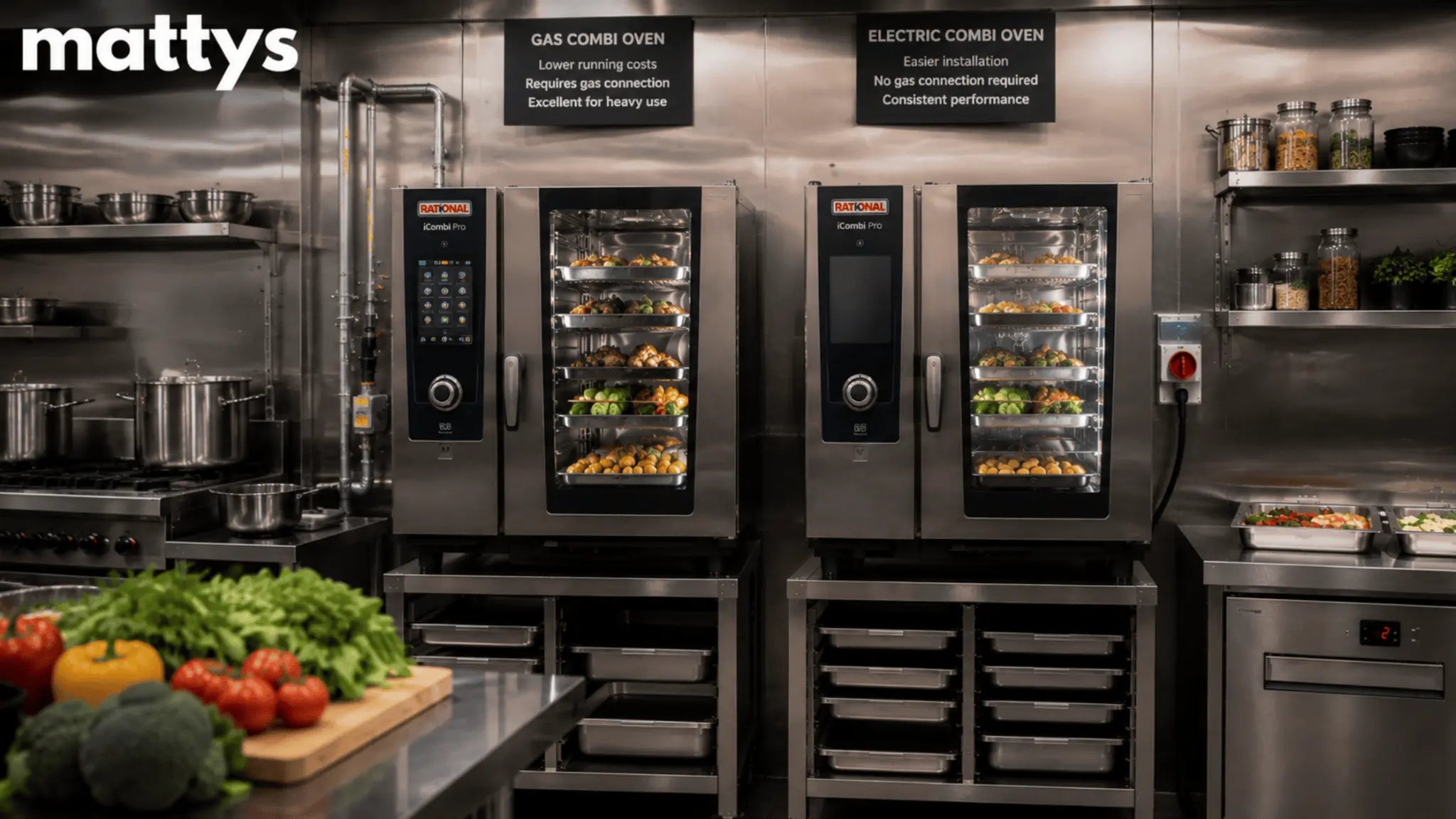
The Decision That Affects Your Energy Bills for the Next 10 Years

Gas or electric. It sounds simple. It's not. The power source you choose for your combi oven determines your installation cost (difference of $2,000–$5,000), your annual energy bill (difference of $1,500–$2,500), your cooking performance profile, and your infrastructure requirements for the next decade.
After fitting out 10,000+ commercial kitchens across Australia, here's what I know: most operators choose based on what they already have in the kitchen. Gas kitchen? Gas combi. Electric kitchen? Electric combi. That's sensible — but it's not always optimal. Sometimes the right answer is the one that requires a small infrastructure investment upfront to save thousands over the oven's lifetime.
This guide covers the real numbers, the real trade-offs, and the specific scenarios where each power source wins in Australian commercial kitchens.
Why Power Source Matters Beyond Just "Cooking"
Your combi oven runs 6–12 hours per day, 300+ days per year. It's one of the most energy-intensive pieces of equipment in your kitchen, typically consuming 15–25% of total kitchen energy. The power source directly affects:
Ongoing costs. Gas combi ovens run 20–30% cheaper per operating hour than electric at current Australian commercial tariffs. Over 10 years, that's $15,000–$25,000 in accumulated savings for a high-use kitchen.
Installation complexity. Electric combis need high-amperage circuits (often 32A–50A three-phase). Gas combis need certified gas lines, AGA-compliant fittings, and enhanced ventilation. Both have upfront costs — but gas installation is typically $2,000–$5,000 more.
Kitchen environment. Gas releases combustion byproducts that require exhaust ventilation. Electric is cleaner and doesn't add combustion heat to the room. In a small, enclosed kitchen, electric creates a more comfortable working environment.
Menu performance. Gas offers faster heat recovery (instant burner response when the door opens mid-service). Electric offers more precise temperature control (critical for delicate pastry and sous vide applications).
Electric Combi Ovens: Precision and Simplicity

How They Work
Electric combi ovens use heating elements — typically located behind the fan assembly — to generate heat. Steam is produced either by a boiler or by injecting water onto the hot elements (boilerless). Temperature control is managed digitally with high precision.
Strengths
Temperature precision. Electric elements deliver consistent, measurable heat output. Digital controllers maintain temperature within ±1°C — essential for pastry, bread proofing, chocolate work, and sous vide applications where small fluctuations affect results.
Simpler installation. No gas fitting, no AGA certification, no additional ventilation for combustion byproducts. You need a dedicated high-amperage electrical circuit (32A–50A three-phase for floor-standing models), which your electrician can install in a day.
Cleaner kitchen environment. No combustion gases means less heat discharged into the room and no combustion byproducts. In a small cafe kitchen without heavy extraction, electric keeps the space more comfortable for staff.
Wider model availability. The majority of countertop and compact combi ovens are electric-only. If you need a 6-tray countertop unit, your options are almost exclusively electric.
Lower installation cost. Electrical connection: $1,500–$3,500. No gas fitting, no AGA compliance. Total installation saving versus gas: $2,000–$5,000.
Limitations
Higher running cost. At current Australian commercial electricity tariffs (32–40¢/kWh depending on state), a 10-tray electric combi running 8 hours/day costs $4,500–$7,000/year in energy. That's 20–30% more than gas.
Slower heat recovery. When you open the door during service, electric elements take slightly longer to recover cooking temperature compared to gas burners. In a high-volume kitchen opening the door 30+ times per shift, this adds cumulative cooking time.
Switchboard requirements. Floor-standing electric combis (10–20 tray) often require three-phase power at 32A–50A. Older Australian buildings may need switchboard upgrades ($2,000–$5,000) before installation.
AUD Running Costs (2026, 10-Tray)
- Energy: $4,500–$7,000/year (based on 8hrs/day @ 35–40¢/kWh)
- Cleaning chemicals: $600–$1,000/year
- Annual service: $500–$800
- Total annual running cost: $5,600–$8,800
Gas Combi Ovens: Speed and Savings

How They Work
Gas combi ovens use natural gas or LPG burners to generate heat. Combustion gases are vented through an exhaust system. Steam is typically produced by a boiler heated by the gas burners. Temperature control is managed digitally, though the response characteristics differ from electric.
Strengths
Lower energy cost. Gas is significantly cheaper per thermal unit than electricity in Australia. A 10-tray gas combi running 8 hours/day costs $3,000–$5,000/year — a $1,500–$2,000 annual saving over electric. Over 10 years, that's $15,000–$20,000.
Faster heat recovery. Gas burners respond instantly to temperature drops (e.g., when the door opens). This means faster recovery to set temperature during service, which matters in high-volume operations where the door opens frequently.
Preferred radiant heat quality. Many chefs prefer gas heat for roasting applications. Gas produces a slightly different thermal profile — more radiant, less dry — that some operators say delivers better caramelisation and moisture retention on proteins. This is subjective, but it's a genuine preference in the industry.
Independent of electrical infrastructure. Gas combis still need electricity for controls, fans, and digital systems, but the primary energy draw is gas. This means no switchboard upgrade required and lower electrical load on your kitchen's circuits.
Limitations
Higher installation cost. Gas fitting ($2,000–$5,000) plus AGA certification. Ventilation upgrade may be required if your existing exhaust doesn't handle combustion byproducts. Total installation premium over electric: $2,000–$5,000.
AGA compliance mandatory. Every gas combi oven sold in Australia must carry AGA (Australian Gas Association) certification. The installation must be performed by a licensed gas fitter and comply with AS/NZS 5601 (Gas Installations).
Fewer model options. Gas combis are available primarily in floor-standing configurations. Countertop and compact models are overwhelmingly electric. If you need a small unit, gas may not be an option.
Ventilation requirements. Gas combustion requires exhaust ventilation that meets BCA and local council requirements. If your kitchen doesn't have adequate extraction, the ventilation upgrade ($3,000–$8,000) adds to the total installation cost.
AUD Running Costs (2026, 10-Tray)
- Energy: $3,000–$5,000/year (based on 8hrs/day @ current commercial gas rates)
- Cleaning chemicals: $600–$1,000/year
- Annual service: $500–$800
- Total annual running cost: $4,100–$6,800
The 10-Year Cost Comparison (10-Tray Models)
| Cost Component | Electric | Gas |
|---|---|---|
| Purchase price | $18,000–$28,000 | $20,000–$30,000 |
| Installation | $6,000–$10,000 | $8,000–$15,000 |
| Energy (10 years) | $45,000–$70,000 | $30,000–$50,000 |
| Maintenance (10 years) | $5,000–$8,000 | $6,000–$9,000 |
| 10-year total | $74,000–$116,000 | $64,000–$104,000 |
| 10-year saving | — | $10,000–$12,000 |
The verdict: Gas saves approximately $10,000–$12,000 over 10 years for a high-use 10-tray combi oven. The installation premium of $2,000–$5,000 is recovered within 18–24 months through lower energy costs.
But: If you don't have gas infrastructure and the connection cost is $8,000+, the payback period extends to 4–5 years. In that scenario, electric may be the pragmatic choice.
Customer Story: Adelaide Restaurant Switches from Electric to Gas
The situation: A 130-cover restaurant in Adelaide's CBD was running a 10-tray electric combi oven purchased in 2019. Annual energy cost: $6,800. The building had gas available but the original fitout hadn't connected it to the kitchen.
The decision: When the electric oven reached end-of-warranty, the owner explored gas. Gas connection cost: $3,800. New gas combi oven: $22,000. Installation: $9,500.
The result: Annual energy cost dropped to $4,200 — a $2,600/year saving. The gas connection investment pays back in 18 months. Over the oven's expected 10-year lifespan, the cumulative saving is $26,000 minus the $3,800 connection cost = $22,200 net saving.
"I should have connected gas from day one. The $3,800 we spent on the gas line is paying us back $2,600 every year."
— Owner, Adelaide CBD
Decision Framework

Choose electric if:
- No gas infrastructure and connection cost exceeds $6,000
- You need a countertop/compact model (gas options are limited)
- Precision temperature control is critical (pastry, sous vide, chocolate)
- Your kitchen is small with limited ventilation
- You're in a leased space and can't modify gas infrastructure
Choose gas if:
- Gas is already connected or connection cost is under $5,000
- You run 100+ covers and the oven operates 8+ hours/day
- Heat recovery speed matters (high-volume, frequent door opening)
- Long-term energy savings are a priority
- You prefer radiant heat for roasting applications
Mistakes to Avoid
Mistake 1: Ignoring the total cost and choosing based on purchase price
Gas ovens cost $2,000–$5,000 more to install. But they save $1,500–$2,500/year in energy. The payback happens in months, not years.
Mistake 2: Installing gas without checking AGA compliance
Every gas installation must be performed by a licensed gas fitter to AS/NZS 5601. Non-compliant installations void insurance and create safety risks.
Mistake 3: Choosing electric in a building with existing gas without investigating
If gas is available, get a quote for connection. If it's under $5,000, gas almost always wins on total cost.
FAQ
Q: Is gas or electric safer?
Both are safe when properly installed and maintained. Gas requires AGA-certified installation and adequate ventilation. Electric requires correct circuit sizing and RCD protection. In Australia, both must meet AS/NZS safety standards.
Q: Can I run a gas combi on LPG instead of natural gas?
Most gas combis are available in both natural gas and LPG configurations. LPG is common in regional Australia where natural gas isn't available. Running costs are similar. Confirm the gas type before ordering — conversion after purchase costs $500–$1,200.
Q: Which is better for baking?
Electric, marginally. The precise temperature control of electric elements produces more consistent results for delicate pastry and bread applications. Gas is excellent for roasting but slightly less precise at the low-temperature ranges used in proofing and pastry.
Ready to Decide?
📞 Call us: 1300 628 897 — we'll assess your infrastructure and recommend the right power source
🛒 Browse combi ovens: Gas models here | Electric models here
Share:
Rational iCombi Pro vs iCombi Classic: Which One Does Your Kitchen Actually Need?
How to Set Up a Commercial Kitchen Under $50K: The Combi-First Approach