

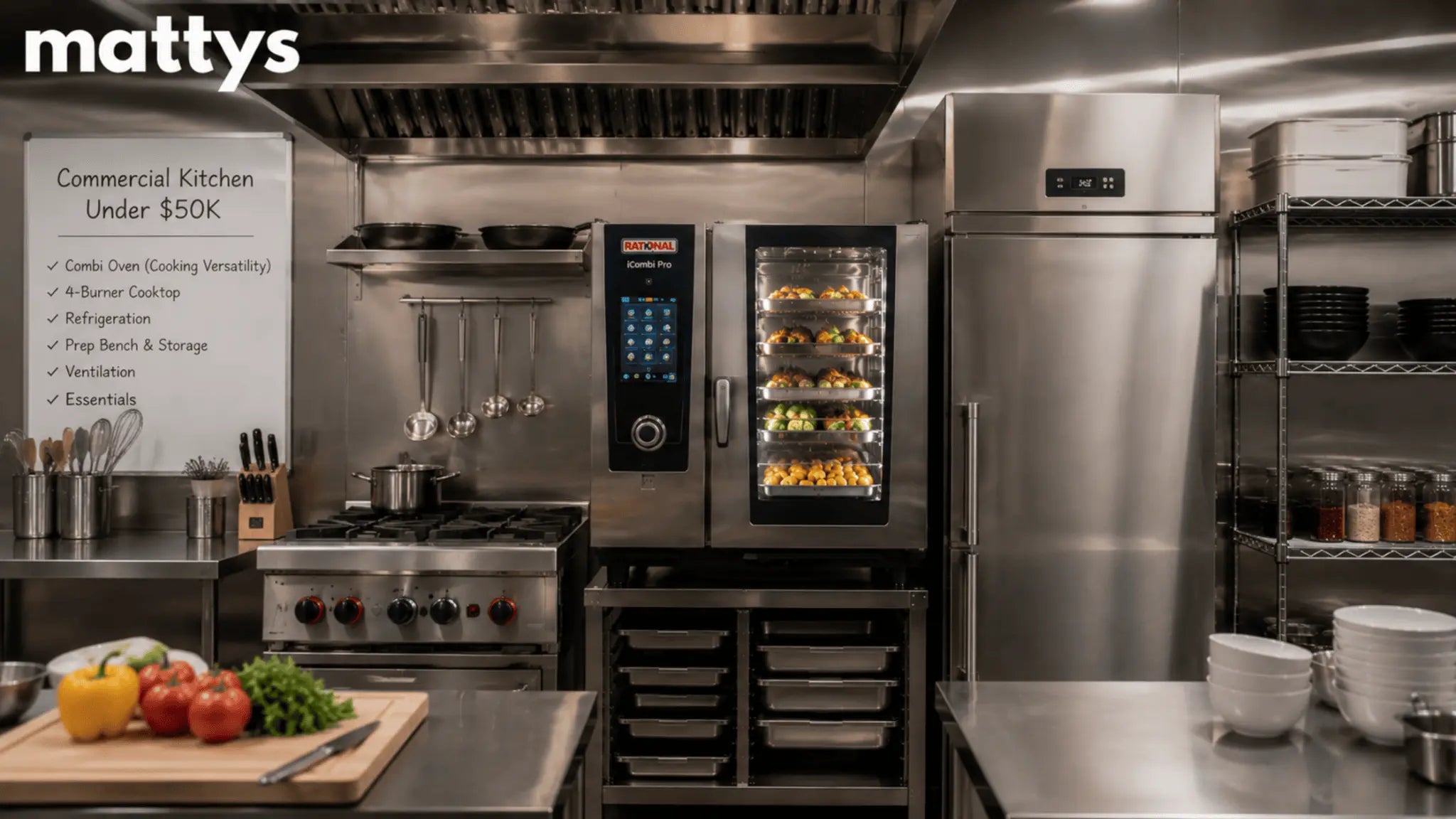
$50,000 Sounds Like a Lot. It Disappears Fast.
You've signed the lease. The space is yours. Now you need to turn an empty room into a functioning commercial kitchen — and your equipment budget is $50,000. That feels generous until you start adding up ovens ($8,000–$30,000), refrigeration ($7,000–$16,000), dishwashing ($5,000–$12,000), benches ($3,000–$8,000), ventilation ($3,000–$8,000), and the twenty smaller items nobody warns you about.
After fitting out 10,000+ commercial kitchens across Australia, I've helped hundreds of operators fit out kitchens on tight budgets. The ones who succeed share a single strategic insight: they build around the combi oven first and let it eliminate three or four other equipment purchases. The ones who struggle buy every piece of equipment separately and run out of budget before the kitchen is functional.
This guide walks you through the combi-first approach — how to allocate your $50,000, what to prioritise, what to defer, and how to build a kitchen that serves 80–120 covers without compromising quality.
Why Combi-First Changes the Budget Equation

The traditional approach to fitting out a commercial kitchen looks like this:
Traditional equipment list:
- Convection oven: $8,000
- Standalone steamer: $5,000
- Salamander/grill: $3,500
- Bain-marie: $2,500
- Proofer (if baking): $4,000
- Subtotal for cooking equipment: $23,000
Combi-first equipment list:
- Combi oven (10-tray, mid-range): $18,000
- Subtotal for cooking equipment: $18,000
The combi oven replaces the convection oven, steamer, and proofer entirely. It handles most salamander and bain-marie functions. You save $5,000 on purchase price, reclaim 2–3sqm of floor space, reduce energy consumption (one appliance vs four), and simplify maintenance.
That $5,000 saving plus the floor space recovery changes what's possible with the remaining $32,000. You can afford better refrigeration, proper ventilation, and quality stainless steel benches — the items that directly affect food safety and operational efficiency.
→ Browse our combi ovens — the foundation of a smart kitchen fitout
The $50K Kitchen: Complete Equipment Budget
Here's how we'd allocate $50,000 for an 80–120 cover cafe or restaurant in Australia (2026 pricing).
Tier 1: Non-Negotiable (Must-Have)
| Equipment | Budget | Notes |
|---|---|---|
| Combi oven (10-tray, mid-range) | $18,000–$22,000 | Unox PLUS or Rational Classic — your cooking backbone |
| Double-door reach-in fridge | $8,000–$11,000 | MEPS Grade-A, primary cold storage |
| Commercial dishwasher | $5,000–$8,000 | Undercounter or pass-through depending on volume |
| Stainless steel bench (2.4m) | $2,500–$4,000 | Grade 304, main prep surface |
| Ventilation / exhaust hood | $3,000–$6,000 | Sized for combi oven + cooktop heat output |
| Tier 1 subtotal | $36,500–$51,000 |
At the low end ($36,500), you have $13,500 remaining. At the high end, you're at budget.
Tier 2: High Priority (Week 1–4)
| Equipment | Budget | Notes |
|---|---|---|
| Undercounter fridge (prep station) | $3,500–$5,500 | Point-of-use access during service |
| Cooktop / flat grill | $2,500–$5,000 | For sautéing, eggs, pancakes — tasks combi doesn't cover |
| Sink (double-bowl commercial) | $1,500–$2,500 | FSANZ-compliant, food prep + handwashing |
| Shelving (chrome wire, 3 units) | $1,200–$2,000 | Dry storage, above bench, walk-through access |
| Tier 2 subtotal | $8,700–$15,000 |
Tier 3: Defer if Budget is Tight (Month 2–3)
| Equipment | Budget | Notes |
|---|---|---|
| Blast chiller | $5,000–$8,000 | Speeds cooling for food safety; can wait if volume is low initially |
| Salamander | $2,000–$3,500 | The combi handles most gratinating; add later if needed |
| Additional bench (1.2m) | $1,500–$2,500 | Second prep surface; defer until workflow is proven |
| Microwave (commercial) | $800–$1,500 | For quick reheats; not essential day one |
| Tier 3 subtotal | $9,300–$15,500 |
Budget Summary
| Scenario | Tier 1 | Tier 2 | Tier 3 | Total |
|---|---|---|---|---|
| Lean ($50K tight) | $36,500 | $10,000 | $3,500 | $50,000 |
| Comfortable ($50K with room) | $42,000 | $8,000 | $0 | $50,000 |
| Premium stretch | $45,000 | $12,000 | $8,000 | $65,000 |
Mathew's recommendation: Spend 40–45% of your budget on the combi oven and refrigeration. These two items determine your cooking capability and food safety. Everything else can be upgraded over time.
The Combi-First Kitchen Layout (80–120 Covers)

Zone 1 — Cooking (8–10sqm): Combi oven (centrepiece) + cooktop/flat grill + ventilation hood above both. The combi handles 70% of your cooking output. The cooktop covers sautéing, eggs, and pan-fried items.
Zone 2 — Prep (6–8sqm): Main bench (2.4m) with undercounter fridge below. Sink adjacent. Shelving above. This is where your mise en place happens. Everything is within reach.
Zone 3 — Cold Storage (3–4sqm): Double-door reach-in positioned between the delivery entrance and Zone 1. Receives deliveries, supplies cooking and prep stations.
Zone 4 — Wash (4–6sqm): Dishwasher + draining bench + glass rack storage. Positioned near the pass to minimise walking distance for front-of-house clearing.
Zone 5 — Dry Storage (3–5sqm): Chrome wire shelving for pantry items, cleaning supplies, packaging. Away from heat and moisture sources.
Where the Combi Oven Saves You Money

Equipment Elimination
| Equipment NOT Needed | Why the Combi Covers It | Saving |
|---|---|---|
| Standalone steamer | Steam mode: vegetables, fish, rice, dim sum | $4,000–$6,000 |
| Separate convection oven | Convection mode: identical performance | $5,000–$10,000 |
| Proofer | Low-temp steam mode: warm, humid proofing | $3,000–$5,000 |
| Bain-marie (for regen) | Regeneration mode: reheats without drying | $2,000–$3,500 |
| Total equipment saved | $14,000–$24,500 |
Ongoing Operational Savings
Energy: One combi oven uses less energy than four separate appliances. Estimated saving: $2,000–$4,000/year.
Maintenance: One service contract instead of four. Estimated saving: $1,000–$2,000/year.
Floor space: 2–3sqm reclaimed. That space becomes prep bench or storage — directly improving workflow and capacity.
Food waste: Steam injection reduces protein shrinkage 15–25%. Estimated saving: $100–$300/week for a 100-cover operation.
Customer Story: A Newtown Cafe Built for $47,000
The situation: A first-time cafe owner opening a 65-cover brunch spot in Newtown, Sydney. Budget: $50,000 for all kitchen equipment. Menu: eggs, avocado toast, sandwiches, soups, baked goods, steamed Asian-inspired sides.
The combi-first approach:
- Unox ChefTop MIND.Maps PLUS 10-tray: $18,500
- Bromic double-door reach-in fridge: $9,200
- Undercounter fridge (under coffee station): $4,200
- Commercial dishwasher (undercounter): $5,500
- Flat grill (for eggs and toast): $3,200
- Stainless steel bench (2.4m, Grade 304): $3,000
- Double-bowl sink: $1,800
- Chrome shelving (3 units): $1,600
- Total: $47,000
What the combi replaced: A separate convection oven ($7,500), a countertop steamer ($3,800), and a proofer ($3,500). Total saving: $14,800 — which funded the quality fridge and proper ventilation that the budget wouldn't otherwise have stretched to.
6-month result: The cafe runs 70 covers on weekdays, 90+ on weekends. The combi handles steamed eggs, baked scones, proofed sourdough, steamed buns, reheated soups, and roasted vegetables — all from one unit. Energy bill: $280/week for the entire kitchen. No equipment failures. The owner has $3,000 remaining for a salamander purchase when volume justifies it.
"Everyone told me to buy each piece of equipment separately. Mathew Hanna told me to start with the combi and build around it. Best advice I got. The kitchen does everything I need and came in under budget."
— Owner, Newtown cafe
What to Buy First, Second, and Third

Buy First (Before Opening)
- Combi oven — nothing works without cooking capability
- Refrigeration — you can't store food without cold storage
- Dishwasher — health inspection non-negotiable
- Main prep bench — you need a surface to work on
- Ventilation — council won't let you operate without exhaust compliance
Buy Second (Month 1–2, After Cash Flow Starts)
- Undercounter fridge — improves service speed
- Cooktop/flat grill — expands menu beyond what the combi handles
- Additional shelving — organises growing dry storage
Buy Third (Month 3–6, When Volume Proves the Need)
- Blast chiller — when food safety at volume demands rapid cooling
- Salamander — when gratinating volume exceeds what the combi can handle
- Additional bench/prep space — when the team outgrows the original layout
The principle: Every purchase should be triggered by demand, not anticipation. Start lean, prove the volume, then invest where the bottleneck appears.
Finance Options for the $50K Kitchen

Mattys Rent-Try-Buy
Lease equipment for 6 months. If it works for your kitchen, purchase it (with rental payments credited toward the price). If it doesn't, return it. This is particularly valuable for first-time operators who aren't sure about combi oven sizing, seasonal businesses testing a new location, and startups managing cash flow in the first 6 months.
Equipment Finance
Standard equipment finance through Australian lenders: 3–5 year terms, $350–$1,200/month depending on total amount financed. Most operators finance 50–70% of the total fitout cost and pay the remainder from working capital.
Staged Purchasing
Buy Tier 1 equipment outright. Finance or defer Tier 2 and 3. This reduces your initial capital requirement to $36,500–$42,000 while maintaining full cooking and safety capability from day one.
Mistakes to Avoid
Mistake 1: Buying every piece of equipment before opening
You don't know what you need until you've run 50 services. Start with the essentials (Tier 1), learn your workflow, then invest where actual bottlenecks appear. The $5,000 salamander you bought "just in case" might sit unused for 6 months.
Mistake 2: Skimping on the combi to fund secondary equipment
A $10,000 entry-level combi + a $5,000 steamer + a $3,500 proofer = $18,500 for less capability than an $18,500 mid-range combi alone. Consolidate spending into the best single unit you can afford.
Mistake 3: Forgetting installation costs
Equipment is 60–70% of total cost. Installation (electrical, plumbing, ventilation, gas) adds 30–40%. A $50,000 equipment budget needs $15,000–$25,000 in installation budget on top. Plan for this.
Mistake 4: Not budgeting for ventilation
Council won't sign off on your kitchen without compliant exhaust ventilation. Budget $3,000–$8,000 for a hood and extraction system. This isn't optional — it's legally required.
FAQ
Q: Can I really fit out a kitchen for $50,000?
For equipment, yes — an 80–120 cover cafe or restaurant can be fully equipped for $47,000–$52,000. Installation costs add $15,000–$25,000 on top. Total fitout including installation: $62,000–$77,000. The $50K number is achievable for equipment if you follow the combi-first approach.
Q: What if my budget is only $30,000?
Possible for a small cafe (40–60 covers). Go with a 6-tray countertop combi ($10,000–$14,000), single-door reach-in ($5,000–$7,000), undercounter dishwasher ($4,000–$5,000), bench + sink ($4,000–$5,000). Tight, but functional.
Q: Should I buy new or used?
For the combi oven: buy new. Warranty, commissioning, and training are worth the premium. For secondary items (benches, shelving, sinks): quality used equipment saves 30–50% without meaningful risk. We can source both.
Q: What's the most common mistake first-time operators make?
Over-buying. They purchase $70,000 of equipment for a kitchen that needs $45,000, then struggle with cash flow in the first 6 months. Start lean. The equipment you don't buy today can always be bought in month 3 when you know what you actually need.
Q: How long until the kitchen pays for itself?
At $50,000 equipment cost with average margins, most 80–100 cover operations recover their equipment investment within 12–18 months. The combi-first approach accelerates this because ongoing costs (energy, maintenance) are lower than multi-appliance setups.
Ready to Plan Your Kitchen?
Whether you're fitting out your first cafe or your fifth restaurant, the combi-first approach delivers maximum capability at minimum cost. We've done this hundreds of times and we'll help you get it right.
📞 Call us: 1300 628 897 — walk us through your space and budget, we'll build your equipment list
🛒 Browse: Combi ovens | Refrigeration | Dishwashers | Stainless steel benches
Share:
Gas vs Electric Combi Ovens: Cost, Performance & Installation for Australian Kitchens
Combi Oven Maintenance: How to Clean, Service & Extend Your Oven's Lifespan