

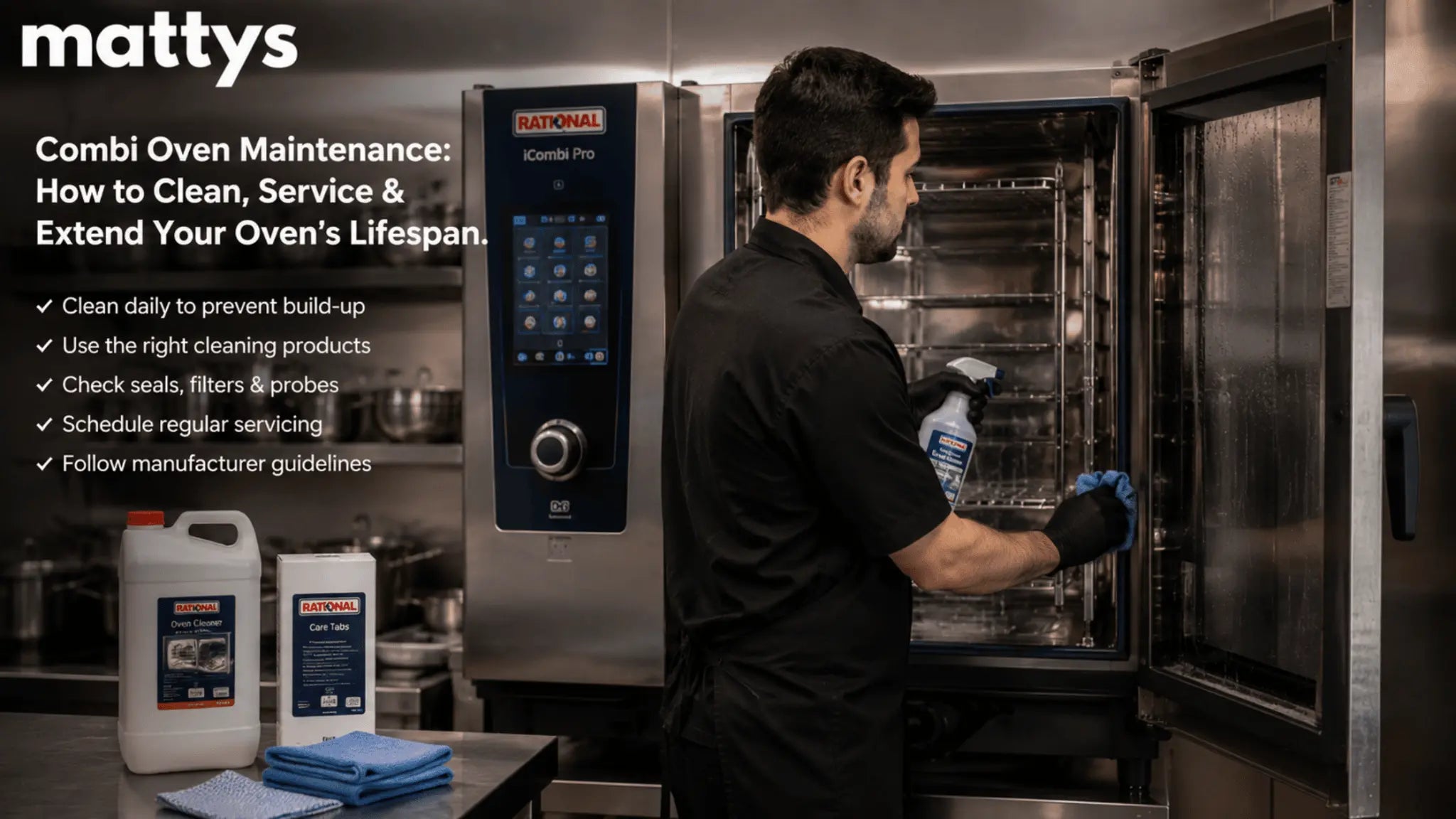
The $35,000 Oven That Died in 4 Years Because Nobody Ran the Cleaning Cycle

I'm going to tell you a story that still frustrates me. A Sydney restaurant owner bought a Rational iCombi Pro — top of the line, $35,000 installed. Four years later, the steam generator was clogged with limescale, the door gasket had deteriorated from grease buildup, the cavity coating was damaged from using the wrong cleaning chemicals, and the heating elements were operating at 60% efficiency. The repair quote: $8,500. The oven was effectively ruined by neglect.
The fix would have been: running the automated cleaning cycle daily (12 minutes), installing a $1,200 water filter at installation, and booking a $600 annual service. Total preventive cost over 4 years: approximately $4,000. Instead, the owner spent $35,000 on a premium oven and destroyed it through $0 of maintenance.
After fitting out 10,000+ commercial kitchens across Australia, this is the pattern I see constantly. The oven isn't the problem. Maintenance is. This guide gives you the complete framework to make your combi oven last 8–10+ years.
Why Combi Oven Maintenance Is Different from Other Equipment

A combi oven is the most complex cooking appliance in your kitchen. It manages heat (up to 300°C), steam (pressurised water injection or boiler-generated), fan-driven air circulation, digital sensors, door seals, and automated cleaning chemicals — all running 6–12 hours a day.
Every session deposits grease, protein residue, starch, and mineral scale inside the cavity. Steam mode introduces water — and with water comes calcium, magnesium, and other minerals that accumulate on heating elements, boiler components, and steam nozzles.
Without cleaning, this buildup cascades:
- Grease carbonises on cavity walls → reduces heat transfer efficiency → oven works harder → energy costs rise 15–25%
- Limescale blocks steam nozzles → uneven steam distribution → inconsistent cooking → food quality drops
- Door gasket absorbs grease → seal degrades → heat escapes → compounding energy waste
- Heating elements clog → hot spots develop → uneven cooking → complaints from chefs
- Sensor accuracy drifts → temperature readings become unreliable → food safety risk
The cost of neglect over 5 years: $8,000–$15,000 in avoidable energy waste, repairs, and premature replacement.
→ Browse our combi oven range — all backed by maintenance support and training
The Daily Clean: Your Most Important 12 Minutes

Every modern combi oven — Rational, Unox, Convotherm — has an automated cleaning cycle. It's the single most impactful maintenance action you can take, and it takes 12–15 minutes for an express clean or 45–60 minutes for a deep clean.
How It Works
The oven heats water with cleaning chemicals (tabs or liquid, depending on manufacturer), sprays the interior cavity, runs rinse cycles, and finishes with a steam purge. The entire process is automated — staff load the chemical, press start, and walk away.
The Daily Routine
After every heavy service (or at minimum end of day):
- Remove all trays and racks from the cavity
- Scrape any large food debris from the cavity floor (use a plastic scraper, never metal)
- Load the correct cleaning tab or liquid into the designated dispenser
- Select the appropriate cleaning cycle:
- Express clean (12–15 min): After standard service with moderate soiling
- Standard clean (30–45 min): After heavy service (roasting, grilling) with significant grease
- Deep clean (45–60 min): Weekly, or after extremely heavy use
- Close the door and start the cycle
- After completion, leave the door slightly ajar to allow the cavity to dry and ventilate
Critical Rules
Use only manufacturer-recommended chemicals. Rational uses their own cleaning tabs. Unox has SENSE.Klean chemicals. Convotherm specifies ConvoClean and ConvoCare. Generic alternatives can damage the cavity coating, void warranty, and leave chemical residue that affects food taste and safety.
Never skip the cleaning cycle "because we're in a rush." A 12-minute express clean at 10pm prevents a $3,000 repair bill in year 2. Every missed clean accumulates carbonised grease that becomes progressively harder to remove.
Never use abrasive tools inside the cavity. Steel wool, wire brushes, and abrasive pads scratch the cavity's non-stick or stainless coating. Scratches create nucleation points for grease buildup and corrosion. Plastic scrapers only.
Weekly Maintenance (20 Minutes, by Kitchen Manager)

Door Gasket Inspection
The door gasket is the most failure-prone component on any combi oven. Heat, steam, and grease attack it from one side; ambient kitchen environment from the other.
Weekly check: Close the door and run your hand along the entire gasket perimeter. Feel for cold spots (indicating gaps), sticky residue (grease buildup), or hardened sections (heat damage). Clean the gasket with a damp cloth and food-safe degreaser.
The paper test: Close the door on a piece of A4 paper at multiple points around the perimeter. Pull the paper. It should resist with moderate friction. If it slides out easily at any point, the gasket is failing.
Replacement timeline: Gaskets typically last 18–24 months in heavy-use kitchens. Replacement cost: $200–$400 for parts, $150–$250 for installation. A worn gasket wastes $5–$15/week in energy — so timely replacement pays for itself in months.
Drain Inspection
Combi ovens have internal drains that handle condensate and cleaning cycle waste water. Blocked drains cause water pooling, which corrodes internal components and creates hygiene risks.
Weekly: Run water through the drain and confirm it flows freely. Remove any food debris from the drain trap. If drainage is slow, flush with hot water and a food-safe drain cleaner.
Exterior and Handle Cleaning
Stainless steel exteriors and handles accumulate fingerprints, grease splatter, and kitchen airborne residue. Clean weekly with a non-abrasive stainless steel cleaner to prevent surface corrosion and maintain a professional appearance.
Monthly Maintenance (45 Minutes)

Fan Assembly Inspection
The internal fan(s) circulate hot air and steam throughout the cavity. They run at high speed for hours daily and accumulate grease on blades and motor bearings.
Monthly: With the oven off and cool, visually inspect the fan blades through the cavity. Look for grease buildup, wobble, or unusual positioning. Listen during operation for rattling, grinding, or squealing — any of these indicate bearing wear.
Fan motor replacement cost: $300–$600 if caught early. If a failing fan motor goes unaddressed, it overloads the motor, damages the controller, and the repair escalates to $1,500–$2,500.
Temperature Calibration Check
Place an independent oven thermometer (digital, not mercury) inside the cavity. Set the oven to 180°C convection mode. After 15 minutes of stable operation, compare the oven's displayed temperature to the independent thermometer.
Acceptable variance: ±2°C. If the variance exceeds 3°C, the thermostat or temperature sensor needs professional calibration.
Water Filter Check (If Installed)
If you have a water filter (and you should — see below), check the filter indicator monthly. Replace the cartridge at the manufacturer's recommended interval (typically every 6–12 months depending on water hardness and usage volume).
Water Filtration: The $1,200 Investment That Saves $5,000+
This is the maintenance item most operators skip — and the one that causes the most expensive failures.
Why It Matters
Australian water varies dramatically in mineral content by region. Sydney's water hardness ranges from 40–120mg/L depending on suburb. Melbourne is softer (typically 10–50mg/L). Adelaide is notably hard (150–300mg/L). Perth sits at 100–250mg/L.
Hard water deposits calcium and magnesium scale on heating elements, boiler components, and steam nozzles. Over 2–3 years without filtration, this scale:
- Reduces heating efficiency by 15–30%
- Blocks steam nozzles, causing uneven cooking
- Corrodes boiler internals (in boiler-based models)
- Triggers premature component failure
What to Install
A point-of-use water filter connected to the combi oven's water inlet. Cost: $800–$1,500 installed, plus $200–$400/year for replacement cartridges.
The maths: $1,200 upfront + $1,600 over 8 years in cartridges = $2,800 total. Without filtration: $2,000–$5,000 in descaling treatments + $3,000–$5,000 in premature component replacement = $5,000–$10,000. The filter saves $2,200–$7,200 over the oven's life.
Mathew's rule: Every combi oven we install includes a water filtration recommendation. In Adelaide and Perth (hard water), it's essentially mandatory. In Sydney, it depends on suburb. In Melbourne, it's optional but still recommended.
Annual Professional Service ($500–$1,000)
This is non-negotiable. Book it annually, every year, without exception.
A licensed technician performs:
- Full electrical inspection (connections, contactors, capacitors, wiring)
- Heating element testing (resistance measurements to detect degradation)
- Steam system inspection (boiler descaling if applicable, nozzle cleaning, pressure checks)
- Temperature sensor calibration (ensuring accuracy across the full range)
- Fan motor assessment (bearing condition, balance, current draw)
- Door gasket and hinge inspection (replacement if needed)
- Software/firmware update (for connected models like Rational iCombi Pro)
- HACCP compliance verification (temperature logging accuracy)
Cost: $500–$1,000 depending on oven size and brand. Rational and Unox both offer annual service packages through authorised Australian distributors.
Coastal kitchens: Service every 6 months. Salt-air corrosion accelerates wear on electrical connections and external components.
The Maintenance Cost vs. Neglect Comparison (7 Years, 10-Tray Combi)
| Item | With Maintenance | Without Maintenance |
|---|---|---|
| Daily cleaning chemicals | $4,200–$7,000 | $0 |
| Water filter + cartridges | $2,800 | $0 |
| Annual service (7 years) | $3,500–$7,000 | $0 |
| Gasket replacements | $900–$1,200 (3×) | $1,500–$2,400 (5× premature replacements) |
| Energy cost (7 years) | $31,500–$49,000 | $39,000–$61,000 (+20% from degraded efficiency) |
| Major repairs | $0–$1,000 | $5,000–$10,000 |
| Premature replacement | Not needed (oven lasts 8–10+ years) | $25,000–$35,000 (replacement at year 4–5) |
| Total | $42,900–$65,200 | $70,500–$108,400 |
The saving: $27,600–$43,200 over 7 years. Maintenance pays for itself 4–5 times over.
Customer Story: How a Melbourne Bakery Got 11 Years from a Combi Oven
The situation: An artisan bakery in Brunswick purchased a Unox ChefTop 10-tray in 2013 for $16,000.
The maintenance approach: Daily express clean without exception. Water filter installed at commissioning and cartridges replaced every 9 months. Annual professional service every January. Gaskets replaced twice (at year 3 and year 7). Total maintenance spend over 11 years: approximately $9,500.
The result: The oven is still running in 2024 — 11 years after purchase. It's had one fan motor replacement ($420) and one temperature sensor replacement ($280). Energy efficiency has declined approximately 12% from original spec, but it still produces consistent results for daily bread production.
The maths: $16,000 purchase + $9,500 maintenance + $700 repairs = $26,200 over 11 years = $2,382/year. An operator who neglects maintenance might replace the oven at year 5, spending $32,000+ over the same period.
"We've never missed a cleaning cycle. Not once in 11 years. That discipline is why this oven is still running. It's the cheapest investment we make every day."
— Owner, Brunswick bakery
Repair vs. Replace: The Decision Framework
Repair If:
- The oven is under 5 years old and the repair is under 35% of replacement cost
- It's a gasket, fan motor, sensor, or control board issue (replaceable components)
- The oven has been well-maintained and the failure is isolated
- Post-repair energy performance returns to within 10% of original spec
Replace If:
- The oven is 7+ years old and repair exceeds 30% of replacement cost
- It's a heating element bank failure or boiler replacement on an aging unit
- Energy consumption has risen 25%+ above original spec despite maintenance
- The cavity coating is damaged (scratched, peeling, or corroded)
- Replacement parts are discontinued or on extended backorder
The 40% Rule
If repair cost exceeds 40% of a new equivalent oven, always replace. A $10,000 repair on a $28,000 oven buys you 2–3 more years from tired equipment. The same $10,000 goes a long way toward a new unit with full warranty.
Mistakes to Avoid
Mistake 1: Using generic cleaning chemicals
Manufacturer chemicals are formulated for the specific cavity coating in your oven. Generic alternatives can be too acidic or too alkaline, stripping the coating and creating corrosion points. The $50 saved per quarter on chemicals costs $3,000 in cavity damage.
Mistake 2: Skipping water filtration to save $1,200
Without filtration, limescale buildup causes $5,000–$10,000 in component failures over 5–7 years. The filter is the highest-ROI maintenance investment you'll make.
Mistake 3: Running the oven past gasket failure
A leaking gasket wastes $5–$15/week in energy and exposes staff to steam escape risk. Replace immediately when the paper test fails — don't wait for visible deterioration.
Mistake 4: Skipping the annual service "because the oven seems fine"
Combi oven problems are cumulative and invisible until they cascade. A $600 annual service catches $3,000 problems when they're $300 fixes.
FAQ
Q: How often should I run the cleaning cycle?
After every heavy service or at minimum once daily. Express clean (12–15 min) for moderate use; standard clean (30–45 min) after heavy roasting/grilling; deep clean weekly.
Q: Can I clean the oven manually instead of using the auto-clean?
For spot cleaning, yes — use a plastic scraper and damp cloth. But manual cleaning doesn't reach the steam system, heating elements, or internal plumbing. The auto-clean cycle is non-replaceable for comprehensive maintenance.
Q: What cleaning tabs should I use?
Rational: iCareSystem cleaning tabs (blue for standard, red for descaling). Unox: SENSE.Klean chemicals. Convotherm: ConvoClean and ConvoCare. Never substitute across brands — the formulations are different.
Q: My oven smells when I run the cleaning cycle. Is that normal?
A mild chemical smell during cleaning is normal. Strong or acrid odours suggest chemical residue from a previous incomplete cycle, or using the wrong chemical concentration. Run an extra rinse cycle after cleaning, and ensure you're using the correct chemical type for your model.
Q: How do I know when to replace the water filter cartridge?
Most filters have a visual indicator or flow-rate marker. As a rule: every 6 months in hard-water areas (Adelaide, Perth, western Sydney), every 9–12 months in softer areas (Melbourne, eastern Sydney). If you notice white deposits on trays or steam nozzles, the filter is overdue.
Next Steps
Maintenance is the difference between a 4-year oven and a 10-year oven. The schedule above takes 15 minutes daily, 20 minutes weekly, 45 minutes monthly, and one professional visit per year. Total annual cost: $2,000–$3,500. Total annual savings: $3,000–$6,000 in avoided energy waste and repairs.
📞 Call us: 1300 628 897 — ask about maintenance packages for your combi oven
🛒 Browse our combi oven range
Share:
How to Set Up a Commercial Kitchen Under $50K: The Combi-First Approach
Rational vs Unox Combi Ovens: The Honest Australian Comparison