

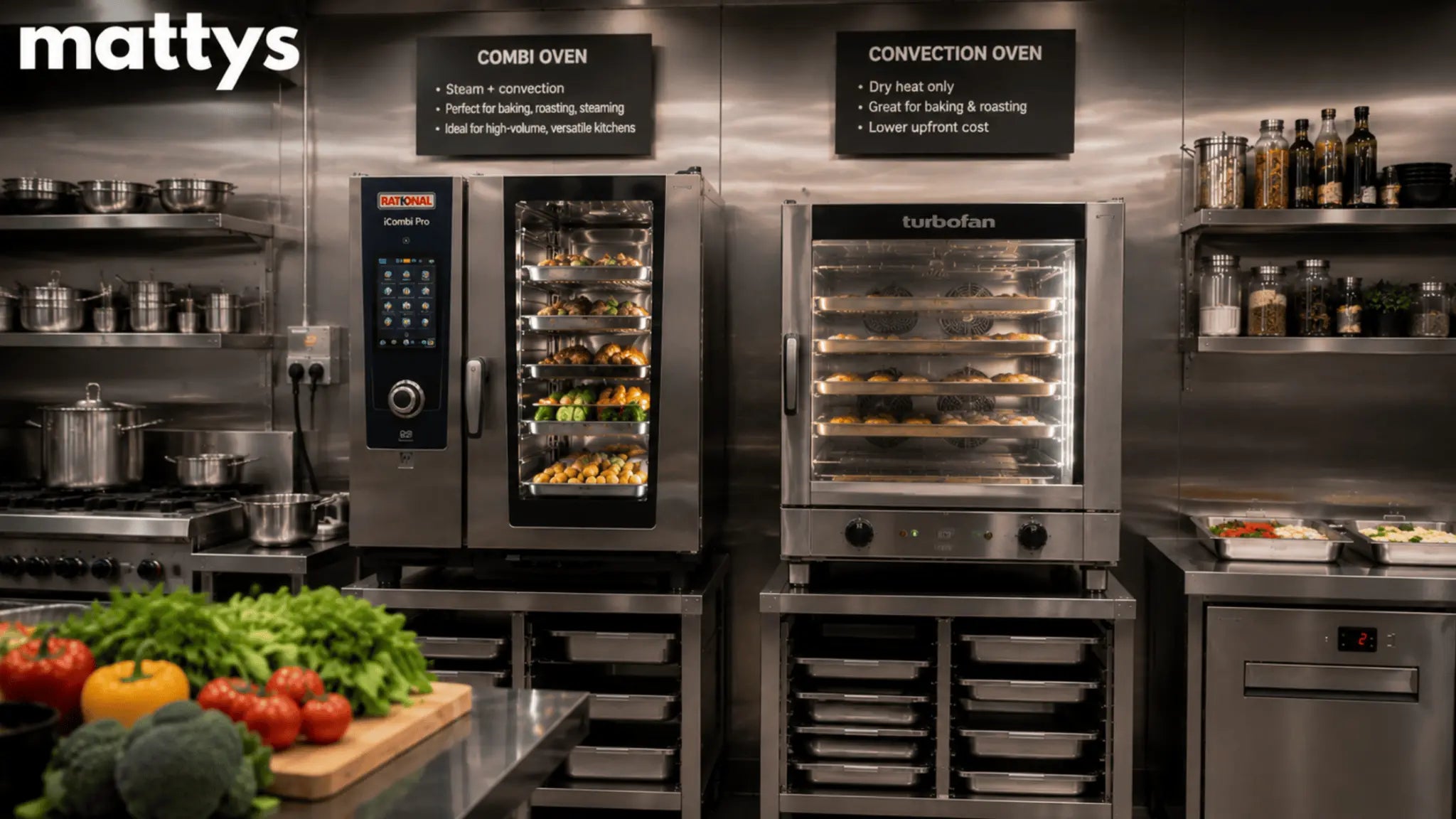
A Convection Oven Costs $5,000. A Combi Oven Costs $18,000. Is the Difference Worth $13,000?

This is the most common question I hear from first-time kitchen operators. They know they need an oven. They've seen combi ovens on every equipment list. But $18,000 for an oven when a $5,000 convection oven "does the same thing" feels hard to justify — especially when the budget is already stretched.
Here's the truth after fitting out 10,000+ Australian kitchens: a convection oven and a combi oven don't do the same thing. A convection oven blows hot air. A combi oven cooks with hot air, steam, or both — and that "both" is where the value lives. But that doesn't mean every kitchen needs a combi. Some operations genuinely run better and cheaper on convection alone.
This guide helps you decide which one your kitchen actually needs, what the real cost difference looks like over 7 years, and when the combi premium pays for itself.
How They're Different (The 60-Second Version)

Convection oven: Circulates hot dry air via fans. Cooks by removing moisture from food surfaces (browning, crisping, drying). One cooking mode. Temperature range typically 50°C–300°C.
Combi oven: Does everything a convection oven does, plus adds precisely controlled steam injection. Three cooking modes — convection (dry heat), steam (moist heat), and combination (both simultaneously). Temperature range typically 30°C–300°C with humidity control from 0–100%.
The fundamental difference: A convection oven cooks with heat. A combi oven cooks with heat and moisture, independently or together. That moisture control is what unlocks steaming, braising, sous vide, proofing, regeneration, and the combination cooking that produces crispy-outside, juicy-inside proteins.
What a Convection Oven Does Well

Convection ovens are not inferior equipment — they're focused equipment. For the right applications, they're actually better value than a combi.
Baking. Pastries, pies, sausage rolls, cookies, pizza bases, scones. Dry heat circulated evenly produces consistent browning and crisp textures. A quality convection oven does this exceptionally well.
Roasting (dry applications). Vegetables, potatoes, dry-rubbed meats where you want exterior crispness and don't need moisture retention. Convection excels here.
Gratinating and browning. Cheese-topped dishes, crumbles, brûlées. The dry, intense heat of convection is ideal.
Reheating baked goods. Pies, pastries, bread rolls — anything where moisture would make the product soggy.
AUD pricing (2026): Countertop: $2,500–$5,000. Full-size floor-standing: $5,000–$12,000. Premium brands (Blue Seal, Turbofan): $8,000–$12,000.
When Convection Is Enough
If your menu consists exclusively of dry-heat applications — baking, roasting, gratinating — and you never need to steam, braise, poach, or regenerate, a convection oven at $5,000–$12,000 is the right tool. You'll save $8,000–$18,000 versus a combi and get excellent results for your specific menu.
Typical operations that run fine on convection only:
- Bakeries focused on pies, pastries, and bread (but note: artisan bread benefits enormously from steam — see below)
- Pizza-focused restaurants (with dedicated pizza oven handling the main output)
- Small cafes with a limited, dry-heat menu
What a Combi Oven Does That Convection Can't

Steam Cooking
Vegetables steamed in a combi retain colour, nutrients, and texture that boiling destroys. Fish steams gently without drying. Rice cooks evenly. Dim sum, dumplings, and steamed buns are possible without a separate steamer.
Why this matters in Australia: Health-conscious menus are growing. Steamed vegetables, steamed fish, and plant-based options are menu requirements, not extras. A convection oven can't deliver these.
Combination Cooking
This is the combi's killer application. Roast chicken with crispy skin and juicy interior. Bread with a caramelised crust and open crumb structure (steam creates the crust; dry heat sets the crumb). Braised meats that are fall-apart tender with a browned exterior.
The protein maths: Steam injection during roasting reduces protein shrinkage by 15–25%. On a $200/kg wagyu loin, that's $30–$50 saved per piece in reduced waste. Across a week of 100-cover services, the waste reduction is $200–$500.
Regeneration
Pre-cooked food reheated in a combi oven with controlled humidity tastes fresh — not dried, not soggy. Hotels, aged care facilities, and catering operations live on regeneration. A convection oven dries food during reheating, degrading quality.
Sous Vide
Many modern combis function as precision low-temperature cooking devices. Set the steam mode to 58°C and cook vacuum-sealed proteins to exact doneness. Without a combi, you need a separate immersion circulator and container.
Proofing
Combi ovens with low-temperature steam create ideal proofing environments for bread dough — warm, humid, controlled. Without a combi, you need a separate proofer ($3,000–$6,000).
The Real Cost Comparison: 7-Year Total Cost of Ownership
Scenario A: Convection Oven Only (10-tray, full-size)
| Component | Cost |
|---|---|
| Purchase | $8,000 |
| Installation | $2,500 |
| Energy (7 years @ $3,500/year) | $24,500 |
| Maintenance (7 years) | $3,500 |
| Subtotal | $38,500 |
| Separate steamer | $4,000–$6,000 |
| Separate proofer | $3,000–$5,000 |
| Total with supplementary equipment | $45,500–$49,500 |
Scenario B: Combi Oven (10-tray, mid-range)
| Component | Cost |
|---|---|
| Purchase | $19,000 |
| Installation | $7,000 |
| Energy (7 years @ $6,000/year) | $42,000 |
| Maintenance (7 years) | $5,000 |
| Total | $73,000 |
| Additional equipment needed | None |
Scenario C: Combi Oven (Including Revenue Impact)
| Component | Value |
|---|---|
| 7-year total cost (from above) | $73,000 |
| Minus: Protein waste reduction (15% less shrinkage × 7 years) | –$7,000 to –$18,000 |
| Minus: Menu expansion revenue (steam/combination dishes) | –$10,000 to –$25,000 |
| Minus: Eliminated equipment (steamer + proofer not needed) | –$7,000 to –$11,000 |
| Adjusted 7-year net cost | $19,000–$49,000 |
The insight: When you factor in eliminated equipment, reduced food waste, and menu expansion revenue, the combi oven's effective cost drops dramatically. For a medium-volume restaurant, the combi can actually be cheaper than convection + supplementary equipment over 7 years.
Customer Story: A Brisbane Bakery That Almost Made the Wrong Choice
The situation: A new artisan bakery in Fortitude Valley was fitting out a 50sqm production kitchen. The owner budgeted $8,000 for a convection oven, planning to add a separate proofer ($4,500) and a countertop steamer ($3,200) for steamed buns (a menu feature).
The total conventional approach: $8,000 + $4,500 + $3,200 = $15,700 for three pieces of equipment occupying 3.2sqm of floor space.
What we recommended: One Unox ChefTop MIND.Maps PLUS 10-tray combi oven at $18,500, occupying 0.9sqm. It handles all baking (convection mode), all proofing (low-temperature steam mode), and all steamed bun production (steam mode).
The result: For $2,800 more than the three-unit approach, the bakery got one piece of equipment in one-third the floor space. The reclaimed 2.3sqm became additional bench space for packing and decorating — directly increasing production capacity.
"I nearly bought three separate machines. One combi oven does everything they would have done, in a fraction of the space, and it actually cost less to run."
— Owner, Fortitude Valley bakery
Decision Framework: When Each Option Wins
Choose Convection If:
- Your menu is 100% dry-heat (baking, roasting, gratinating — no steaming, braising, or regeneration)
- You have a very tight budget (under $10,000 total for cooking equipment)
- You already have separate steaming and proofing equipment
- You're a dedicated pizza or pie shop where convection is the primary cooking method
Choose Combi If:
- Your menu includes any steamed, braised, poached, or regenerated items
- You want to reduce food waste on proteins (the shrinkage savings are real)
- You're fitting out a new kitchen and want to consolidate equipment
- You need proofing capability (bread, pastry)
- You want menu flexibility to add steam-based dishes in the future
- You're replacing multiple aging units (convection + steamer + proofer) with one combi
Mistakes to Avoid
Mistake 1: Buying a convection oven and then adding a steamer 6 months later
If there's any chance you'll need steam capability, buy the combi now. Adding a separate steamer later costs $4,000–$6,000 and occupies floor space you don't have.
Mistake 2: Buying a combi oven and only using convection mode
We see this more than we'd like. Operators spend $18,000+ on a combi and never use steam or combination modes because nobody trained the team. Insist on manufacturer training during commissioning.
Mistake 3: Comparing purchase price instead of total cost of ownership
A $5,000 convection oven plus $8,000 in supplementary equipment plus higher food waste costs more over 7 years than an $18,000 combi that eliminates all of those.
FAQ
Q: Can a combi oven completely replace a convection oven?
Yes. Every combi oven has a convection-only mode that performs identically to a standalone convection oven. There is no cooking application a convection oven handles that a combi cannot.
Q: Is the energy consumption higher for a combi than a convection oven?
Yes, moderately. A combi oven uses 15–30% more energy than an equivalent convection oven because the steam generation system adds load. However, a combi replaces multiple pieces of equipment — so total kitchen energy may actually decrease.
Q: What if I only need steam occasionally?
A combi oven still makes sense. Even occasional steam use (once or twice per week) provides value through regeneration capability and menu flexibility. The combi sits idle in steam mode when you don't need it — there's no energy penalty for having the capability available.
Q: How long do each last?
Convection ovens: 10–15 years with maintenance. Combi ovens: 7–10 years with maintenance. Combis have more components (steam system, sensors, digital controls) which shortens the typical lifespan slightly. However, the additional capability during that lifespan more than compensates.
Ready to Decide?
The combi vs convection question comes down to one thing: does your menu need moisture control? If yes, the combi premium pays for itself. If your menu is exclusively dry-heat, save the money.
📞 Call us: 1300 628 897 — tell us your menu, we'll tell you which oven
🛒 Browse: Combi ovens here | Convection ovens here
Share:
Rational vs Unox Combi Ovens: The Honest Australian Comparison
Commercial Combi Ovens: The Complete Australian Buyer's Guide (2026)