

The Machine Most Operators Get Wrong Before Service Even Starts

Pick the wrong commercial ice machine and you'll know about it within a week. The bin runs dry at 7pm on a Friday. The unit struggles to keep up because it was sized for 21°C air and your kitchen runs at 35°C. Or you bought on price alone and the first service call costs you $400 — followed by six more in the same year.
After fitting out 10,000+ commercial kitchens across Australia, from single-origin cafés in Fitzroy to high-volume seafood restaurants in Fremantle, we've seen every version of this play out. The good news is that getting it right isn't complicated — it just requires asking the right questions before you spend a dollar.
This guide covers every decision you need to make: ice type, daily capacity, machine format, cooling method, water treatment, and real Australian pricing for 2026. Whether you're opening your first venue or replacing ageing equipment before summer, this is the resource we wish every operator had on day one.
→ Browse Mattys commercial ice machine range
Why Your Ice Machine Decision Matters More Than You Think

Ice Affects Customer Experience Directly
In a bar, cloudy ice in a premium cocktail signals cheap corners cut. In a seafood display, the wrong ice type — say, cubes instead of flake — means your product sits above the ice rather than bedded in it, raising surface temperature and reducing shelf life. In a café running 150 covers at lunch, running out of ice during the service rush isn't just an inconvenience; it's a refund, a complaint on Google, and a staff headache rolled into one.
Australia's Climate Changes the Equation
This is the part most international guides miss entirely. A machine rated at 100kg per day in a manufacturer's datasheet was tested at 21°C ambient air and 10°C incoming water — lab conditions that don't exist in a Queensland kitchen at 2pm in January, or even in a western Sydney venue during a 38°C February week.
At 32°C ambient and 21°C water (realistic summer conditions across most of NSW, QLD, and WA), the same machine may produce 25–35% less ice than its nameplate rating. Size for the worst realistic conditions at your site, not the best-case spec sheet.
Getting It Wrong Has a Real Cost
A commercial ice machine that's undersized, poorly matched to your ice type requirements, or inadequately serviced will cost you in three ways: stock loss (seafood, produce, beverages), customer complaints, and repair bills. We've seen operators replace a $3,500 undercounter unit after 18 months because it was the wrong format for their volume. A $500 upfront conversation with the right supplier would have saved them the whole experience.
Step 1: Choose Your Ice Type First

Every other decision — capacity, format, cooling method — flows from the ice type your operation actually needs. This is where most buyers start too late in the process.
Dice and Half-Dice Cube Ice
The workhorses of the ice world. Full dice cubes (roughly 30mm) and half-dice (about 22mm) are the standard for cold drinks, spirits, soft drinks, and general bar service. They melt slowly, stack well in a glass, and are produced efficiently by most commercial machines.
Half-dice is the more versatile option for mixed-use venues — it works in cocktails, dispensers, and blended drinks without the clunking of full dice. In our experience, about 70% of Australian cafés and bars running general beverage service are best suited to half-dice.
Gourmet and Top-Hat Ice
Clear, slow-melting, presentation-grade ice. If you're running a cocktail bar, a hotel rooftop, or any venue where the drink is as much about aesthetics as flavour, gourmet cube ice is worth the premium. These units cost more to purchase and run, but the product quality difference is real and visible.
Nugget (Chewblet) Ice
Soft, chewable, cylindrical ice made from compressed flake. Enormously popular in healthcare settings — hospitals and aged care facilities specify nugget ice because it's safe for patients to chew and hydrates as it melts. Also gaining popularity in US-style casual dining and fast food. If you're running a healthcare operation or a high-volume dispensing environment, nugget is worth serious consideration.
Flake Ice
Soft, irregular, high-surface-area ice that beds around product rather than sitting above it. This is the choice for seafood displays, fresh produce presentations, salad bars, and fishmongers. It's also used in food processing and some medical applications. Flake ice machines operate differently to cube units — don't try to repurpose a cube machine for a seafood display.
"We get calls from seafood operators every summer who bought a cube machine on price and are now losing product because their display isn't holding temperature. Flake ice for seafood isn't optional — it's the spec. Get it right before you order."
— Mathew Hanna, Founder
Crescent Ice
A curved, half-moon shape that's easy to dispense and sits well in cups and glasses. Common in self-serve environments like hotel vending alcoves, convenience stores, and healthcare corridors. Crescent ice is designed for high-throughput dispensing rather than premium presentation.
Want the full breakdown of every ice type, where each excels, and where each falls short? Read our complete Ice Types Guide.
Step 2: Size Your Machine for Peak Hour, Not Average Demand

This is the most commonly misunderstood part of the buying process, and it's the one that causes the most operational pain.
The Peak-Hour Principle
Manufacturers rate ice machines by daily output (kg per 24 hours). But your ice demand isn't spread evenly across 24 hours — it spikes during service. A café running 120 covers at Saturday lunch will burn through most of its ice in a 3-hour window. If your machine's storage bin can't cover that peak, you run dry mid-service regardless of the daily production number.
The right formula is: size the machine's production capacity to your daily demand, and size the storage bin to cover your peak service period.
Rough Sizing Guide for Australian Venues
| Venue Type | Estimated Daily Ice Demand | Recommended Production Capacity |
|---|---|---|
| Café, 40–60 covers | 15–25 kg/day | 30–40 kg/day unit |
| Bar, 80–120 covers | 40–70 kg/day | 80–100 kg/day unit |
| Restaurant, 100–150 covers | 50–90 kg/day | 100–130 kg/day unit |
| Hotel, 100+ rooms | 80–150 kg/day | 150–200 kg/day modular |
| Seafood/fishmonger | Volume-dependent | Flake unit, 50–200 kg/day |
| Healthcare ward | Volume-dependent | Nugget dispenser, per unit count |
Always apply a 20–30% buffer above your calculated peak demand. And remember — if your site runs hotter than 25°C ambient in summer, derate the machine's nameplate capacity by 20–30% when sizing.
Don't Forget the Bin
The storage bin is as important as the ice-making head. A high-production machine paired with a too-small bin means ice is being produced but not stored — and you're back to running out at peak. Most self-contained undercounter units have integrated bins sized to their production rate. For modular setups, bin size is a separate decision.
"We had a client in Parramatta — a 90-cover Italian restaurant — who spec'd a 120kg/day modular unit with a 40kg bin. Great production capacity, wrong bin. They ran dry every Friday. The fix cost them $800 in a new bin they could have bought upfront for the same price. Always size the bin to peak service, not daily average."
— Mathew Hanna, Founder
For the complete step-by-step methodology — daily demand calculations, climate correction tables, and worked examples — read our Ice Machine Sizing Guide.
Step 3: Choose the Right Machine Format

Once you know your ice type and capacity, format is the next decision.
Self-Contained Undercounter Machines
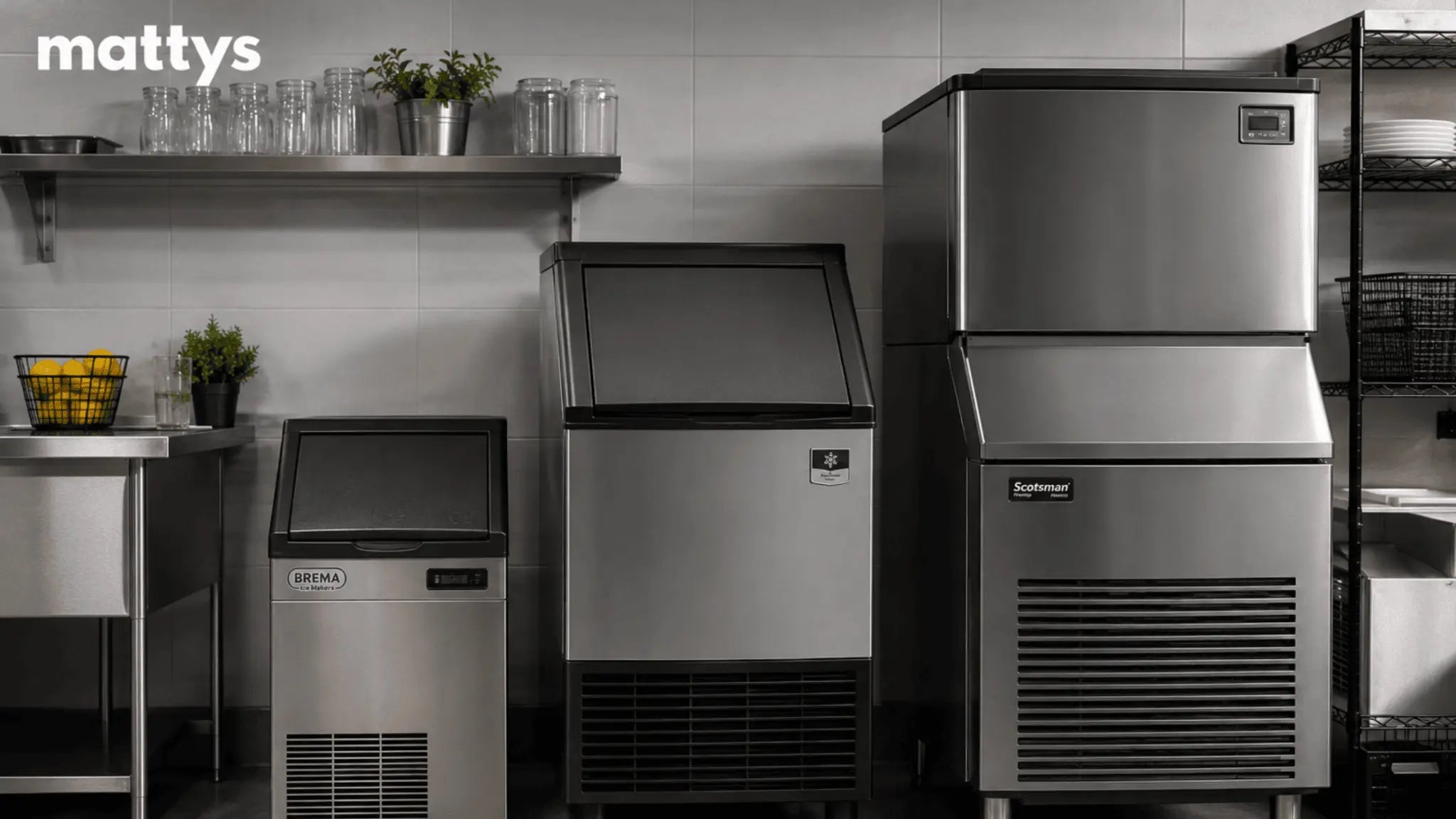
These are single-unit machines with the ice-making mechanism and storage bin integrated. They fit under a standard 900mm bench, typically produce 30–150 kg/day, and suit most small-to-medium venues: cafés, small bars, quick-service restaurants, healthcare rooms.
They're easy to install — water in, drain out, power on — and most require no specialist fitout. For a venue producing under 100 kg/day, this is almost always the right format.
Modular Head-and-Bin Units
The ice-making head sits on top of a separate storage bin (or an ice dispenser). These are the right call for high-volume venues producing 150 kg/day or more. The head and bin are specified and purchased separately, giving you flexibility to match production capacity to your storage requirement precisely.
Modular setups typically require more installation planning — they're heavier, take up more floor space, and need more clearance for ventilation. Budget for a proper install, not just a plug-and-play.
Ice Dispensers
Stainless steel units with a storage bin and a dispensing mechanism — the user pushes a cup against a lever or sensor and ice is dispensed automatically. These are the standard for hotel corridors, hospital wards, and self-serve convenience environments. Hoshizaki and Scotsman both have strong dispenser ranges available in Australia.
Combination Units (Ice + Water)
Some dispensers combine ice production with chilled water dispensing. These suit corporate offices, healthcare waiting rooms, and convenience stores where both are needed and counter space is limited.
Not sure which format and ice type suits your specific venue? See our Ice Machines by Venue Type guide for café, restaurant, bar, hotel, healthcare and seafood-specific recommendations.
Step 4: Air-Cooled, Water-Cooled, or Remote?
The condenser removes heat from the refrigeration cycle. Where that heat goes depends on your cooling method — and the right choice affects running costs, installation complexity, and suitability for your site.
Air-Cooled (Most Common in Australia)
The condenser uses ambient air to dissipate heat. Air-cooled units are simpler to install, less expensive to run in terms of water consumption, and suit most Australian venues.
The catch: they add heat to your kitchen. In a small BOH space that's already running hot, an air-cooled ice machine can raise ambient temperature by 2–5°C — which in turn reduces the machine's own ice production efficiency. They also need adequate clearance (typically 150mm on sides and rear) for ventilation.
This is the right choice for: most cafés, restaurants, and bars with adequate BOH ventilation.
Water-Cooled
The condenser is cooled by a continuous flow of water rather than air. Water-cooled units run efficiently in hot, poorly ventilated spaces and add no heat to the kitchen. The tradeoff is ongoing water consumption — these units use significantly more water than air-cooled equivalents, which affects both your water bill and your environmental footprint.
Some councils and water authorities in drought-prone regions have restrictions on water-cooled commercial refrigeration. Check your local requirements before specifying.
This is the right choice for: venues with high-ambient kitchens, inadequate ventilation, or where heat rejection into the kitchen is a problem.
Remote-Cooled
The condenser is located outside the building — on a rooftop, in a plant room, or outdoors — and connected to the ice-making head via refrigerant lines. This is the most expensive option to install but gives you the most flexibility. No heat added to the kitchen, no water consumption, and the machine runs efficiently even in high-ambient conditions.
This is the right choice for: large-scale operations, purpose-built fitouts, and venues where remote condenser placement is practical.
"In our experience, about 80% of Australian venue fitouts land on air-cooled as the right answer. The key is adequate ventilation clearance — which is something a lot of operators overlook when squeezing equipment into a tight BOH. If you're short on space, talk to us before you order."
— Mathew Hanna, Founder
Step 5: Water Quality and Filtration

This is the section most buyers skip — and it's the one that shortens machine life more than any other factor.
Why Water Quality Matters
Commercial ice machines pass large volumes of water through an evaporator plate or cylinder. The minerals in that water — primarily calcium and magnesium — are left behind as scale deposits when water freezes. Over time, scale builds up on the evaporator surface and reduces heat transfer efficiency. The machine works harder, produces less ice, consumes more energy, and eventually fails prematurely.
The water chemistry varies significantly across Australia. Melbourne's soft water is relatively kind to ice machines. Sydney's water is moderately hard. Perth's water is significantly harder and more corrosive in some supply areas. Coastal venues also have to account for salt air, which accelerates corrosion on exposed metal components.
Water Filtration: What You Actually Need
A basic sediment filter removes particles that cause mechanical wear. For most Australian venues, you also need a scale inhibitor or water softener to manage mineral buildup. In areas with heavy chlorination (common in Australian town water), a carbon filter stage helps with taste and odour, which affects ice quality directly.
Most commercial ice machine manufacturers — Hoshizaki, Scotsman, Bromic — specify a water filtration system as a condition of warranty. If you install a machine without adequate filtration and the evaporator scales up, don't expect a warranty claim to succeed.
Recommended filtration setup for most Australian venues: sediment pre-filter + scale inhibitor + carbon block. Budget $300–$600 for the filter housing and cartridges; cartridges typically need replacing every 6 months.
For the full state-by-state water hardness breakdown and filtration setup recommendations, read our Water Filtration Guide.
What Does a Commercial Ice Machine Cost in Australia? (2026 Pricing)
Prices below are indicative AUD ranges for 2026. Confirm current pricing with Mattys before committing — lead times and pricing can shift with supply chain conditions.
Machine Purchase Prices
| Format / Capacity | Indicative Price Range (AUD, 2026) |
|---|---|
| Undercounter self-contained, 30–50 kg/day | $1,800 – $4,500 |
| Undercounter self-contained, 60–100 kg/day | $3,500 – $7,500 |
| Modular head, 100–200 kg/day | $5,000 – $12,000 |
| Modular head, 200–400 kg/day | $10,000 – $22,000 |
| Storage bin (separate, 80–200 kg) | $1,200 – $4,500 |
| Ice and water dispenser | $4,000 – $9,500 |
| Flake ice machine, 50–150 kg/day | $3,500 – $10,000 |
Installation and Ancillary Costs
Allow $400–$1,200 for a standard undercounter installation (plumber + electrician). Modular or remote-cooled installs can run $1,500–$4,000 depending on complexity and site. Water filtration adds $300–$600 upfront plus ongoing cartridge costs.
Total Cost of Ownership (5-Year View)
The purchase price is only part of the story. A well-maintained commercial ice machine from a quality brand — Hoshizaki, Scotsman, Bromic — should run 10–15 years with regular service. The real cost comparison to make is: purchase price + installation + filtration + annual service (typically $300–$500/year) + energy costs.
A $3,000 machine with $800/year in service and energy costs over 5 years costs $7,000 total. A $5,500 machine with $350/year in the same period costs $7,250. The premium unit often costs less over its operating life — and it doesn't let you down on a Saturday night.
"We stopped recommending the cheapest undercounter machines about five years ago after seeing too many of them in for service within 12 months of install. The entry-level price point has some genuine options now — but for anything in a venue running 7 days a week, we won't put our name behind anything below the mid-range. Spend the extra $800 upfront; you'll spend twice that on callouts otherwise."
— Mathew Hanna, Founder
Want our honest take on Hoshizaki vs Scotsman vs Bromic — where each brand performs best and where each falls short? Read our Brand Comparison Guide.
What a High-Volume Venue Got Right (and What Nearly Went Wrong)
A 130-cover modern Australian restaurant in Sydney's inner west came to us two years ago ahead of a kitchen refit. They were replacing a 7-year-old undercounter unit that had served them well but was now struggling to keep up with a growing wine-and-cocktail program.
The chef's initial brief was simple: "bigger undercounter, same footprint." But when we walked through the kitchen, two things stood out. Their BOH ran consistently hot — the pass and the ice machine sat side by side with minimal ventilation — and their cocktail bar had started using gourmet clear ice for premium serves, which requires a completely different machine type to standard cube production.
We spec'd a Hoshizaki modular head-and-bin setup with a remote condenser on the rooftop, paired with a separate Hoshizaki gourmet undercounter unit for the bar. Yes, it cost more than a single bigger undercounter. But the result was a machine that performs at rated capacity even in a 34°C kitchen, purpose-built ice quality for the bar program, and zero service calls in the first 18 months.
"The difference in the bar program is noticeable to customers. We've had people comment on the ice specifically. That's not something I expected to happen."
— Restaurant owner, Sydney inner west
Getting the spec right before the order is placed is always cheaper than changing it after install.
5 Mistakes Australian Operators Make When Buying Ice Machines
1. Sizing to the Manufacturer's Rated Capacity Without Applying a Climate Correction
As covered above — if your site runs hot in summer, derate the nameplate figure by 20–30%. Don't discover this at 6pm on a 38°C Saturday when the bin runs dry.
2. Buying the Wrong Ice Type for the Application
Cube ice in a seafood display. Flake ice in a cocktail bar. These aren't just aesthetic mismatches — they affect food safety, product quality, and customer perception. Know your primary use case before you choose a machine type.
3. Skipping Water Filtration to Save Upfront Cost
A $350 water filtration kit can add 3–5 years to a machine's life. Not installing one can void your warranty, scale up your evaporator within 12 months, and result in a service call that costs more than the filter would have. This is a false economy we see repeatedly.
4. Specifying an Air-Cooled Unit for a Poorly Ventilated Kitchen
Air-cooled machines need room to breathe. In a tight BOH with no ventilation, the machine recycles its own waste heat, ambient temperature climbs, ice production drops, and the compressor works harder than it should. The fix — retrofitting ventilation or switching to a water-cooled unit — costs significantly more than specifying correctly at the start.
5. Buying on Price Alone From an Unfamiliar Supplier
The machine purchase is the start of a long relationship. You need parts availability, local service capability, and someone who will still be answering the phone in three years. We've seen operators buy cheap imported units where the local distributor folded within 18 months. Stick to brands with established Australian distribution and service networks.
Once your machine is installed, keeping it running reliably comes down to a proper cleaning and service schedule. See our Maintenance & Cleaning Guide for the full daily, weekly, monthly and professional service breakdown.
Frequently Asked Questions
How much does a commercial ice machine cost in Australia?
Entry-level undercounter units start around $1,800 AUD. Mid-range café and bar units typically sit between $3,500 and $7,500. High-volume modular systems for restaurants and hotels range from $8,000 to $22,000 or more, before installation. Confirm current pricing with Mattys for 2026 lead times and availability.
What ice machine brands are available in Australia?
The most widely supported commercial brands in Australia include Hoshizaki, Scotsman, Bromic, Blizzard, and Polar. Hoshizaki and Scotsman have the strongest national service network coverage. Ice-O-Matic is also available through selected distributors. Mattys carries a curated range — talk to us about what's in stock and what lead times look like.
How much ice does my venue actually need?
A rough starting point: allow 0.5–0.7 kg of ice per beverage cover per day for a standard bar or restaurant. Add 20–30% buffer for hot weather and peak service spikes. Seafood and produce displays require separate calculation based on display volume and ambient temperature. When in doubt, size up — running out of ice mid-service costs more than carrying a little extra capacity.
How often does a commercial ice machine need servicing?
Most manufacturers recommend a professional service every 6–12 months, plus regular operator cleaning every 1–3 months depending on water quality and usage intensity. Water filter cartridges typically need replacing every 6 months. A neglected machine will produce less ice, consume more energy, and fail sooner — the service cost is almost always worth it.
Does my ice machine need to comply with Australian standards?
Yes. Commercial ice machines sold in Australia must comply with AS/NZS 60335 electrical safety standards. Food contact surfaces must meet food-grade hygiene standards consistent with FSANZ requirements. Water connections must comply with local plumbing codes (AS/NZS 3500). Ensure any machine you purchase is compliant before installation — this matters for council inspections and insurance purposes.
What's the difference between self-contained and modular ice machines?
A self-contained unit integrates the ice-making mechanism and storage bin in one unit — simpler, more compact, suited to lower-volume venues. A modular unit has a separate ice-making head (which sits on top of a bin or dispenser) and is used for higher-volume applications where production capacity and storage can be independently matched.
Can I lease or finance a commercial ice machine in Australia?
Yes. Equipment finance and leasing options are widely available through equipment finance brokers and some suppliers directly. Leasing can make sense for start-ups or venues managing tight capital budgets — just factor in total cost over the lease term versus outright purchase. Mattys can point you toward finance options if needed.
How long should a commercial ice machine last?
A quality commercial ice machine — properly installed, adequately filtered, and regularly serviced — should run 10–15 years. Entry-level units with lighter-gauge components tend to have shorter lifespans of 5–8 years under commercial loads. The brand, the service program, and the water quality at your site are the three biggest factors in machine longevity.
Ready to Get the Spec Right?
Choosing the right commercial ice machine comes down to five decisions: ice type, daily capacity, machine format, cooling method, and water treatment. Get those right and you'll have a machine that performs reliably for a decade. Get any of them wrong and you'll be reading this guide again in 18 months.
At Mattys, we've been supplying and fitting out commercial kitchens across Australia for over 20 years. We stock Hoshizaki, Scotsman, Bromic, and a curated range of other proven brands — and we'll tell you honestly which one suits your venue, your climate, and your budget.
Talk to Mattys About Your Ice Machine
📞 Call us: 1300 628 897
🛒 Browse the range
We'll have a quote back to you within 24 hours. No obligation, no pressure — just the right spec for your operation.
Share:
Commercial Deep Fryers: The Complete Australian Buyer's Guide (2026)
The Right Commercial Ice Machine for Your Venue Type: A Practical Australian Guide