



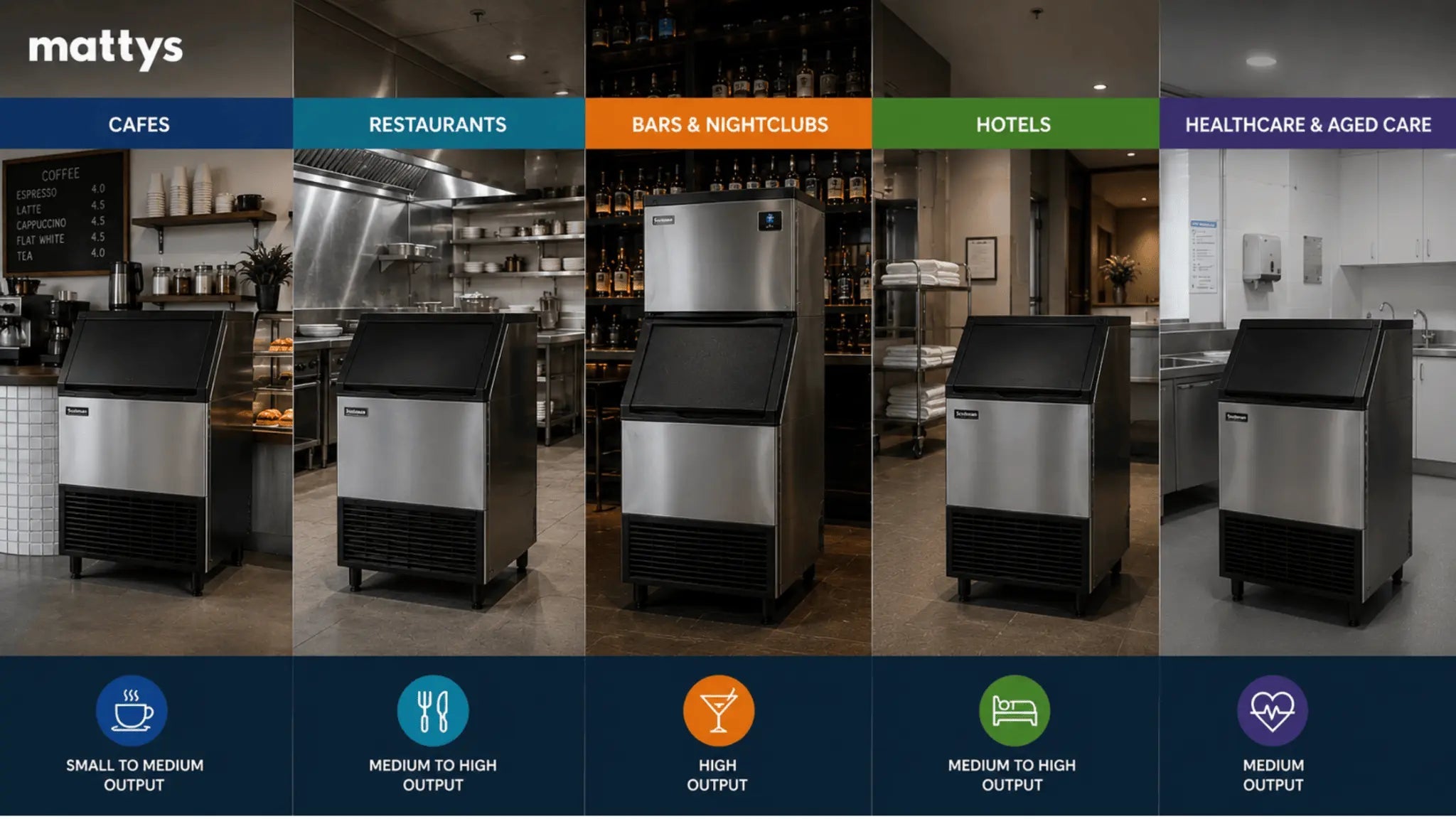
One Size Does Not Fit All — and the Wrong Fit Is Expensive

A 60-cover Brunswick café and a 300-bed Canberra hospital are both buying commercial ice machines this year. They will buy completely different machines, for completely different reasons. The right choice for one is entirely wrong for the other.
After fitting out 10,000+ commercial kitchens across Australia — from Byron Bay juice bars to offshore mining camp kitchens in the Pilbara — we understand that the best ice machine spec is always venue-specific. This guide cuts straight to the recommendation for each major venue type: the right ice, the right capacity range, the right format, and the brand we'd suggest.
For the full decision framework, see the complete commercial ice machine buyer's guide. This article goes one level deeper — specific to your type of operation.
→ Browse Mattys ice machines by application
Cafés and Coffee Shops

The Ice Challenge for Cafés
Most Australian cafés think ice is a secondary consideration — something the bar fridge handles. That changes quickly when iced coffee programs, smoothie menus, and summer iced drink volumes grow. A café that runs out of ice at 11am on a Saturday loses revenue on some of its highest-margin items.
What Most Cafés Need
- Ice type: Half-dice cube. Works in iced coffee, cold brew, smoothies, iced tea, and general cold beverages. Versatile and efficiently produced.
- Capacity: For a 40–70 cover café with a moderate iced drink program, 40–60 kg/day production is typically adequate. Apply the standard climate derating for your location — a Brisbane café sizing at 40 kg/day should look at a 55–60 kg/day nameplate machine.
- Format: Self-contained undercounter. Compact, easy to install under the bar or in a small BOH, no specialist installation beyond standard plumbing and power.
- Brand: Hoshizaki or Bromic depending on budget. Hoshizaki undercounter units are exceptionally reliable and worth the premium for cafés running 7 days a week with no time for machine downtime. Bromic is a solid mid-market option for venues where the budget is tighter.
What to Avoid
Don't buy a consumer-grade or light commercial machine for a trading café. The distinction matters: consumer machines (and some "commercial-grade" products sold online) aren't built for continuous 12–16 hour daily operation. They cycle more aggressively, compressors fail earlier, and the economics of frequent replacement are worse than buying once correctly.
"We see a lot of cafés in inner-city Sydney and Melbourne start with a consumer-grade machine 'just to see how much ice they need' and then replace it within 12 months. Just buy the commercial unit from day one. A Bromic undercounter at $3,500 runs for 10 years. A consumer unit at $800 runs for 18 months and gives you headaches the whole time."
— Mathew Hanna, Founder
Typical Spec for a Café
| Detail | Spec |
|---|---|
| Ice type | Half-dice cube |
| Daily capacity (nameplate) | 50–70 kg/day |
| Format | Self-contained undercounter |
| Storage bin | Integrated, 20–30 kg |
| Brand | Hoshizaki or Bromic |
| Approximate investment | $3,200–$6,500 installed |
Restaurants (Full Service)

The Ice Challenge for Restaurants
Full-service restaurants have two distinct ice needs that often require two different approaches: beverage service ice for the floor, and BOH ice for chilling and preparation. Many operators run one machine for both — which works fine at low volume but creates competition for the same bin at peak service.
What Most Full-Service Restaurants Need
- Ice type: Half-dice cube for beverage service; flake ice if there's a raw bar, oyster service, or fresh produce display element.
- Capacity: 80–150 kg/day for a 100–180 cover restaurant, depending on the weight of the bar program and whether BOH icing is included in the same machine. Apply climate derating for your location.
- Format: Larger self-contained undercounter (100+ kg/day) or a modular head-and-bin setup for venues at the higher end of the capacity range. Modular gives you the flexibility to specify bin size independently, which matters when peak service patterns create high bin draw-down.
- Brand: Hoshizaki for volume and reliability. Scotsman for restaurants with a serious cocktail or wine program where gourmet ice is relevant to the beverage offer.
Restaurants With a Cocktail Bar Component
If the restaurant has a standalone cocktail bar or a dedicated spirits program, a second smaller machine producing gourmet or top-hat ice for the bar is worth considering. The incremental cost ($5,000–$10,000 for a Scotsman gourmet undercounter) pays back quickly in the quality signal it sends on $22+ cocktails.
Typical Spec for a Full-Service Restaurant
| Detail | Spec |
|---|---|
| Ice type | Half-dice cube (+ flake if display) |
| Daily capacity (nameplate) | 100–160 kg/day |
| Format | Self-contained or modular head-and-bin |
| Storage bin | 40–80 kg |
| Brand | Hoshizaki |
| Approximate investment | $5,500–$14,000 installed |
Bars and Pubs

The Ice Challenge for Bars
Bars have the most intensive ice demand per square metre of any hospitality venue. A busy Friday-night inner-city bar can consume 80–120 kg of ice in a 5-hour service window. The machine needs to keep pace with that demand, and the bin needs to buffer peak service so staff aren't waiting for ice.
What Bars and Pubs Need
- Ice type: Half-dice cube as the primary workhorse for all beverage service. Consider gourmet top-hat ice as a second machine for venues with a serious cocktail program or premium spirits offer.
- Capacity: Size aggressively. Under-speccing a bar ice machine is one of the most operationally painful mistakes in hospitality. For a 100–150 cover bar, 100–150 kg/day capacity is a starting point before climate derating. Apply a 30%+ buffer on top of calculated demand.
- Format: Modular head-and-bin for any bar over 80 covers. The ability to specify a larger bin independently is critical for managing peak service draw-down. A high-production modular head paired with a 100+ kg bin ensures the bin doesn't run dry during a peak 2-hour service window.
- Brand: Hoshizaki is our first call for high-volume bar environments. The build quality under sustained load conditions is industry-leading.
The Cocktail Bar Specifically
A dedicated craft cocktail bar is a separate category to a standard bar. Ice is a product, not a utility — the texture, clarity, and melt rate of the ice directly affects the quality and presentation of every cocktail. For this category:
- Primary machine: Scotsman or Hoshizaki gourmet ice for cube cocktail service
- Consider block or large-format ice for batched serves and presentation, produced by specialty equipment
- A second half-dice machine for high-volume simple mixed drink service
"The best cocktail bars we've fitted in Sydney and Melbourne treat ice as seriously as their spirits selection. At the Bulletin Place level of cocktail bar, the ice spec conversation takes as long as the kitchen equipment conversation. If your bar program is that serious, call us — we'll spec the ice program properly."
— Mathew Hanna, Founder
Typical Spec for a High-Volume Bar
| Detail | Spec |
|---|---|
| Ice type | Half-dice cube (gourmet for cocktail program) |
| Daily capacity (nameplate) | 150–250 kg/day |
| Format | Modular head + large bin |
| Storage bin | 80–130 kg |
| Brand | Hoshizaki (primary); Scotsman gourmet (cocktail) |
| Approximate investment | $9,000–$20,000 installed |
Hotels

The Ice Challenge for Hotels
Hotels have multiple ice demand points — in-room/corridor dispensers, restaurant and bar, banquet and events, and kitchen preparation. These typically require separate machines in different locations, each with their own capacity and format specification.
In-Room and Corridor Dispensers
Ice dispensers for hotel corridors are a different product category from production machines. They combine ice production and dispensing in a single sealed unit. The guest pushes a cup against a lever or sensor; ice falls into the cup. No scoops, no bin access, no cross-contamination.
Crescent ice is the standard for hotel dispensers — the curved shape dispenses cleanly without bridging in the dispenser mechanism. Hoshizaki and Scotsman both produce purpose-built hotel dispenser units.
Sizing: Allow 0.3–0.5 kg per occupied room per day for corridor dispenser demand. A 100-room hotel typically needs 30–50 kg/day from corridor dispensers, served by one or two units depending on floor layout.
Restaurant and Bar in a Hotel
Spec as per the standalone restaurant and bar guidance above. In a hotel context, the bar program often runs longer hours and serves a broader range of drink styles — generous capacity sizing is recommended.
Banquet and Events
High-volume, occasional-demand ice supply for events (weddings, conferences, gala dinners) is typically served by either a dedicated high-production machine or supplemented with purchased bulk ice for large events. A dedicated events ice machine at 200+ kg/day is common in purpose-built event venues. For hotels running occasional large events, bulk ice purchase may be more economical than dedicated equipment.
Healthcare and Aged Care

The Ice Challenge for Healthcare
Healthcare is one of the most highly specified and compliance-critical environments for ice equipment in Australia. The wrong ice type creates genuine patient safety risks. The wrong machine design creates infection control challenges. And the purchase decision involves not just the operator but often the facility's infection control officer and procurement team.
What Healthcare Facilities Need
- Ice type: Nugget (chewblet) ice for all patient-facing consumption. Nugget ice is soft, chewable, and safe for patients with swallowing difficulties, dental fragility, or post-surgical sensitivity. Cube ice presents aspiration and dental injury risks in vulnerable patients.
- Format: Ice dispensers, not open-bin machines. In a healthcare environment, open bin ice machines where staff use a scoop create infection control risks. Purpose-built dispenser units — where patients or staff hold a cup to a dispensing chute — eliminate the manual handling contact point.
- Hygiene features: Specify machines with clean-in-place capability, antimicrobial surfaces on food-contact components, and touchless dispensing where possible. Scotsman's Meridian and Prodigy dispenser ranges are purpose-designed for healthcare and are the most commonly specified in Australian hospitals.
- Placement: Ward-level placement (one dispenser per ward or corridor zone) is standard. Sizing per unit: 0.15–0.25 kg per bed per day is a reasonable starting assumption for a general medical ward; consult your facility's clinical team for more specific estimates.
- Compliance: Confirm compliance with relevant Australian healthcare standards and your state health department's infection control guidelines. The specific machine purchased should be on your facility's approved equipment list or equivalent.
"Healthcare ice machine procurement is different to hospitality — there are often formal procurement processes, approved product lists, and clinical sign-off requirements. We've supplied ice machines into major hospital networks across NSW and Queensland and understand this process. Talk to us early if you're speccing for a healthcare facility."
— Mathew Hanna, Founder
QSR and Fast Food

What QSR Venues Need
Quick-service restaurants have high ice throughput, self-serve dispensing environments, and often limited maintenance capability. The ice machine needs to run reliably with minimal intervention.
- Ice type: Nugget or half-dice, depending on the dispenser format. Nugget ice is increasingly preferred in the QSR sector for the customer texture experience and dispensing reliability (nugget doesn't bridge in dispenser mechanisms). Half-dice cube works well in gravity-fed cup dispensers.
- Format: Built-in dispenser unit or modular head feeding a dispenser. Most major QSR chains specify purpose-built dispenser units with the ice-making head integrated or mounted directly above the dispensing mechanism.
- Capacity: QSR ice demand is high and relatively consistent across trading hours. For a 200+ seat QSR, 200–350 kg/day capacity from a single or pair of modular units is typical. Verify with your operations team.
Seafood and Fresh Food Retail

What Seafood Venues Need
This is the application where getting the ice type right is most directly linked to food safety — not just product quality.
- Ice type: Flake. Full stop. Flake ice beds around fish, shellfish, and fresh produce, maintaining surface contact and keeping product temperatures within FSANZ-compliant ranges. Cube ice in a seafood display is a food safety problem, not just a quality issue.
- Capacity: Calculate on display surface area (approximately 20–30 kg/m²/day for an active flake display, more in hot conditions). A 4-metre seafood counter in a Darwin fish market in January needs more ice than the same counter in a Melbourne fishmonger in July — apply ambient temperature thinking here too.
- Format: Modular flake head and bin. Flake ice machines at the production volumes required for a serious seafood display are almost always modular configurations. Self-contained undercounter flake units exist but are suited only to small countertop displays.
- Brand: Hoshizaki and Scotsman are both strong in the flake ice category for Australian seafood applications.
Catering and Events

Key considerations: Ice demand for catering and events is episodic — very high on event days, zero between events. This creates a different economic calculation than a venue running daily.
Options to consider: purchasing a high-production machine and accepting low utilisation between events; supplementing with purchased bulk ice for peak demand; or for large catering operations with frequent events, a modular 200+ kg/day machine used across multiple events.
For catering businesses doing fewer than 2–3 large events per week, the economics of bulk ice purchase often make more sense than a high-production machine with low utilisation.
Quick-Reference Summary
| Venue Type | Ice Type | Capacity Range | Format | Brand |
|---|---|---|---|---|
| Café, 40–80 covers | Half-dice cube | 50–70 kg/day | Undercounter self-contained | Hoshizaki / Bromic |
| Restaurant, 100–180 covers | Half-dice cube | 100–160 kg/day | Undercounter or modular | Hoshizaki |
| Bar/pub, high volume | Half-dice cube | 150–250 kg/day | Modular head + bin | Hoshizaki |
| Cocktail bar | Gourmet/top-hat | 50–100 kg/day | Undercounter gourmet | Scotsman |
| Hotel corridor | Crescent or nugget | 30–50 kg/day/zone | Dispenser unit | Hoshizaki / Scotsman |
| Hospital/aged care | Nugget | Per ward/bed | Touchless dispenser | Scotsman Meridian |
| QSR/fast food | Nugget or half-dice | 200–350 kg/day | Dispenser/modular | Scotsman / Hoshizaki |
| Seafood display | Flake | Per display m² | Modular flake + bin | Hoshizaki / Scotsman |
Frequently Asked Questions
What size ice machine does a café need?
For a 40–70 cover café with a moderate iced drink program, a self-contained undercounter unit producing 50–70 kg/day is adequate for most Australian cities. Apply a 20–30% climate derating for venues in QLD, WA, or NT. If the café has a significant smoothie or blended drink program, size toward the upper end.
What ice machine do restaurants use in Australia?
Full-service restaurants typically use half-dice cube ice from a Hoshizaki or Scotsman modular or self-contained unit producing 100–160 kg/day. Restaurants with seafood displays or raw bar components need a separate flake ice machine for the display.
What ice machine does a hospital use?
Australian hospitals use nugget (chewblet) ice dispensers for patient-facing applications, almost exclusively. Scotsman's Meridian range is the most commonly specified in Australian healthcare. Open-bin machines are not suitable for healthcare patient ice due to infection control requirements.
Do pubs and bars need a different ice machine to restaurants?
Yes. Bars have significantly higher ice intensity per cover than restaurants and typically need higher-capacity machines with larger storage bins. A pub bar running 100 covers will use 2–3× the ice of a 100-cover restaurant per service period, simply because drink volumes are higher. Size for the bar program specifically, not the total cover count.
Tell Us Your Venue — We'll Tell You the Right Machine
Venue-specific ice machine spec takes 10 minutes with our team. We'll ask about your covers, your service pattern, your climate zone, and your ice applications — and give you a specific recommendation with current stock and pricing.
Return to the full buying guide: Commercial Ice Machines: The Complete Australian Buyer's Guide 2026
Get a Venue-Specific Recommendation From Mattys
📞 Call us: 1300 628 897
🛒 Browse the range
Share:
Commercial Ice Machines: The Complete Australian Buyer's Guide (2026)
Water Filtration for Commercial Ice Machines: What Australian Operators Need to Know