

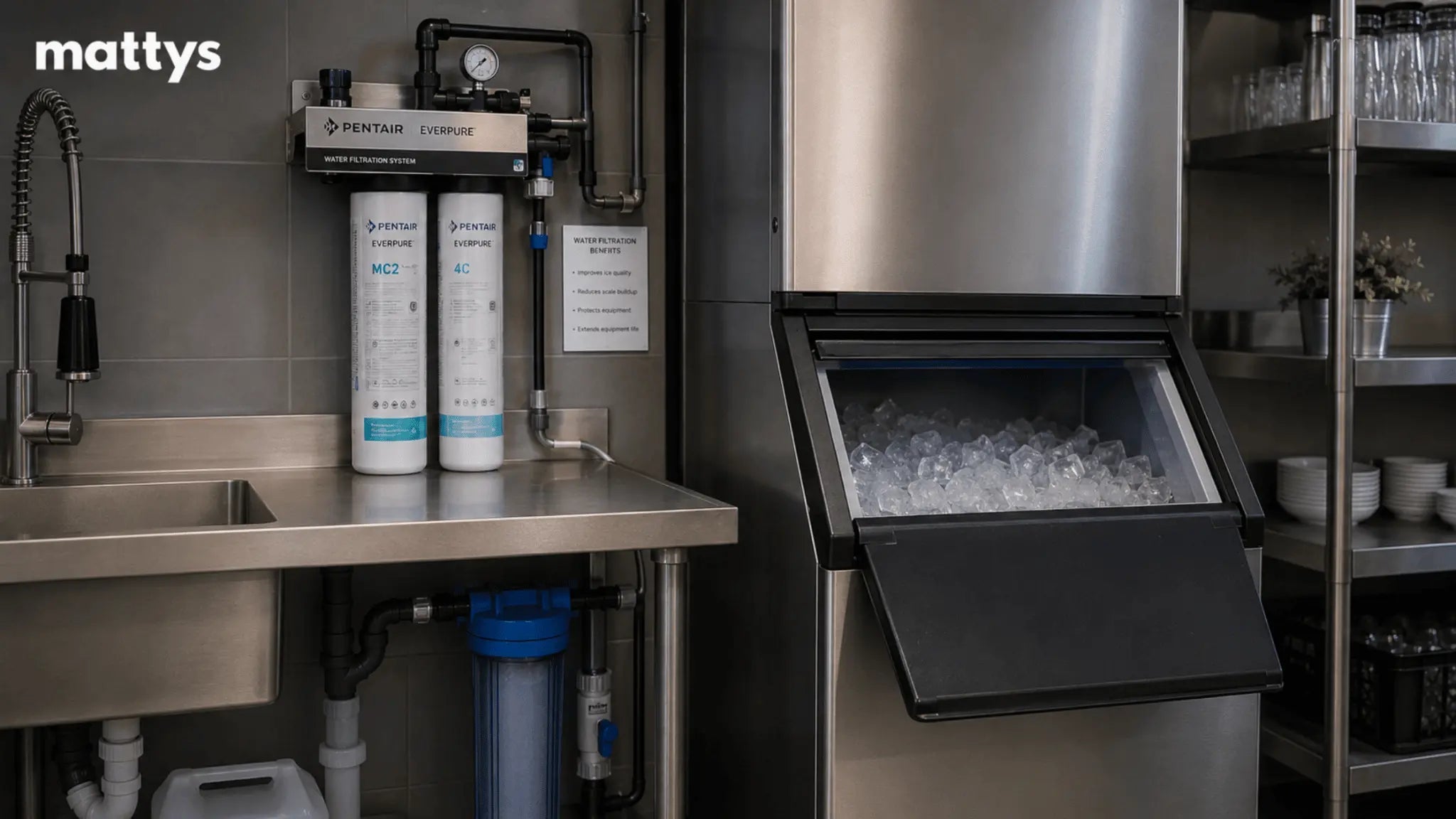
The $350 Decision That Protects a $10,000 Investment
There is one accessory that we recommend on every single commercial ice machine sale, without exception. It costs $300–$600. It adds 3–5 years to the machine's operating life. It protects the manufacturer warranty. And it's the most commonly skipped item in a kitchen fitout budget.
Water filtration.
After fitting out 10,000+ commercial kitchens across Australia, the pattern is consistent: the ice machines that fail early, scale up in 18 months, or lose production performance ahead of schedule are almost always machines running on unfiltered mains water. The ones that run cleanly for 12–15 years are almost always on a properly specified filtration system.
This guide covers exactly what filtration you need, why it matters specifically for Australian conditions, and what's different about the water in your state.
For the full purchasing context, start with the complete commercial ice machine buyer's guide.
Why Water Filtration Matters So Much for Ice Machines

An ice machine passes enormous volumes of water through an evaporator — a precision-engineered heat exchange surface where water freezes in controlled cells or on a drum. The water that goes in contains minerals. When water freezes, those minerals are left behind as deposits on the evaporator surface.
This process is called scale formation, and it's the primary cause of premature commercial ice machine failure in Australia.
What Scale Does to Your Machine
As mineral scale accumulates on the evaporator surface, it acts as an insulating layer between the refrigerant and the water. Heat transfer efficiency drops. The refrigeration cycle takes longer to freeze each batch. The machine produces less ice per hour, runs longer to compensate, and puts additional load on the compressor.
Left unchecked, scale buildup:
- Reduces ice production by 20–40% over 12–18 months in high-mineral water areas
- Increases energy consumption by 10–30% as the compressor works harder
- Causes premature compressor failure as the unit runs at elevated pressure
- Creates uneven ice formation, leading to smaller, misshapen cubes
- Requires expensive descaling services or, in severe cases, evaporator replacement
Beyond Scale: The Other Water Quality Issues
Chlorine and chloramines are used to disinfect Australian town water supplies. At the concentrations typically present in mains water (0.5–1.5 mg/L), they're safe for human consumption but affect ice taste and odour. Ice made from chlorinated water has a detectable off-taste that is particularly noticeable in premium beverages. A carbon block filter stage removes chlorine and chloramines, producing clean, neutral-tasting ice.
Sediment and particulates in mains water — rust particles, sand, or debris from aging pipes — can cause mechanical wear in the ice machine's water inlet valve, float valve, and pump. A sediment pre-filter catches these particles before they reach the machine.
Bacteria and biological contaminants are not typically a concern in treated Australian town water, but can become a factor in rainwater, bore water, or water from aging infrastructure. If your venue uses any non-town water source, discuss water treatment requirements with a qualified technician.
Australian Water Quality by State: What You're Dealing With

Water hardness (measured in milligrams per litre of calcium carbonate, or mg/L CaCO₃) varies significantly across Australia. This directly affects how aggressive scale formation will be in your ice machine and how frequently filtration cartridges need replacing.
| State / City | Water Hardness (Approx.) | Scale Risk | Recommended Filtration Cycle |
|---|---|---|---|
| Sydney (metro) | 50–80 mg/L (moderately soft) | Moderate | Standard 6-month cartridge cycle |
| Melbourne (metro) | 10–40 mg/L (soft) | Low-moderate | Standard 6-month cartridge cycle |
| Brisbane (metro) | 100–130 mg/L (moderately hard) | Moderate-high | 6-month cartridge cycle; monitor scale |
| Perth (metro) | 120–200 mg/L (hard) | High | 4–6 month cartridge cycle; consider water softener |
| Adelaide (metro) | 130–170 mg/L (hard) | High | 4–6 month cartridge cycle |
| Darwin | 10–30 mg/L (soft) | Low | Standard 6-month cycle |
| Hobart | 5–15 mg/L (very soft) | Low | Standard 6-month cycle |
| Regional/inland (QLD, WA, NSW, SA) | 200–400+ mg/L | Very high | Consult a water treatment specialist |
"We have clients in regional Western Australia and inland Queensland running on bore water or high-mineral town supply where scale builds up visibly within 3 months on an unfiltered machine. For these operators, a proper water softener — not just a scale inhibitor cartridge — is often the right answer. If you're outside a major city, tell us your location and we'll find out what the local water chemistry looks like before we spec your filtration."
— Mathew Hanna, Founder
Coastal Venues and Salt Air
Salt air doesn't affect water quality directly (unless you're on tank or rainwater supply), but it does accelerate corrosion on metal components outside the machine — connections, fittings, and the condenser coil if it's exposed. For coastal venues, specify machines with stainless or coated external components where possible, and ensure outdoor condenser placements are protected from direct sea spray.
What Filtration Stages You Actually Need

A properly specified filtration system for an Australian commercial ice machine typically has three stages. Each addresses a different water quality issue.
Stage 1: Sediment Pre-Filter (5–20 Micron)
What it does: Removes suspended particles — rust, sand, debris — from the incoming water supply.
Why you need it: Particles as small as 20 microns can cause wear in the ice machine's water inlet valve and float valve. They can also discolour ice or cause intermittent valve failures. A sediment pre-filter is the first line of defence and the cheapest cartridge in the system.
Filter life: 6 months under normal conditions; may need more frequent replacement if visible sediment is present.
Stage 2: Scale Inhibitor or Water Softener
What it does: Addresses mineral hardness. There are two common approaches:
- Polyphosphate scale inhibitor: Releases small amounts of polyphosphate into the water supply, which coats mineral crystals and prevents them from adhering to metal surfaces as scale. This doesn't remove minerals — it changes their physical behaviour so they don't deposit as hard scale. Effective in low-to-moderate hardness water (up to approximately 150 mg/L CaCO₃).
- Ion exchange water softener: Replaces calcium and magnesium ions with sodium ions, effectively removing hardness from the water. More effective for high-hardness water (150+ mg/L). Requires periodic regeneration with salt (for whole-venue softeners) or cartridge replacement (for inline units).
For most Australian metro venues, a polyphosphate scale inhibitor cartridge is adequate. For high-hardness areas (Perth, Adelaide, regional inland), an ion exchange softener may be the more cost-effective long-term solution — confirm with our team based on your specific water supply.
Stage 3: Carbon Block Filter (Taste and Odour)
What it does: Removes chlorine, chloramines, and volatile organic compounds from the water supply, producing clean, neutral-tasting water.
Why you need it: Chlorine and chloramines in Australian mains water are detectable in ice, particularly when ice is used in premium beverages. A carbon block filter stage produces ice that tastes clean and doesn't impart any chemical off-notes to drinks.
Filter life: 6 months under normal conditions. Carbon blocks become saturated over time and lose effectiveness — replacement at the specified interval is important for ongoing ice quality.
Putting It Together: Recommended Filtration Setup

Standard Australian Café or Bar (Soft-Moderate Water: Melbourne, Sydney, Darwin, Hobart)
- 5-micron sediment pre-filter
- Scale inhibitor cartridge (polyphosphate)
- Carbon block taste/odour filter
- Budget: $300–$450 for the housing and initial cartridges
- Annual cartridge replacement cost: $150–$250
High-Hardness Venue (Perth, Adelaide, Regional QLD/WA/SA/NSW)
- 5-micron sediment pre-filter
- Scale inhibitor cartridge or inline ion exchange softener
- Carbon block taste/odour filter
- Budget: $400–$700 for housing and initial cartridges
- Annual cartridge replacement cost: $200–$400 (more frequent replacement in very hard water)
Venues With Very High Hardness or Bore Water Supply
Consult a water treatment specialist or talk to our team. A whole-venue water softener may be more cost-effective than repeatedly replacing inline cartridges. This is a separate installation to the ice machine filtration and serves the whole kitchen.
Installation Basics

Water filtration for a commercial ice machine is typically installed inline on the cold water supply line to the machine, prior to the machine's water inlet valve. Installation is a plumbing task — it should be done by a licensed plumber as part of the machine installation to ensure compliance with AS/NZS 3500 plumbing standards.
Key installation considerations:
- The filter housing should be accessible for cartridge replacement without moving the machine
- Install a shut-off valve upstream of the filter housing to allow cartridge changes without interrupting the water supply to the kitchen
- Label the housing with the installation date and next replacement date
- If installing multiple filter stages, the correct order is: sediment first → scale inhibitor/softener → carbon block last
Maintenance Schedule
| Task | Frequency |
|---|---|
| Replace sediment pre-filter cartridge | Every 6 months |
| Replace scale inhibitor cartridge | Every 6 months (every 4 months in high-hardness areas) |
| Replace carbon block cartridge | Every 6 months |
| Inspect filter housing O-rings and seals | Annually at professional service |
| Test water hardness post-filter | Annually or if scale is observed |
Set a recurring calendar reminder for filter changes — this is the most commonly missed maintenance task, and running an expired carbon or scale inhibitor cartridge provides no protection to the machine.
The Warranty Angle: Why Filtration Isn't Optional

Most commercial ice machine manufacturers — Hoshizaki, Scotsman, Bromic — specify water filtration as a requirement for warranty coverage. The specific language varies by brand and model, but the general principle is consistent: if the machine's evaporator fails due to scale damage caused by untreated water, the manufacturer will not cover the repair under warranty.
This is a legitimate position — scale formation is entirely preventable with appropriate filtration, and the evaporator is an expensive component. A warranty claim on a scaled evaporator that was running on unfiltered mains water is unlikely to succeed.
In practical terms: buying a $7,000 Hoshizaki undercounter and skipping the $350 filtration system means your warranty protection on the most expensive internal component is potentially void. The maths makes the filtration an obvious inclusion.
Frequently Asked Questions
Do I really need a water filter on a commercial ice machine in Australia?
Yes. Every commercial ice machine in Australia should have water filtration. The level of filtration required depends on your water supply hardness and quality, but at minimum a sediment pre-filter, scale inhibitor, and carbon block are recommended for all venues on town water supply.
What's the difference between a scale inhibitor and a water softener?
A scale inhibitor (typically polyphosphate-based) coats mineral particles to prevent them depositing as scale, but doesn't remove minerals from the water. A water softener uses ion exchange to remove calcium and magnesium from the water, replacing them with sodium. Softeners are more effective in high-hardness water but require ongoing cartridge replacement or salt regeneration. For most Australian metro venues, a scale inhibitor is adequate.
How do I know if my water is hard?
Your water utility publishes water quality data including hardness on their website. Alternatively, basic water hardness test strips are available from plumbing suppliers. For venues outside a major city water supply zone, a water test from a qualified laboratory is worth doing before specifying filtration.
Can I install the filtration myself?
The filter housing and cartridges can be sourced and supplied by Mattys or your ice machine supplier. Installation on the water supply line should be done by a licensed plumber to comply with AS/NZS 3500. DIY plumbing connections on commercial food equipment create potential compliance issues.
What happens if I forget to replace the filter cartridges?
An expired sediment filter may allow particles through to the machine's water valves, causing wear or valve failure. An expired scale inhibitor provides no protection against mineral scale — the evaporator begins scaling immediately. An expired carbon block loses its chlorine and chloramine removal capability, and ice quality degrades. Replace at the specified intervals.
Protect Your Machine From the Inside Out
Water filtration is the lowest-cost, highest-impact maintenance decision you can make for a commercial ice machine. It protects the warranty, extends the machine life, improves ice quality, and costs a fraction of a single emergency service call.
At Mattys, we specify the right filtration system for your water supply and location, and supply everything needed at the time of machine purchase. It's not an afterthought — it's part of the spec.
Return to the full buying guide: Commercial Ice Machines: The Complete Australian Buyer's Guide 2026
Talk to Mattys About Water Filtration for Your Venue
📞 Call us: 1300 628 897
🛒 Browse filtration products
Share:
The Right Commercial Ice Machine for Your Venue Type: A Practical Australian Guide
Winnie’s Sydney: Mattys Helps Deliver Phase One of the Opera Bar Transformation