

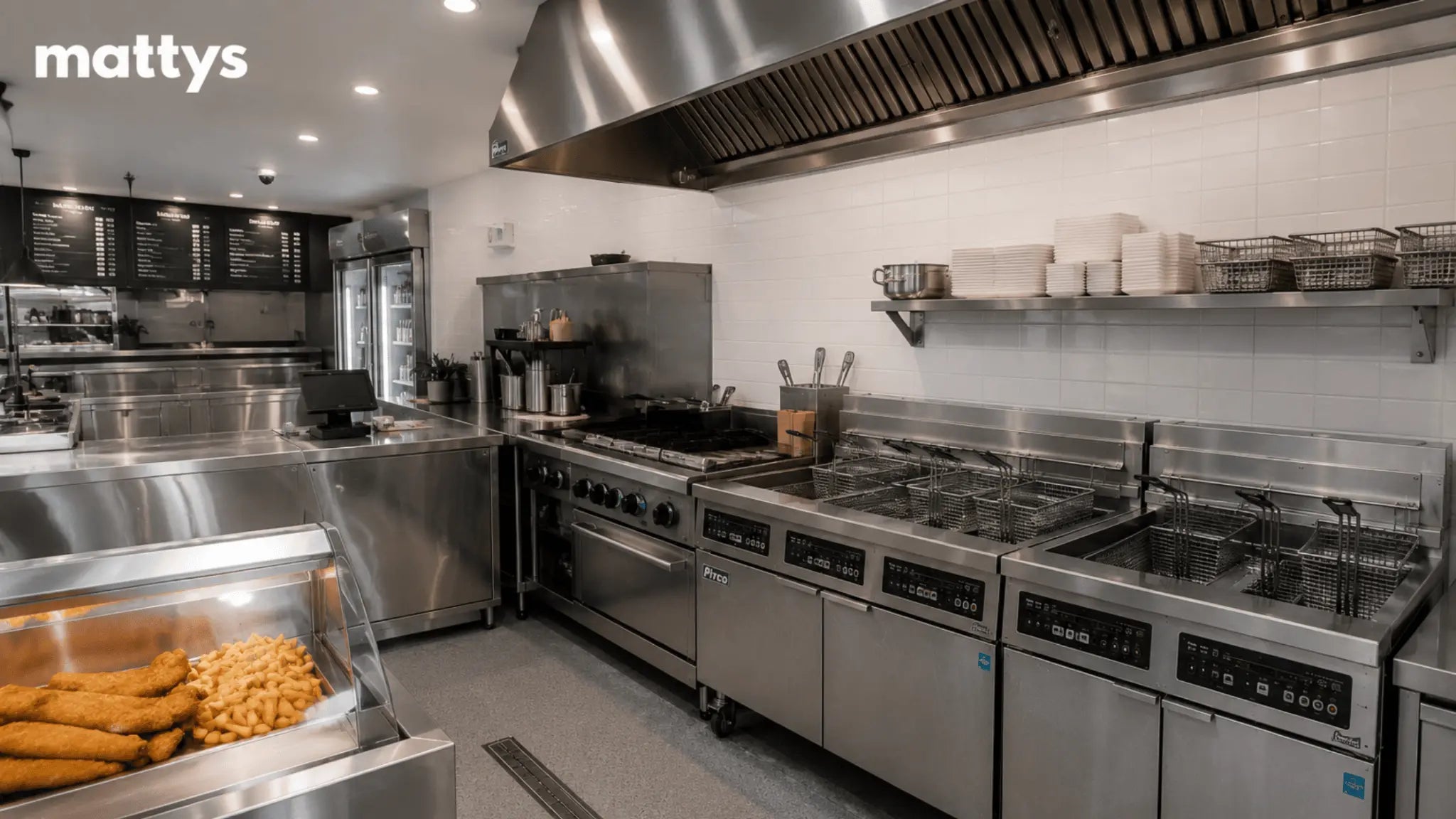
Australia's Most Loved Takeaway Needs the Right Equipment Behind It

Fish and chips is Australia's unofficial national dish. From beachside shops in Byron Bay to suburban takeaways in Melbourne's west, the formula is simple: fresh seafood, golden batter, crispy chips, and fast service. But behind that simplicity is a kitchen that needs to push 30–50kg of fried product per hour during a Friday rush, maintain oil quality across 300+ serves, keep battered fish at food-safe temperature in the display, and do it all without burning through your margins.
After fitting out 10,000+ commercial kitchens across Australia — including dozens of fish-and-chip operations from Darwin to Hobart — I've learned that the equipment spec makes or breaks this type of business. The fryer is the heart, but the bain-marie, display case, prep bench, and exhaust system are what keep the whole operation running.
This guide gives you the complete equipment list, the specification logic, real Australian costs, and the mistakes I've watched fish-and-chip operators make that cost them thousands.
Why Fish & Chip Shop Equipment Is Different

A fish-and-chip operation has unique demands that separate it from a restaurant or cafe:
Continuous high-volume frying. Unlike a restaurant where frying happens in bursts, a busy fish-and-chip shop fries continuously for 4–6 hours during peak service. Your fryer needs to hold temperature through sustained, heavy use — not just occasional basket drops.
Battered product dominance. Batter sheds debris into the oil at a much higher rate than crumbed or naked product. This means faster oil degradation, more frequent filtration, and a fryer type (open pot) specifically designed to handle sediment without burning it.
Display holding. Customers expect to see product in the display and take it home immediately. Battered fish and chips need to hold at 60°C+ (FSANZ requirement) without going soggy. The display/bain-marie specification is as important as the fryer specification.
Speed is revenue. A fish-and-chip shop's revenue per hour is directly proportional to throughput speed. Every minute of fryer recovery delay, every queue bottleneck at the counter, every temperature drop in the display costs you customers — especially during the Friday 6pm–7pm rush.
→ Browse our commercial fryer range
The Complete Equipment List
Tier 1: Essential Equipment (Must Have Before Opening)
| Equipment | Specification | AUD Budget (2026) |
|---|---|---|
| Primary fryer (floor, twin tank, gas) | 2 × 20–25L open pot, built-in filtration | $10,000–$18,000 |
| Secondary fryer (for chips only, high volume) | 1 × 20–25L floor, gas or electric | $5,000–$10,000 |
| Bain-marie / hot display | 4–6 pan capacity, thermostatically controlled | $3,000–$6,000 |
| Heated display cabinet | Glass front, 3–4 tier, fan-forced | $4,000–$8,000 |
| Prep bench (stainless, 1.8–2.4m) | Grade 304, with undershelf | $2,500–$4,500 |
| Commercial fridge (reach-in, double door) | MEPS compliant, 1,000–1,400L | $7,000–$11,000 |
| Exhaust / ventilation | Sized for fryer bank heat output | $4,000–$10,000 |
| Grease trap | Sized per council requirement | $1,500–$3,500 |
| Handwash basin | FSANZ compliant, knee-operated | $500–$800 |
| Fire suppression | Wet chemical, Class F, covers fryer bank | $2,500–$5,000 |
| Tier 1 total | $40,000–$76,800 |
Tier 2: High Priority (First Month)
| Equipment | Specification | AUD Budget |
|---|---|---|
| Undercounter fridge (prep station) | Under batter station, 200–350L | $3,500–$5,500 |
| Chest freezer | Bulk frozen stock (fish, chips, seafood) | $1,500–$3,000 |
| Batter station (dedicated bench with trays) | Stainless, with flour/batter trays | $1,500–$3,000 |
| POS system | Touchscreen, kitchen display integration | $2,000–$4,000 |
| Tier 2 total | $8,500–$15,500 |
Tier 3: Optimisation (Month 2–3)
| Equipment | Specification | AUD Budget |
|---|---|---|
| Chip warmer / dump station | Keeps chips hot between fryer and display | $1,000–$2,500 |
| Oil filtration cart (if fryers lack built-in) | Portable, 15–20L capacity | $800–$2,000 |
| Potato chipper (manual or electric) | For fresh-cut chips | $500–$2,500 |
| Packaging station | Bench with paper, containers, bags within reach | $800–$1,500 |
| Tier 3 total | $3,100–$8,500 |
Total Fitout Budget Range
| Scenario | Equipment Total | Installation | Grand Total |
|---|---|---|---|
| Lean fitout (essentials only) | $48,500 | $15,000–$25,000 | $63,500–$73,500 |
| Standard fitout (Tier 1 + 2) | $60,000 | $18,000–$30,000 | $78,000–$90,000 |
| Premium fitout (all tiers) | $72,000 | $20,000–$35,000 | $92,000–$107,000 |
Specifying the Fryer Bank: The Heart of the Operation

Why You Need Multiple Fryers
A single fryer — even a large one — creates a single point of failure and a production bottleneck. If it breaks during Friday service, your business stops. Two or three fryers provide redundancy (if one fails, you continue at reduced capacity), product separation (fish in one fryer, chips in another), and volume flexibility (run one during quiet periods, all three during the Friday rush).
Recommended Fryer Bank Configuration
Small shop (150–200 serves/day): 2 × 20L open pot gas fryers (1 fish, 1 chips). Budget: $10,000–$18,000.
Medium shop (200–350 serves/day): 2 × 25L open pot gas fryers (1 fish, 1 chips) + 1 × 15L for specialty items. Budget: $16,000–$26,000.
High-volume shop (350+ serves/day): 3 × 25–30L open pot gas fryers + dedicated chip fryer. Budget: $22,000–$36,000.
Why Open Pot for Fish & Chips
Battered fish sheds significant debris into the oil — loose batter, flour, protein fragments. In an open pot fryer, this debris sinks to a cool zone below the heating area where it doesn't carbonise or contaminate the cooking oil. In a tube fryer, debris lodges around the tubes, carbonises, and degrades the oil rapidly.
Our firm recommendation: Open pot for any operation where battered products are the primary output. Tube fryers are excellent for chips-only tanks (no batter debris), but the fish tank should always be open pot.
The Hot Display: Where Revenue Meets Food Safety

Why Display Specification Matters
Customers buy what they see. A well-stocked, well-lit display sells 20–30% more than a bare counter where everything is cooked to order. But the display must maintain food at 60°C+ (FSANZ requirement) without drying out the batter or turning chips soggy.
Display Types
Bain-marie (wet heat): Uses water to generate steam that keeps food warm. Excellent for holding chips and some proteins. Risk: excess moisture can soften batter on fish. Best for chips, potato cakes, and dim sims.
Heated display cabinet (dry heat, fan-forced): Circulates warm, dry air around product displayed on shelves. Better for battered fish because it maintains crispness. Glass front showcases product to customers.
Combination approach: Most successful fish-and-chip shops use both — bain-marie for chips and hot sides, heated display cabinet for battered fish and crumbed items. This combination optimises both product quality and customer appeal.
Display Sizing
Rule of thumb: 1 bain-marie pan per 30 serves per hour during peak. If you're pushing 150 serves/hour on a Friday, you need 5 pans of bain-marie capacity.
Display cabinet: 3–4 tier for a medium shop. Each tier holds approximately 8–12 pieces of battered fish. Ensure the cabinet maintains 60°C+ throughout — check with a probe thermometer at different shelf levels.
Customer Story: Cronulla Fish & Chips — From Struggling to $15K/Week
The situation: A new fish-and-chip shop in Cronulla, Sydney, opened with minimal equipment: one twin-tank benchtop fryer (2 × 8L), a basic bain-marie, and a domestic fridge.
The problem: The benchtop fryer couldn't keep up with Friday demand. Oil temperature crashed with every batch. Chips came out greasy. Fish batter was inconsistent. The domestic fridge couldn't hold enough stock for a busy weekend. By week 4, the owner was considering closing.
What we did — complete re-specification:
- Replaced benchtop with 2 × 20L open-pot gas floor fryers (built-in filtration): $16,000
- Added a heated display cabinet (4-tier, fan-forced): $5,500
- Upgraded to commercial double-door reach-in fridge: $9,200
- Installed proper exhaust ventilation: $6,500
- Total investment: $37,200
The result: Peak throughput jumped from 15 serves/hour to 60 serves/hour. Oil lasts 7 days instead of 2. The heated display sells product faster because customers see it and buy. Revenue went from $4,000/week (struggling) to $15,000/week (profitable). Investment payback: 4 months.
"The first setup was a disaster. Mattys rebuilt the kitchen properly and the business turned around in a month. The equipment is the business — I should have specified it right from day one."
— Owner, Cronulla
Australian Compliance for Fish & Chip Shops

Food Safety (FSANZ / State Regulations)
- Hot holding: All displayed food must be maintained at 60°C or above
- Cold storage: Raw fish and seafood must be stored at 0–5°C
- 2/4-hour rule: Food between 5°C and 60°C for more than 4 hours must be discarded
- Oil quality: TPM should not exceed 24% (monitored with test strips)
- Allergen management: Seafood allergies must be declared; separate frying tanks help manage cross-contamination
Building & Council
- Development Application or Complying Development Certificate for commercial food premises
- Council health inspection before opening (and ongoing)
- Grease trap — mandatory in most Australian councils for commercial kitchens with fryers
- Fire suppression — wet chemical system covering the fryer bank (Class F rated)
- Ventilation — exhaust hood sized for total heat output of all cooking equipment
Gas Compliance
- AGA certification on all gas fryers
- Licensed gas fitter for installation (AS/NZS 5601)
- Annual gas safety inspection recommended
Mistakes to Avoid
Mistake 1: Starting with benchtop fryers to "test the market"
If your business plan says fish and chips, your fryer needs to be floor-standing from day one. A benchtop fryer in a fish-and-chip shop is like a bicycle in a delivery fleet — technically functional, practically useless at volume.
Mistake 2: Skipping the heated display cabinet
Customers buy what they see. An empty counter with a "cooked to order" sign loses 20–30% of impulse purchases. Invest in display — it directly drives revenue.
Mistake 3: Using one fryer tank for fish AND chips
Cross-flavour transfer produces fishy chips. Customers may not complain — they just don't come back. Twin tanks minimum. Fish and chips must be fried separately.
Mistake 4: Not budgeting for ventilation and grease trap
These are council requirements, not optional extras. Budget $5,500–$13,500 for ventilation + grease trap before you sign the lease.
FAQ
Q: How much does it cost to open a fish and chip shop in Australia?
Equipment: $48,500–$107,000. Installation: $15,000–$35,000. Fit-out (counters, flooring, signage): $20,000–$50,000. Total: $83,500–$192,000 depending on size and quality. The equipment is your largest single investment.
Q: Should I use fresh or frozen fish?
Both work commercially. Fresh fish delivers a premium product but requires daily sourcing and careful cold-chain management. Frozen fish is more consistent, easier to manage, and reduces waste. Most successful Australian fish-and-chip shops use a mix — fresh for premium fillets, frozen for standard battered fish.
Q: How much oil does a fish and chip shop use per week?
A medium shop (250 serves/day) with twin 20L fryers and daily filtration uses approximately 40–60L of oil per week across all tanks. At $4.50/L, that's $180–$270/week in oil costs. Without filtration, oil use increases 40–50%.
Q: Do I need separate ventilation for each fryer?
Not necessarily separate systems, but your single exhaust hood must be sized for the combined heat output of all fryers plus any other cooking equipment. Undersized ventilation creates smoke, grease buildup, and council compliance issues.
Q: What's the most profitable menu addition beyond fish and chips?
Based on what we see across our customer base: potato cakes, dim sims, spring rolls, and calamari have the highest margins because they fry quickly, hold well in the display, and use inexpensive ingredients. Burgers and grilled items diversify the menu but require additional equipment (flat grill, bun warmer).
Ready to Fit Out Your Fish & Chip Shop?
📞 Call us: 1300 628 897 — tell us your location, your size, and your budget. We'll build the complete equipment list.
🛒 Browse: Commercial fryers | Bain-marie | Commercial refrigeration | Stainless steel benches
Share:
Pitco vs Frymaster vs Blue Seal: Which Fryer Brand Suits Your Australian Kitchen?
Commercial Deep Fryers: The Complete Australian Buyer's Guide (2026)