

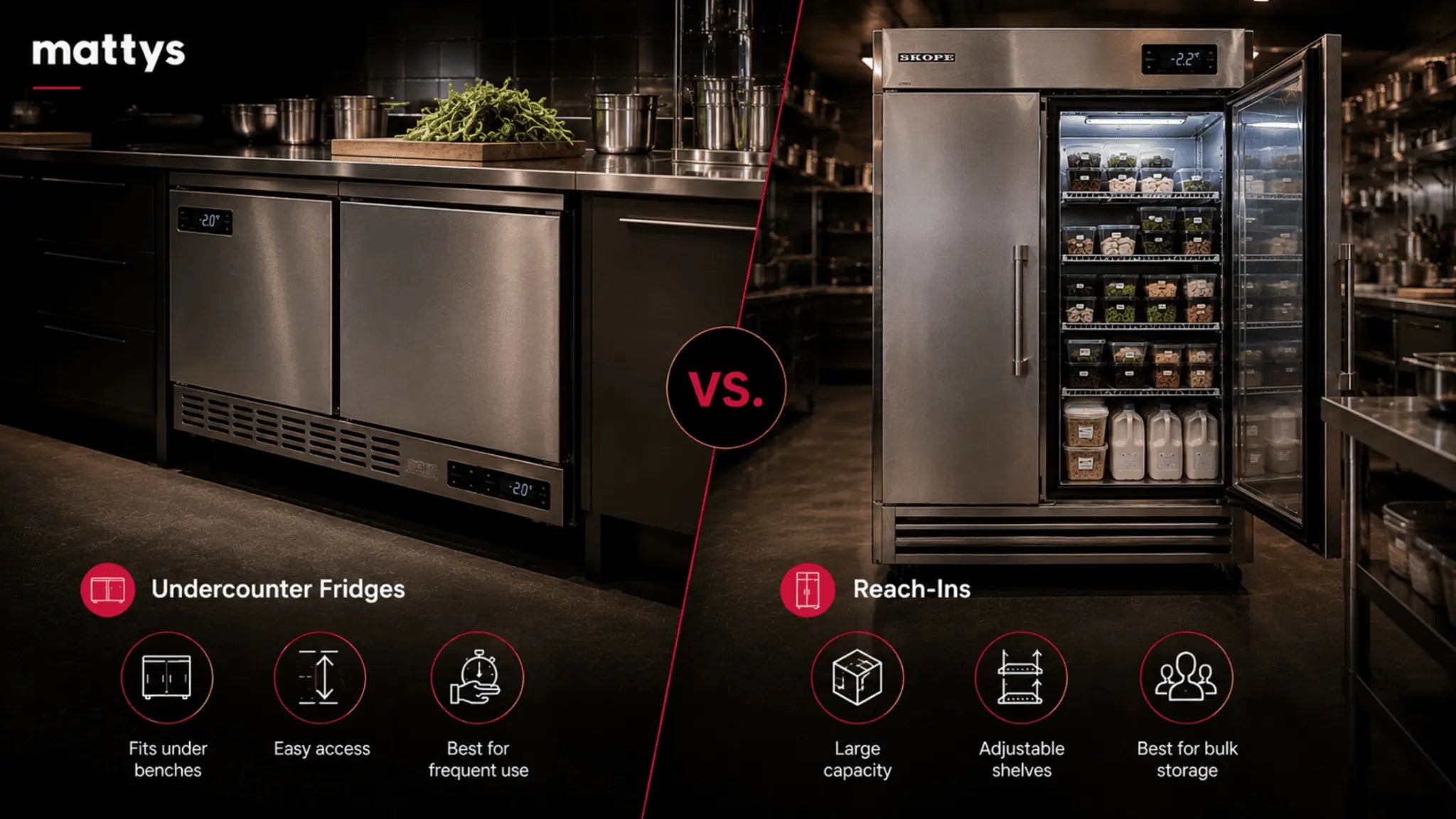
The $4,000 Question Every Kitchen Operator Asks
Looking for the full picture? Read our complete Commercial Refrigeration Buying Guide.
"Should I buy undercounters for every station, or one big reach-in for the whole kitchen?"
I hear this question at least three times a week. And there's no universal right answer — it depends on your floor space, your covers, your menu complexity, and how your kitchen actually flows during service. But I can tell you this: operators who get this wrong spend an extra $4,000–$8,000 over three years fixing the consequences.
After fitting out 10,000+ commercial kitchens across Australia, I've seen every possible combination of undercounter and reach-in setups. Some work brilliantly. Others create bottlenecks that cost operators thousands in lost efficiency. This guide breaks down exactly when to use each, when to combine them, and the specific scenarios where one clearly beats the other.
What this guide covers: Capacity comparison, workflow analysis, cost breakdown (AUD 2026), space requirements, and the hybrid approach that works for most Australian kitchens.
Why This Decision Shapes Your Entire Kitchen Workflow
Refrigeration placement determines how fast your kitchen moves. It's not about cold storage — it's about whether your staff can grab what they need in two seconds or twenty.
Place an undercounter at the prep station and your cook reaches down, grabs what they need, and never leaves the line. Place a reach-in six metres away and that same cook walks 12 metres return trip, opens a shared door, finds their item, walks back, and picks up where they left off. Multiply that by 80 trips per shift and you've lost 40 minutes of productive time.
Conversely, scatter undercounters everywhere and you've got five small fridges running five compressors consuming five times the energy of one well-placed reach-in. Your power bill doubles. Your maintenance schedule quintuples.
The right answer is almost always a combination — but the ratio matters enormously.
Undercounter Fridges: What They Do Best

The Strengths
- Point-of-use access: An undercounter sits directly beneath your workstation. During service, everything you need is within arm's reach without leaving your station. For a pizza chef, that means dough balls, mozzarella, and toppings are all 30cm below the bench. For a barista, milk is right under the coffee machine.
- Space efficiency: Undercounters occupy dead space — the 850mm beneath your bench that would otherwise hold nothing. In a 20sqm kitchen (typical Melbourne cafe), floor space is currency. Undercounters spend none of it.
- Station independence: Each workstation controls its own cold chain. The garde manger station doesn't compete with the grill station for fridge access. No cross-contamination risk from shared storage. No traffic jams.
The Limitations
- Small capacity: A standard undercounter holds 200–350 litres. Compare that to a single-door reach-in at 500–700 litres or a double-door at 900–1,400 litres. If you need serious volume, undercounters alone won't cut it.
- Higher energy per litre: Running three undercounters (3 × 250L = 750L total) costs more in energy than one double-door reach-in (1,000L) because you're powering three separate compressors instead of one. Typical penalty: 25–40% more energy for equivalent storage.
- More maintenance points: Three undercounters mean three gasket sets, three compressors, three annual service visits. More moving parts equals more potential failure points.
Best Suited For
- Small cafes (30–50 covers) with tight floor plans
- Dedicated prep stations in larger kitchens (supplementary, not primary)
- Pizza, sushi, or sandwich bars where point-of-use access is critical
- Under-bench mise en place storage during service
AUD pricing (2026): $3,200–$5,500 per unit (single-door); $5,200–$8,500 (double-door)
Reach-In Fridges: What They Do Best

The Strengths
- Massive capacity: A double-door reach-in holds 900–1,400 litres — equivalent to four undercounters. For bulk delivery storage, overnight prep holding, and multi-station supply, nothing beats a reach-in.
- Energy efficiency per litre: One compressor running one large cabinet is inherently more efficient than multiple small units. A double-door reach-in typically costs $35–$45/week to run. Three undercounters providing similar capacity cost $55–$70/week.
- Organisation at scale: Adjustable shelving across 1,000+ litres means you can dedicate sections: proteins top shelf, dairy middle, veg and prep bottom. Label the zones. Train the team once. Everything has a place.
- Fewer maintenance headaches: One unit, one compressor, one gasket set, one annual service. Simpler is cheaper and more reliable.
The Limitations
- Floor space: A double-door reach-in occupies roughly 1,400mm × 850mm of floor space. In a tiny kitchen, that's significant real estate.
- Shared access: Everyone uses the same fridge. During Friday service, three staff reaching into the same unit creates a bottleneck. Doors stay open longer. Temperature recovery suffers. Efficiency drops.
- Walking distance: If the reach-in is across the kitchen from the cooking line, staff lose time on every trip. Over a shift, those 20-second walks add up to 30–40 minutes of lost productivity.
Best Suited For
- Medium-to-large kitchens (80+ covers)
- Bulk storage and delivery intake
- Overnight holding of prepped items
- Central cold storage supplemented by undercounters at stations
AUD pricing (2026): $7,200–$11,000 (double-door); $10,500–$16,000 (triple-door)
The Head-to-Head Comparison
|
Factor |
Undercounter |
Reach-In |
Winner |
|
Capacity |
200–350L per unit |
500–2,100L per unit |
Reach-In |
|
Floor space used |
Zero (uses dead space) |
750–2,000mm wide |
Undercounter |
|
Energy cost (per litre stored) |
Higher (multiple compressors) |
Lower (single compressor) |
Reach-In |
|
Point-of-use access |
Excellent (at the station) |
Poor (shared, distant) |
Undercounter |
|
Maintenance complexity |
Higher (multiple units) |
Lower (one unit) |
Reach-In |
|
Purchase cost (750L equivalent) |
$9,600–$16,500 (3 units) |
$7,200–$11,000 (1 double) |
Reach-In |
|
Staff workflow during service |
Independent stations |
Shared bottleneck risk |
Undercounter |
|
Organisation |
Limited per unit |
Extensive (zoned shelving) |
Reach-In |
|
Noise |
Multiple quiet units |
One louder unit |
Draw |
|
Installation complexity |
Simple (plug-in, slide under) |
Moderate (levelling, clearance) |
Undercounter |
Bottom line: Reach-ins win on cost, capacity, energy, and maintenance. Undercounters win on workflow, space, and station independence. Neither wins alone — the hybrid approach is almost always optimal.
The Hybrid Approach: What Actually Works
In our experience, the configuration that works for 70–80% of Australian commercial kitchens is:
One reach-in (double or triple-door) as primary storage — handles bulk delivery intake, overnight holding, and morning prep. This is where your main inventory lives.
Plus 1–3 undercounters at key workstations — holds the mise en place, service-ready items, and station-specific ingredients that need point-of-use access during service.
Example 1: 80-Cover Cafe (Surry Hills, Sydney)
- 1 × double-door reach-in (back of kitchen, bulk storage): $9,500
- 1 × undercounter (under coffee machine, milk/dairy): $4,200
- 1 × chef-base undercounter (under flat grill, proteins/sauces): $5,800
- Total: $19,500 | 1,650L combined capacity | Energy: ~$62/week
Example 2: 150-Cover Restaurant (South Yarra, Melbourne)
- 1 × triple-door reach-in (main kitchen, all categories): $14,000
- 2 × undercounters (garde manger station + dessert station): $8,400
- 1 × chef-base (under salamander, sauces/garnishes): $5,800
- Total: $28,200 | 2,600L combined capacity | Energy: ~$85/week
Example 3: 40-Cover Sandwich Bar (Fortitude Valley, Brisbane)
- 0 × reach-in (no space)
- 2 × undercounters (one each side of prep bench): $8,400
- 1 × display counter (customer-facing, pre-made items): $7,500
- Total: $15,900 | 850L combined capacity | Energy: ~$48/week
Budget Reality: Hybrid Configuration Costs (AUD, 2026)
|
Kitchen Size |
Recommended Config |
Purchase Cost |
Install Cost |
Weekly Energy |
5-Year Total |
|
Small (30–50 covers) |
2 undercounters |
$6,400–$11,000 |
$1,600–$3,000 |
$28–$38 |
$15,280–$23,880 |
|
Medium (60–100 covers) |
1 reach-in + 1–2 undercounters |
$14,400–$24,300 |
$2,500–$4,500 |
$50–$70 |
$30,900–$47,000 |
|
Large (100–200 covers) |
1 triple reach-in + 2–3 undercounters |
$23,700–$37,500 |
$3,500–$6,000 |
$75–$105 |
$46,700–$70,800 |
Customer Story: How a Melbourne Cafe Saved $6,200 by Switching Strategy
The situation: A cafe in Fitzroy was running four undercounters — one at each station. Total capacity: 1,100 litres across four units.
The problem: Four compressors running simultaneously pushed energy costs to $82/week. Two units were over 5 years old and needing repairs ($1,800/year combined). Staff were constantly reorganising between units because capacity per unit was too small for peak delivery days.
The solution: We replaced two of the four undercounters with one double-door reach-in for bulk storage. Kept two undercounters at the busiest stations (coffee and grill).
The result: Energy dropped to $55/week. Repair costs dropped to $400/year. Staff stopped shuffling stock between units. Total savings over 2 years: $6,200 — and the kitchen flows better.
"I thought more small fridges meant more access. Actually, it meant more problems. The hybrid setup is simpler and cheaper."
— Owner, Fitzroy cafe
Mistakes to Avoid
Mistake 1: All undercounters, no central storage
You end up with fragmented inventory, higher energy costs, and delivery-day chaos when nothing fits.
Mistake 2: One massive reach-in with no station-level access
Staff walk back and forth 80+ times per shift. Service slows. Frustration rises.
Mistake 3: Mismatching undercounter depth with benchtop depth
A 700mm-deep undercounter under a 600mm bench sticks out and creates a trip hazard. Measure before ordering. Always.
FAQ
Q: Can I use a chef-base as my only fridge?
A: Only if you're a very small operation (under 30 covers). Chef-bases typically hold 150–250 litres — enough for service-ready items, not bulk storage. Use them as supplements, not primaries.
Q: Do undercounters need the same GEMS compliance as reach-ins?
A: Yes. All commercial refrigeration sold in Australia must be GEMS-registered and MEPS-compliant. Check the GEMS registration number before purchasing any unit, regardless of size.
Q: How much floor space does the hybrid approach actually save?
A: Significant. Two undercounters + one double-door reach-in uses roughly 40% less total floor space than four separate reach-ins providing equivalent capacity.
Q: Which configuration is best for a food truck commissary?
A: One reach-in for bulk prep storage, plus one undercounter at the packing station. Food trucks need volume (reach-in) and speed (undercounter at the load-out area).
← Back to the Commercial Refrigeration Buying Guide
What to Do Next
The undercounter vs. reach-in question isn't either/or — it's both, in the right ratio. Map your kitchen. Count your covers. Identify where staff need cold access during service. Then spec the combination that puts storage where work happens, without wasting energy or money on redundant units.
📞 Call us: 1300 628 897 — we'll walk through your kitchen layout and recommend the right ratio.
🛒 Browse undercounter fridges here
🛒 Browse reach-in fridges here
Share:
Commercial Fridge Maintenance: How to Get 10+ Years From Your Equipment
Walk-In Cool Room Planning: Space, Capacity, Compliance & Costs for Australian Kitchens