

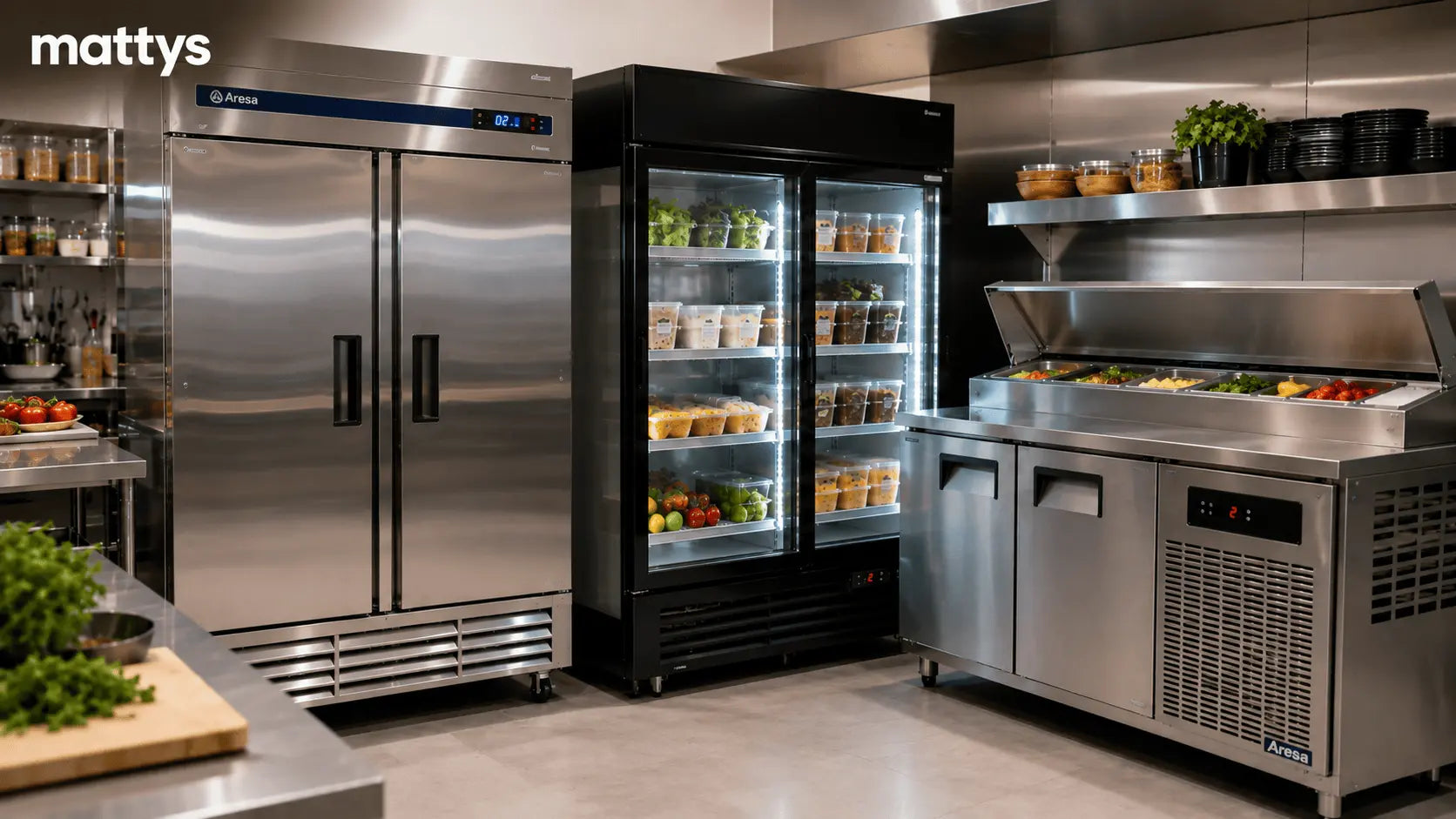
Introduction: Don't Make This $15K Mistake
You're standing in a half-fitted commercial kitchen with a $30,000 budget and a list of equipment that doesn't quite fit. The sales rep just told you an undercounter fridge would save $5,000 compared to a reach-in model. You nod and take notes. But you're wondering: will it actually hold what you need? Will it last five years or ten? Is it MEPS compliant? What does it cost to run?
After fitting out 10,000+ commercial kitchens across Australia, I've watched operators make expensive refrigeration mistakes that cost them thousands in wasted food, failed health inspections, and premature replacements. The wrong choice isn't just an inconvenience — it's a revenue leak, an operational headache, and a sign you didn't have the right advice at the table.
This guide covers exactly what you need to know: the types of commercial refrigeration that actually work in Australian kitchens, the cost reality (not the sales pitch), how to avoid the mistakes I've seen a hundred times, and the specific compliance rules that matter in 2026.
What this guide covers: Equipment types, capacity planning, energy efficiency standards, Australian compliance rules, real costs, and the decision framework that's worked for the thousands of operators Mattys has helped.
Why Commercial Refrigeration Matters More Than You Think

Most operators treat commercial refrigeration like it's a commodity purchase — click, buy, install. That's exactly where the problems start.
A commercial fridge isn't just a box that keeps food cold. It's a 24/7 operational backbone that either supports your service or sabotages it. Get the spec right, and it runs invisibly for 10 years. Get it wrong, and you're managing temperature swings during Friday lunch service, watching stock spoil, running failed council inspections, and calling the repair guy every month.
Here's what we've learned from 10,000+ fitouts: the operator who measured twice and specified once spends a fraction of what the operator who guessed ends up spending. Temperature control isn't glamorous, but it's foundational.
In Australia, it matters even more. Our climate varies wildly — Bondi's salt-air corrosion is nothing like Parramatta's inland heat. Our compliance standards (FSANZ, GEMS/MEPS) are strict and getting stricter. Energy costs are rising. If you choose a fridge that doesn't align with your climate zone, your compliance requirements, or your actual kitchen throughput, that decision echoes for a decade.
What most operators miss: They focus on upfront cost and ignore the total cost of ownership. A $12,000 fridge that lasts 4 years and costs $80/week to run is far more expensive than a $18,000 fridge that lasts 10 years and costs $35/week to run. The math is worth doing before you decide.
Understanding Commercial Refrigeration Types: What Actually Works

Not all commercial fridges are created equal. Let me walk through the types that matter and help you understand which one solves your specific problem.
Reach-In Refrigerators: The Workhorse
A reach-in is what you picture when you think "commercial fridge." Stainless steel doors, adjustable shelves, typically 600mm to 900mm wide, built for direct-line access during service. They come in single-, double-, triple-, and quad-door configurations.
When to choose this: You're a high-volume kitchen (100+ covers), you need organised cold storage for prep and service, and you want everything within arm's reach without disrupting workflow. Cafes, restaurants, and hotels live on reach-ins.
Why they work: Fast access, professional footprint, excellent for bulk storage. You can line three reach-ins in a kitchen and have distinct cold zones (proteins, dairy, veg prep) without walking 20 metres to get what you need.
The Australian edge: Reach-ins typically run cooler than display models and handle Australia's summer heat without losing temperature integrity. In a Sydney kitchen hitting 35°C, a quality reach-in with a bottom-mounted compressor stays stable.
Real-world example: A Bondi café running 80 covers per session chose a triple-door reach-in with undershelf storage. Three years in, they haven't replaced anything. Contrast that with a competitor down the street who bought a cheap undercounter model to save $4,000 — they're on their second replacement and spending more on repairs than they saved on purchase.
Read our complete guide: Commercial Reach-In Refrigerators: The Complete Australian Buyer's Guide
Undercounter & Chef-Base Refrigeration: The Space Savers
These slide under your cooking line, workbenches, or prep stations. Typical depths are 600mm–700mm, heights around 850mm–900mm. Chef-base models have a flat top for cooking equipment.
When to choose this: You're a cafe with limited floor space, you want cold access directly at the prep line (no back-and-forth), or you're fitting a tight kitchen.
Why they work: They don't consume floor space; they use dead space. Staff efficiency improves when cold storage is where work happens.
The limitation: Limited capacity. An undercounter holds maybe 250–350 litres, whereas a single-door reach-in holds 500–700 litres. If you're a high-volume kitchen, undercounter alone won't cut it. Use it alongside reach-ins.
Australian compliance note: Undercounter models must still meet GEMS/MEPS standards and climate-class requirements. Some cheaper imports don't — check GEMS registration before ordering.
Not sure which is right for your kitchen? Read our full Undercounter vs. Reach-In comparison guide
Upright Glass-Door Merchandisers: The Sales Engine
These are the display fridges with glass doors, backlit shelving, often with branding space for menu boards. They're beverage-focused but also work for yoghurt, pre-made salads, or any product you want to sell cold.
When to choose this: You're running a cafe, bar, or grab-and-go operation and want customers to see cold drinks or products and buy them without asking.
Why they work: Customers see, they buy. Simple. Also great for branding — many have customisable marquee panels where you can display your logo.
Real cost warning: Glass-door merchandisers are energy-hungry. Budget $50–80 per week to run, versus $30–45 for a solid-door reach-in of equivalent capacity.
Australian angle: If you're in a coastal venue (Byron Bay, Cairns, anywhere salt air reaches), you need a model with stainless steel frames and anti-corrosion handles. Cheap brass hardware will discolour within 18 months.
Walk-In Cool Rooms: The Bulk Solution
These are large rooms (2m × 3m and up) with modular insulated panels, usually custom-fitted to your space. They're the backbone of high-volume kitchens, supermarkets, and catering operations.
When to choose this: You're a hotel kitchen, a busy restaurant, or a central catering facility needing massive bulk storage. If you're fitting out a 200-seat restaurant, a walk-in is non-negotiable.
Why they work: You store 2,000+ litres instead of 500. Staff can walk in, select items, and refill without making six trips to a reach-in.
Australian-specific: Walk-in systems in Australia must be installed by licensed refrigeration contractors. Costs start around $15,000–$30,000 for a 2m × 3m basic unit, plus installation. They last 15–20 years if maintained.
Compliance: All new walk-in panels must comply with GEMS/MEPS and use low-GWP refrigerants (R290 or R744 standard from 2021 onwards).
Planning a walk-in? Read our detailed Walk-In Cool Room Planning Guide: sizing, compliance and real costs
Display & Service Counters: The Hybrid
These combine refrigeration with a stainless steel working surface — ideal for pizza prep, sandwich assembly, or scooping ice cream. Cold storage below, service counter above.
When to choose this: You're a pizza shop, gelato bar, or sandwich cafe where cold prep and customer-facing work overlap.
The catch: They're space-efficient but not high-capacity. If you need serious bulk storage, you'll add a reach-in elsewhere.
Budget Reality: What Commercial Refrigeration Actually Costs in Australia (2026)
Let me give you the real numbers. Not the MSRP, not the "call for quote" dodge — the actual prices Australian operators are paying for equipment, delivered and installed.
Equipment Purchase Costs (AUD, 2026)
| Equipment Type | Single Door | Double Door | Triple Door | Notes |
|---|---|---|---|---|
| Reach-In Refrigerator | $4,500–$7,200 | $7,200–$11,000 | $10,500–$16,000 | Premium brands (Rational, Bromic); mid-tier (SKOPE, Anvil) cheaper by 15–25% |
| Undercounter Fridge | $3,200–$5,500 | $5,200–$8,500 | — | Often specified with chef-base option (+$1,500) |
| Glass-Door Merchandiser | $3,000–$6,000 | $5,500–$10,000 | $9,000–$14,000 | Energy star rating affects price ±10% |
| Walk-In Cool Room (2m × 3m) | — | — | — | $15,000–$30,000 basic unit + $8,000–$15,000 installation |
| Display Counter/Service Fridge | $6,000–$10,000 | $10,000–$16,000 | — | Often custom-built; lead time 8–12 weeks |
Pricing notes:
- Premium brands: Rational, Bromic, SKOPE, Liebherr (5–10% cost premium, but 8–10 year lifespan)
- Mid-tier: Anvil, Polar, FED (standard quality, 6–8 year lifespan, 15–25% cheaper)
- Budget: Generic Asian imports (often 3–4 year lifespan, 30–40% cheaper but short warranty)
Installation & Delivery Costs
- Delivery (metro Sydney, Melbourne, Brisbane): $800–$2,000 depending on distance and equipment size
- Installation labour: $1,500–$3,500 (electrical connection, plumbing if required, levelling, shelving installation)
- Contingency (flooring prep, electrical rewiring): Budget $2,000–$5,000 if your space isn't pre-fitted
Energy Running Costs (Annual, 2026)
| Equipment | kWh per 24h | Weekly Cost @ 38¢/kWh | Annual Cost |
|---|---|---|---|
| Reach-In (Grade A rated) | 3.5–4.2 | $35–$42 | $1,820–$2,184 |
| Reach-In (older model, pre-2015) | 6.0–7.5 | $57–$72 | $2,964–$3,744 |
| Undercounter Fridge | 2.0–2.5 | $19–$24 | $988–$1,248 |
| Glass-Door Merchandiser | 4.5–6.0 | $43–$57 | $2,236–$2,964 |
| Walk-In Cool Room (20m³) | 8.0–12.0 | $76–$114 | $3,952–$5,928 |
Australian reality check: Electricity rates vary by state. NSW/VIC ~38¢/kWh (2026). Queensland ~32¢/kWh. WA ~40¢/kWh. Budget higher if you're on peak-rate commercial plans.
Want the full compliance picture? Read our MEPS Compliance & Energy Efficiency guide for Australian kitchens
Total Cost of Ownership: Five-Year Comparison
Option A: Budget Reach-In ($8,500 + install)
- Purchase + delivery + install: $12,000
- Energy (5 years): $14,730 (assuming 7 kWh/day)
- Repairs & maintenance: $2,500–$4,000
- Total 5-year cost: $29,230–$30,730
Option B: MEPS Grade-A Reach-In ($12,000 + install)
- Purchase + delivery + install: $16,500
- Energy (5 years): $9,100 (assuming 4.2 kWh/day)
- Repairs & maintenance: $800–$1,500
- Total 5-year cost: $26,400–$27,100
The winner: Option B costs $3,000 less over 5 years, despite being more expensive upfront. And it's likely to run another 5 years, whereas Option A might need replacement by year 5–6.
GEMS/MEPS Impact on Pricing
From May 2021 onwards, all commercial refrigeration sold in Australia must be registered under the GEMS scheme and meet Minimum Energy Performance Standards. This has eliminated the cheapest garbage-tier equipment but actually hasn't driven prices up — it's driven standardisation.
What this means for you: You can't buy a cheap undercounter fridge and hope it runs for years. It must meet a standard. That standard means better energy efficiency, longer lifespan, and more predictable running costs. The upfront price is a bit higher, but the long-term cost is lower.
Want the full compliance picture? Read our MEPS Compliance & Energy Efficiency guide for Australian kitchens
Customer Story: How a Bondi Cafe Got the Spec Right

The situation: A new 60-cover breakfast and lunch cafe opening on Campbell Parade, Bondi. Owner, Sarah (first time cafe operator), had $40,000 for all kitchen equipment including refrigeration. She was tempted by online quotes for undercounter fridges at $3,500 each.
The problem: Bondi is coastal, salt-air territory. The cafe would be high-volume (6am–4pm, back-to-back service). Sarah needed:
- Cold storage for 40+ kilograms of prep (eggs, bacon, dairy, veg, sauces)
- Access during morning prep without walking to the back
- Compliance with FSANZ temperature requirements
- Equipment that would survive salt air without corroding
What went wrong with the initial plan: Three undercounter fridges at $3,500 each = $10,500 for 1,050 litres of storage. But undercounters get hammered in a small cafe — staff opens them 50+ times per shift. In a coastal environment, cheap stainless steel hardware rusts.
What actually worked:
- One Bromic triple-door reach-in (Grade-A, coastal-rated hardware, stainless 304) = $14,000
- One SKOPE undercounter for plates and mise en place = $5,200
- Total: $19,200 (vs $10,500 initially budgeted, but 50% more capacity and infinitely better workflow)
The result: Three years in, Sarah's triple-door hasn't skipped a beat. No corrosion. Energy bills are $45/week instead of the $70+ she'd pay if she'd gone cheap. The hardware looks new. She's recommended Mattys to six other cafe owners on the same beachfront.
The lesson: Coastal location + high-volume + tight space = specification matters more than price. Saving $8,000 upfront would have cost her $500/month in extra energy plus $3,000 in premature replacement and repairs by year 3.
Mistakes to Avoid (What I've Seen Operators Do Wrong)

I've watched these mistakes play out a thousand times. They cost real money. Here's how to sidestep each one.
Mistake 1: Choosing by capacity alone and ignoring access
What happens: Operator specifies a double-door because it has 1,200 litres, but the kitchen layout puts it in a corner. During service, three staff need ingredients from the same fridge. It becomes a traffic jam. People wait. Service slows. Stress rises.
How to avoid it: Map your kitchen workflow first. Where does prep happen? Where's the cooking station? Where do you pack orders? Specify refrigeration at the point of work, not just based on volume. A reach-in in the right spot beats a walk-in in the wrong spot.
Mistake 2: Buying cheap in a coastal environment
What happens: Grade 201 or 304 stainless steel with brass hinges. Six months in, salt air corrodes the hinges, rusts door seals. By month 12, you're replacing hardware or buying a new fridge.
How to avoid it: If you're within 10km of the coast, specify Grade 316 stainless and stainless hardware. Yes, it costs 15–20% more. No, you're not wasting money.
See our full breakdown: Grade 304 vs 316 Stainless Steel — what the difference means for your kitchen
Mistake 3: Ignoring energy ratings and picking the cheapest option
What happens: $7,000 fridge uses 7.5 kWh/day. $10,000 Grade-A fridge uses 3.8 kWh/day. Owner feels smart about saving $3,000 upfront. By year 3, the cheaper fridge has cost $6,000 more in electricity alone. Plus, it's failing.
How to avoid it: Always calculate 5-year total cost of ownership, not just purchase price. A GEMS/MEPS Grade-A fridge will almost always win on total cost, even if it costs more upfront.
Mistake 4: Not checking GEMS compliance before ordering
What happens: You order a fridge from an overseas distributor. It arrives. It's not registered on the GEMS database. You can't legally sell it in Australia. You're stuck with a $10,000 paperweight.
How to avoid it: Ask your supplier for the GEMS registration number before ordering anything. Check it on the GEMS website. If it's not there, don't buy.
Mistake 5: Specifying for the wrong climate class
What happens: A kitchen in inland Sydney (consistently 25°C) orders a fridge rated for 32°C ambient temperature (tropical spec). It works fine in winter. Summer rolls around — 30°C+ indoor temps — and the compressor can't keep up. Temperature swings. Food spoils. Staff panic.
How to avoid it: Know your ambient temperature profile. If you're in a kitchen without heavy AC, in an inland location, or subject to seasonal heat (like a catering kitchen), specify for a higher ambient class. Ask your supplier what climate class they recommend for your location. It costs nothing extra.
Mistake 6: Not factoring in noise
What happens: Operator specifies a fridge based on price and capacity, ignoring that commercial compressors are loud. During service, the compressor cycles and customers ask why there's a jet engine running in the kitchen. Staff stress. Service suffers.
How to avoid it: If noise matters (cafe in a front-of-house space, open kitchen), ask for models with noise-reduction technology. They cost 5–10% more but sound $5,000 better.
FAQ: The Questions I Hear Every Week
Q: What's the difference between Grade 304 and Grade 316 stainless steel?
A: Grade 304 is the workhorse — 18% chromium, 8% nickel. Handles acids and normal kitchen conditions well. Grade 316 adds molybdenum, which resists salt-air corrosion. For inland kitchens, 304 is sufficient. For coastal venues within 10km of the ocean, 316 is worth the premium.
Q: How long should a commercial fridge last?
A: A quality MEPS-compliant fridge (Bromic, SKOPE, Liebherr) should last 8–12 years with regular maintenance. Budget models often fail by year 3–5. Mid-tier typically 6–8 years.
Q: What does MEPS compliance actually mean for me?
A: MEPS (Minimum Energy Performance Standard) means the fridge has been tested to ISO 23953 standards and must meet energy efficiency thresholds set by the Australian government. Non-compliant fridges can't be sold in Australia.
Q: Is R290 refrigerant safe?
A: R290 (propane) is a natural refrigerant widely adopted since the HFC phase-down began in 2018. Charge limits are low (typically 50–150g per cabinet), making the risk minimal. If you see a fridge advertised with R404A or R134a refrigerant, it's not compliant with current Australian standards — avoid it.
Q: Should I rent or buy commercial refrigeration?
A: Buy if: You're permanent or planning to be in the space 3+ years. Ownership cost works out to roughly $3,500–$5,000 per year per reach-in when you factor in purchase, energy, and depreciation.
Rent if: You're in a pop-up space, trialling a menu concept, or absolutely capital-constrained. Rental is $250–$350/month per reach-in — pricey monthly, but no capital upfront.
Our call: Most operators should own. The rental cost adds up. But seasonal venues or short-lease situations should rent.
Q: What's the warranty situation?
A: Premium brands (Bromic, Liebherr): 3–5 year warranty with extended parts & labour options. Mid-tier (Anvil, SKOPE): Usually 1–2 years, with extended warranty available. Budget brands: Often 1 year only.
If a supplier offers a 1-year warranty on a fridge, that's a red flag about longevity. Push for extended warranty.
Q: How often should I service my fridge?
A: Professionally: Once per year for standard maintenance (coil cleaning, seal inspection, temperature calibration). If you're coastal, twice per year. Operator-level: Monthly visual inspection (listen for odd noises, check seals, verify temperature at opening), weekly shelving organisation, daily surface clean.
Read the complete schedule: Commercial Fridge Maintenance: How to Get 10+ Years From Your Equipment
Q: What's the deal with energy rebates in Australia?
A: The Energy Efficiency Grants program (varies by state) offers rebates for replacing old fridges with MEPS-compliant models. Rebates typically cover 20–40% of upgrade costs — worth $2,000–$5,000 of your purchase cost.
Next Steps: How to Specify Your Commercial Refrigeration
Here's the process that works:
Step 1: Map your kitchen. Sketch it to scale. Mark where prep happens, where cooking is, where you pack orders.
Step 2: Calculate storage need. Count your peak inventory. Add 30% buffer. That number tells you whether you need one reach-in or two, or whether you need a walk-in.
Step 3: Check your environment. Coastal? Inland? Air-conditioned or ambient? Ambient temperature + climate history = your climate class and material spec.
Step 4: Budget total cost, not just purchase price. Five-year ownership cost is what matters. It usually justifies buying well.
Step 5: Call someone who knows Australian kitchens. Don't buy from the first web quote. Talk to someone who's fitted out 10,000+ Australian kitchens.
The Mattys Difference: Why We Get This Right
After 20+ years and 10,000+ kitchen fitouts across Australia, here's what we know:
- Real Australian context matters. Bondi's corrosion profile is nothing like Parramatta's. We know the difference and specify accordingly.
- Operators trust the advice, not the brand. Your name in a 5-star review means you'll recommend us to 5–10 people. We've earned that through honest guidance, not just sales.
- We stock what we recommend. We're not resellers shifting inventory. We choose brands (Bromic, SKOPE, Liebherr, Anvil) because they work in Australian kitchens for the 8–12 year timeframe we expect.
- We help you think in total cost of ownership, not just purchase price. A $3,000 upfront difference often means a $6,000+ total-cost advantage for the right choice.
- Rent-Try-Buy option. If you want to test a specification before committing capital, we offer lease-to-own through our Rent-Try-Buy program. Try it for 6 months. If it's not right, we take it back.
Ready to Specify Your Refrigeration?
📞 Call Mathew's team: 1300 628 897
🛒 Browse our commercial refrigeration range here
Share:
How to Choose & Budget for Stainless Steel Gear: Benches, Sinks, & Cabinets
Commercial Fridge Maintenance: How to Get 10+ Years From Your Equipment