

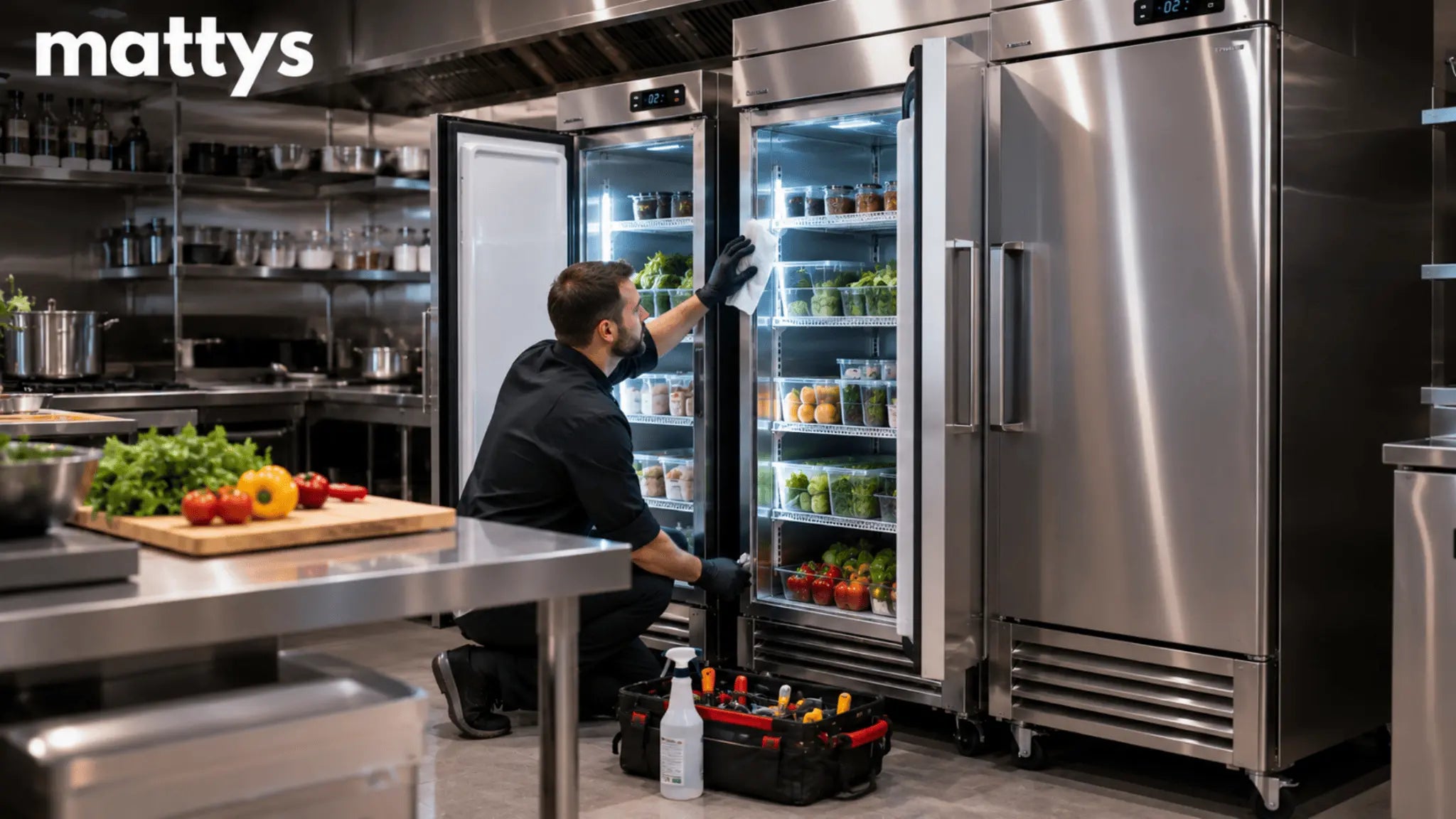
A $150 Gasket Replacement Prevents a $3,000 Compressor Failure
Looking for the full picture? Read our complete Commercial Refrigeration Buying Guide.
Here's what I've learned after 20+ years of watching commercial fridges live and die across 10,000+ Australian kitchens: the operators who maintain their equipment get 10–12 years from a quality fridge. The operators who don't get 5–6 years from the same model.
The difference isn't the equipment. It's maintenance. And the irony is that maintenance is absurdly cheap compared to the cost of neglect. A $150 gasket. A $200 coil clean. A 10-minute visual check every Monday. These tiny investments compound into years of additional lifespan and thousands of dollars in avoided emergency repairs.
This guide gives you the complete maintenance framework — daily through annual — that we recommend to every operator who buys from Mattys. Follow it, and your fridge will outlast your lease.
Why Maintenance Is the Highest-ROI Spend in Your Kitchen
Your commercial fridge runs 8,760 hours per year. It never stops. Every minute it operates, the compressor cycles, the fans spin, the gaskets flex, and the coils exchange heat. Wear is constant and cumulative.
Without maintenance, here's the cascade:
-
Condenser coils accumulate dust and grease → heat exchange efficiency drops 15–20%
-
Compressor works harder to compensate → energy consumption rises $8–$15/week
-
Compressor overheats → lifespan drops from 10 years to 6–7
-
Door gaskets wear and crack → warm air infiltrates, temperature fluctuates
-
Temperature instability → food safety risk, stock spoilage, council inspection risk
-
Compressor fails → $2,500–$4,000 emergency replacement + $1,500+ in spoiled stock
The total cost of neglect over 5 years: $8,000–$15,000 in avoidable energy waste, repairs, and premature replacement.
The total cost of maintenance over 5 years: $2,500–$4,000. That's a 3:1 return on a routine you can largely do in-house.
→ Browse our commercial refrigeration range — all backed by maintenance support
The Four-Tier Maintenance Schedule
Tier 1: Daily Checks (2 Minutes, by Kitchen Staff)
These take almost no time and catch problems before they escalate.
Temperature verification. Check the external display reads 0–5°C when you open in the morning. If it's above 5°C, investigate immediately — a compressor issue, a door left ajar, or a gasket failure. Log the reading. This creates a paper trail for food safety audits and helps you spot gradual drift before it becomes critical.
Door seal check. Close the door and run your hand along the gasket edge. If you feel cold air escaping, the gasket isn't sealing properly. This is the number one cause of energy waste and temperature instability.
Interior cleanliness. Wipe spills immediately. Accumulated liquid (especially acidic marinades or dairy) corrodes shelving and creates bacterial growth points. A 30-second wipe prevents a 30-minute deep clean later.
Airflow check. Make sure stock isn't blocking the internal air vents. Overloaded shelves restrict airflow, creating warm spots where food temperature rises above safe levels.
Tier 2: Weekly Checks (15 Minutes, by Kitchen Manager)
Shelving inspection. Check that shelves are level, clips are secure, and nothing is bent or overloaded. A bent shelf restricts airflow and can fail under load — dumping $500 of stock onto the floor.
Exterior wipe-down. Clean the exterior stainless steel with a non-abrasive cloth and food-safe stainless cleaner. This prevents surface buildup that can hide early corrosion signs, especially in coastal environments.
Drain pan check. The condensate drain pan (usually at the base, near the compressor) collects moisture from defrost cycles. If it's overflowing or blocked, water can pool around the compressor base, accelerating corrosion and creating slip hazards. Empty and clean it weekly.
Gasket deep-check. Close the door on a piece of paper. Pull the paper. If it slides out easily, the gasket isn't creating enough suction. This test takes 10 seconds per door and is the most reliable early-warning system for seal failure.
Tier 3: Monthly Checks (30–45 Minutes, by Kitchen Manager or Maintenance Staff)
Condenser coil cleaning. This is the single most impactful maintenance task. Condenser coils (located at the top or bottom of the unit, depending on compressor placement) accumulate dust, grease, and kitchen particulates. Dirty coils force the compressor to work 15–25% harder, increasing energy consumption by $8–$15/week and shortening compressor lifespan by 2–3 years.
How to clean coils:
-
Turn off the fridge (or switch to defrost mode)
-
Access the coil panel (usually a removable grille at top or base)
-
Use a coil brush or soft-bristle brush to remove loose debris
-
Vacuum the coils gently with a brush attachment
-
For heavy grease buildup, use a commercial coil cleaner spray (available from any refrigeration supplier for $15–$25)
-
Reassemble and restart
Time: 20 minutes. Cost: $15–$25 for cleaner. Savings: $400–$780/year in energy + extended compressor life.
Fan motor inspection. Listen for unusual noises — rattling, grinding, or squealing. Check that fans spin freely. A failing fan motor restricts airflow and overloads the compressor. Replacement cost: $200–$400 if caught early. Consequence if missed: compressor failure at $2,500–$4,000.
Interior deep clean. Remove all shelving. Clean interior walls, floor, and ceiling with food-safe sanitiser. Check for rust spots, especially at shelf clip points and rear wall seams. Clean and dry shelves before reinstalling.
Temperature calibration check. Place an independent thermometer (digital, not mercury) inside the fridge for 30 minutes. Compare reading to the fridge's display. If they differ by more than 1°C, recalibrate the thermostat or call for professional service.
Tier 4: Annual Professional Service ($300–$600)
This is non-negotiable. An annual professional service by a licensed refrigeration technician covers everything an operator can't safely or effectively do:
Refrigerant pressure check. Verifies the refrigerant charge is correct. Low charge indicates a leak, which causes the compressor to overwork and eventually fail.
Compressor amp draw test. Measures the electrical current drawn by the compressor. Higher-than-spec current indicates wear, bearing failure, or electrical issues. Catching this early prevents a $3,000+ compressor replacement.
Electrical connection inspection. Checks wiring, contactors, and capacitors for wear, corrosion, or loose connections. Electrical faults are a fire risk and an equipment-failure risk.
Full gasket assessment. A technician can detect gasket failures that the paper test might miss — particularly at corners and hinge points where deformation is gradual.
Thermostat and defrost cycle calibration. Ensures the unit defrosts correctly (too often wastes energy; too rarely causes ice buildup that blocks airflow) and maintains accurate temperature.
Coastal environments: twice per year. If your kitchen is within 10km of the coast, schedule professional service every 6 months. Salt-air corrosion accelerates wear on electrical connections, fan bearings, and coil surfaces.
The Maintenance Cost vs. Neglect Cost Comparison
|
Item |
With Maintenance (10 years) |
Without Maintenance (10 years) |
|
Annual professional service |
$4,000–$6,000 |
$0 |
|
Monthly coil cleaning (supplies) |
$180–$300 |
$0 |
|
Gasket replacements |
$600–$900 (2–3 replacements) |
$1,200–$1,800 (4–6 replacements + damage) |
|
Energy cost (double-door reach-in) |
$18,000–$22,000 |
$24,000–$30,000 (+25% from dirty coils/bad gaskets) |
|
Compressor replacement |
$0 (preventable) |
$3,000–$4,500 (likely by year 6–7) |
|
Premature full replacement |
$0 (unit lasts 10+ years) |
$12,000–$16,000 (replacement at year 6–7) |
|
Stock spoilage |
Minimal ($200–$500 over 10 years) |
Significant ($2,000–$5,000 over 10 years) |
|
TOTAL |
$23,000–$29,700 |
$42,200–$57,300 |
The saving: $13,000–$27,600 over 10 years. Maintenance pays for itself 4–6 times over.
Customer Story: How a Parramatta Bakery Extended Their Fridge Life to 14 Years
The situation: A high-volume bakery in Parramatta purchased a Bromic double-door reach-in in 2010. At the time, it cost $8,500.
The maintenance approach: The owner followed our recommended schedule religiously. Monthly coil cleans. Weekly gasket checks. Annual professional service without exception. Total maintenance spend over 14 years: approximately $7,500.
The result: The unit is still running in 2024 — 14 years after purchase. It's had two gasket replacements ($300 each), one fan motor replacement ($380), and zero compressor issues. Energy efficiency has declined slightly (approximately 15% above original spec), but it's still operating within acceptable parameters.
The maths: $8,500 purchase + $7,500 maintenance = $16,000 over 14 years = $1,143/year. Compare that to an operator who neglects maintenance, replaces the unit at year 6, and spends $20,000+ over the same period.
"Mathew told us in 2010: clean the coils every month, check the gaskets every week, service it every year. We did. It's still running. That's the best $7,500 we ever spent."
— Owner, Parramatta bakery
When to Repair vs. When to Replace
Not every breakdown justifies a repair. Here's the decision framework we use:
Repair If:
- The unit is less than 5 years old and the repair cost is under 40% of replacement cost
- It's a gasket, fan motor, or thermostat issue — these are consumable parts, not structural failures
- The unit has been well-maintained and the failure is isolated (not part of a pattern)
- The repair restores original performance — energy consumption returns to spec
Replace If:
- The unit is 8+ years old and the repair cost exceeds 30% of replacement cost
- It's a compressor failure on an older unit — the compressor is the most expensive component, and if it fails, other components are likely near end-of-life too
- Energy consumption has risen 25%+ above original spec — even after maintenance, this indicates system-wide wear
- The unit uses R404A refrigerant — recharge costs are increasing due to HFC quotas, and long-term servicing will become progressively more expensive
- It's not GEMS-compliant — if you're replacing and insuring, non-compliant equipment creates liability
The 50% Rule
If the repair cost exceeds 50% of a new equivalent unit, always replace. A $4,000 repair on a $9,000 fridge is a bad investment. That $4,000 buys you 2–3 more years from tired equipment. The same $4,000 added to your budget gets you a new unit with a 3-year warranty and 10+ years ahead of it.
Mistakes to Avoid
Mistake 1: Skipping coil cleaning because it's "not that dirty"
Coils don't look dirty to the naked eye until they're severely clogged. By the time you can see the buildup, you've been paying 15–25% extra on energy for months. Clean monthly regardless of appearance.
Mistake 2: Waiting until the gasket fails completely
A gasket that's "a bit loose" is already costing you $5–$10/week in energy waste. Replace it when the paper test fails, not when cold air is visibly escaping.
Mistake 3: Using the wrong cleaning products
Never use bleach or chloride-based cleaners on stainless steel — they attack the chromium oxide layer that protects against corrosion. Use food-safe stainless steel cleaners only. This is especially critical for Grade 304 equipment.
Mistake 4: Ignoring unusual noises
A fridge that starts clicking, buzzing, or rattling is telling you something's wrong. The compressor is struggling, a fan bearing is failing, or a relay is misfiring. Addressing the noise when it starts costs $200–$400. Ignoring it until something breaks costs $2,500–$4,500.
FAQ
Q: How often should I defrost my commercial fridge?
A: Most modern commercial fridges have automatic defrost cycles (typically every 6–8 hours). If yours is manual, defrost when ice buildup reaches 5mm on the evaporator coils. Excessive ice blocks airflow and forces the compressor to overwork.
Q: Can I clean condenser coils myself?
A: Yes. It requires a coil brush ($15), a vacuum with brush attachment, and 20 minutes. No special training needed. If coils are heavily greased (common in kitchens near grills and fryers), use a commercial coil cleaner spray. For walk-in cool rooms, professional cleaning is recommended due to the larger coil area.
Q: What's the best way to prevent rust on stainless steel fridges?
A: Weekly exterior cleaning with a food-safe stainless cleaner. Immediately dry any water that pools on surfaces. In coastal environments, wipe salt residue weekly. Never use steel wool or abrasive pads — they scratch the protective oxide layer.
Q: Should I turn off my fridge when the kitchen is closed?
A: Never turn off a commercial fridge unless you're decommissioning it. The thermal cycling (cooling down, warming up, cooling down again) stresses the compressor more than continuous operation. Most modern fridges have "economy mode" that reduces energy consumption during off-peak hours without shutting down.
Q: What warranty should I expect?
A: Premium brands: 3–5 years parts and labour. Mid-tier: 1–2 years with extended warranty available. If a supplier offers only 1 year, that's a signal about confidence in the product's longevity.
← Back to the Commercial Refrigeration Buying Guide
Next Steps
Maintenance is the cheapest, highest-ROI investment you can make in your kitchen equipment. The schedule above takes less than 2 hours per month of staff time and less than $600/year in professional service — and it consistently delivers $1,300–$2,700/year in energy savings and avoided repairs.
Every fridge we sell at Mattys comes with a printed maintenance schedule and our direct support line for questions. We want your equipment to last 10+ years because that's how we earn the recommendation.
📞 Call us: 1300 628 897 — ask about our maintenance support packages
🛒 Need replacement gaskets or parts? Browse parts
Share:
Commercial Refrigeration Buying Guide: How to Choose the Right Fridge for Your Australian Kitchen
Undercounter Fridges vs. Reach-Ins: Which Is Right for Your Kitchen?